
Japanese金閣・鹿苑寺の三層建築
Kinkaku and Rokuon-ji: A Three-Story Building in Three Styles
Other spellings and namesKinkaku-ji / Golden Pavilion / Rokuon-ji / Kitayama-dono / Ashikaga Yoshimitsu / Kinkaku reliquary hall / 鹿苑寺
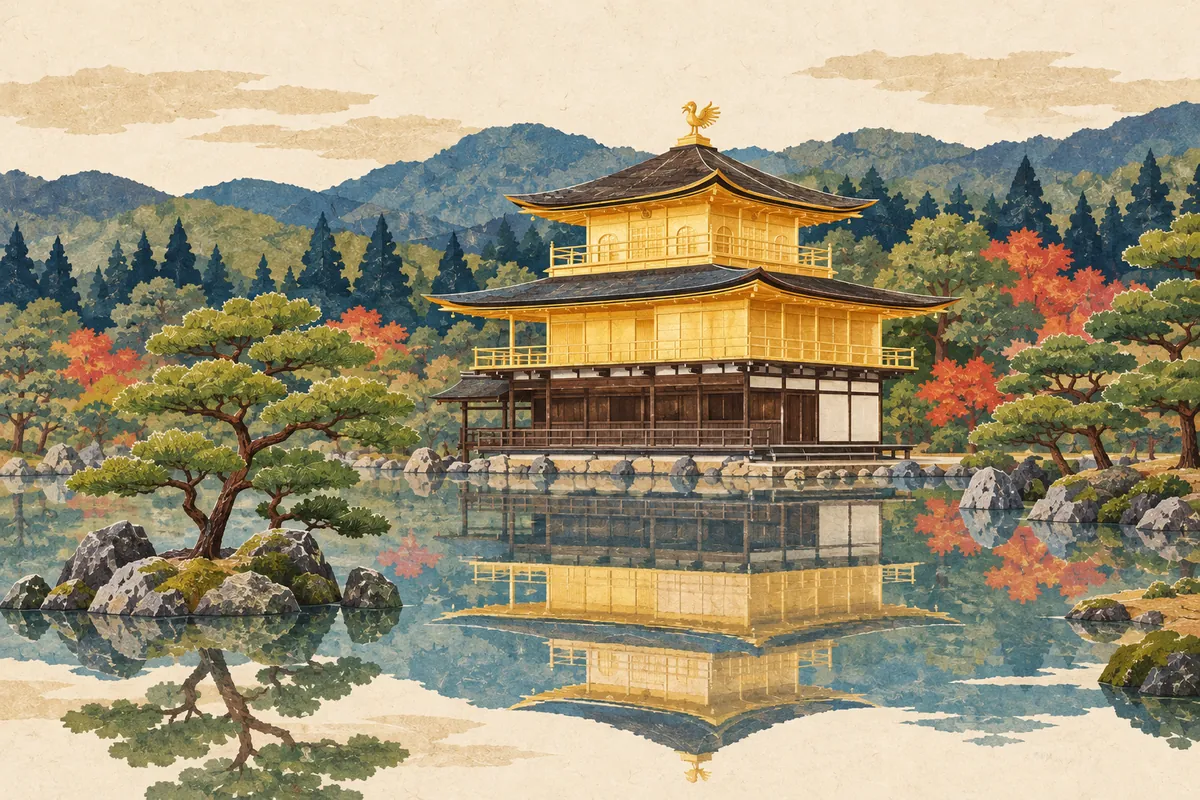
In short
The official name of Kinkaku-ji is Rokuon-ji. It began when Ashikaga Yoshimitsu started building his mountain villa, Kitayama-dono, in 1397 on land that had been a villa of the Saionji family in the Kamakura period, and its reliquary hall, Kinkaku (the Golden Pavilion), stacks a different architectural style on each story. Today's Kinkaku is a building reconstructed in 1955 after it burned down in 1950.Key points in 30 seconds
The official temple name is Rokuon-ji
It originated as Ashikaga Yoshimitsu's Kitayama-dono; before that, the land was a Saionji family villa
The second story is in the buke-zukuri style and the third in the Zen Buddhist hall style
Burned down by arson in 1950 and rebuilt in 1955
From Kitayama-dono to Rokuon-ji
The official temple name of Kinkaku-ji is Rokuon-ji. Its gleaming golden reliquary hall is called Kinkaku.
Ashikaga Yoshimitsu, the third shogun of the Muromachi shogunate, established his mountain villa, Kitayama-dono, in 1397.
Ashikaga Yoshimitsu established Kitayama-dono in 1397. It later became a Zen temple and was named Rokuon-ji.
The name Rokuon-ji was taken from Ashikaga Yoshimitsu's posthumous Buddhist name, Rokuon-in-den.
Kinkaku's second story, Chōon-dō, is in the buke-zukuri (warrior residence) style. The first story is in the shinden-zukuri (aristocratic residence) style, and the third is in the Zen Buddhist hall style.
Kinkaku's third story, Kukkyō-chō, is in the Zen Buddhist hall style. The three stories combine different styles.
A symbol of Kitayama culture
Kinkaku-ji is presented as a representative building of the lavish Kitayama culture.
Before Yoshimitsu, it was a Saionji family villa
This site was originally where Saionji Kintsune, a court noble of the Kamakura period, built Saionji, his clan temple, and his mountain villa, Kitayama-dai, which were dedicated in 1224 (Gennin 1). When the Saionji family declined, Kitayama-dai fell into ruin, and the pond is said to be the only remaining feature from that time.
Ashikaga Yoshimitsu acquired the land and began building Kitayama-dono in 1397 (Ōei 4). In 1408 (Ōei 15), Emperor Go-Komatsu visited, an event known as the Kitayama Gyōkō (the imperial visit to Kitayama). Yoshimitsu lived here until his death at 51; afterward his son Yoshimochi turned it into a temple, inviting Musō Kokushi as its founder, and named it Rokuon-ji.
At Kitayama-dono, Kitayama culture flourished against the backdrop of trade with Ming China. In the Edo period, Saishō Shōtai became chief priest on Tokugawa Ieyasu's orders and the temple's financial foundation was secured. After struggling in the Meiji era with the loss of its patrons, the temple began accepting visitors in 1894 (Meiji 27).
Main events in the history of Rokuon-ji (Kinkaku-ji)
| Year | Event |
|---|---|
| 1224 | Dedication of Saionji Kintsune's Saionji temple and Kitayama-dai villa |
| 1397 | Ashikaga Yoshimitsu begins building his mountain villa, Kitayama-dono |
| 1408 | Emperor Go-Komatsu visits Kitayama-dono (the Kitayama Gyōkō) |
| After Yoshimitsu's death | Ashikaga Yoshimochi turns it into a temple with Musō Kokushi as founder and names it Rokuon-ji |
| Ōnin War | The temple is damaged, but Kinkaku, the Ishi-fudō-dō, and the Goma-dō survive the fires |
| 1894 (Meiji 27) | The temple begins accepting visitors |
| 1950 | Kinkaku burns down due to arson |
| 1955 | Kinkaku is rebuilt |
| 1987 | Repairs: lacquer recoated and gold leaf replaced |
| 1994 | Inscribed as a World Cultural Heritage site, "Historic Monuments of Ancient Kyoto" |
What is enshrined on each of the three stories?
Kinkaku is a reliquary hall enshrining relics of the Buddha (busshari). The first story houses a seated statue of Yoshimitsu and other images, the second a seated Iwaya Kannon and statues of the Four Heavenly Kings, among others, and the third the Buddha's relics. It is a building in which each story enshrines something different, not just a dazzling sight from outside.
Gold leaf covers the second and third stories, applied over lacquer. The first story is in the shinden-zukuri style and the second in the buke-zukuri style, and Kinkaku is said to blend the cultures of the court nobility and the warrior class. A phoenix is mounted on the top of the roof.
How Kinkaku's stories differ
| Story | Style | Main enshrined objects | Gold leaf |
|---|---|---|---|
| First story | Shinden-zukuri | Seated statue of Ashikaga Yoshimitsu, etc. | — |
| Second story (Chōon-dō) | Buke-zukuri | Seated Iwaya Kannon, Four Heavenly Kings, etc. | Gold leaf over lacquer |
| Third story (Kukkyō-chō) | Zen Buddhist hall style | Relics of the Buddha | Gold leaf over lacquer (phoenix on the roof) |
Is today's Kinkaku a reconstruction? Before you visit
Kinkaku survived from Yoshimitsu's time through the Ōnin War, but it burned down by arson in 1950 (Shōwa 25). The building now standing beside the pond was rebuilt in 1955 (Shōwa 30), and in 1987 (Shōwa 62) its lacquer was recoated and its gold leaf replaced. People often assume it is the original Muromachi-period building, but the structure is a postwar reconstruction.
The pond-circuit garden surrounding Kinkaku, on the other hand, is designated a Special Historic Site and Special Place of Scenic Beauty. North of the reliquary hall are the Ginga-sen spring, the Ganka-sui water, and the Ryūmon Falls, all said to be associated with Yoshimitsu, as well as the Sekka-tei teahouse, known for its shelves of bush clover and its alcove post of nandina wood. The address is 1 Kinkakuji-chō, Kita Ward. Visiting hours and fees may change, so check the temple's official information before you go.
Mini quiz for this entry
Check what you've read with 3 multiple-choice questions.
Which building represents the lavish Kitayama culture of the Muromachi period?
Who created the Kitayama-dono villa that became Kinkaku?
What inspired the temple name Rokuon-ji?
Sources and verification
Content checked: October 11, 2026
Updated: October 11, 2026
References are in Japanese.