
Japanese室町幕府と花の御所
The Muromachi Shogunate and the Hana no Gosho
Other spellings and namesMuromachi-dono / Muromachi-dai / Hana no Gosho (Palace of Flowers) / Ashikaga Yoshimitsu / Nijō-gawara Rakusho / 花の御所
In short
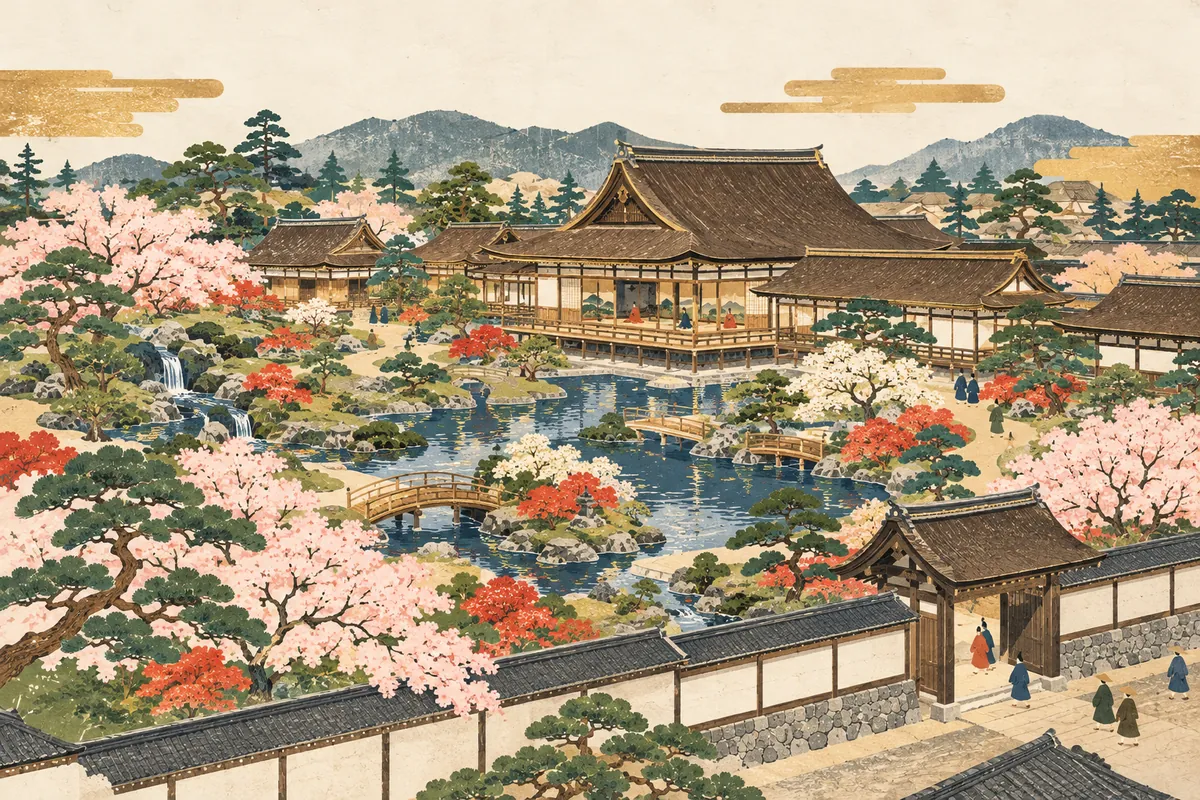
The Hana no Gosho (花の御所, "Palace of Flowers") was the name for the shogun's residence made up of Muromachi-dono (also called Muromachi-dai), completed in 1378 by Ashikaga Yoshimitsu, the third Muromachi shogun, at Kitakōji (today's Imadegawa-dōri) and Muromachi, together with the Hanatei to its north, where he moved the following year. It was named for its beautiful garden, which drew water from the Kamo River and was planted with many flowers, and the name "Muromachi shogunate" itself comes from Muromachi-dono. The site is in Kamigyō Ward, in the area bounded by Imadegawa-dōri, Kamidachiuri-dōri, Karasuma-dōri, and Muromachi-dōri.Key points in 30 seconds
Ashikaga Yoshimitsu completed Muromachi-dono (Muromachi-dai) in 1378
It was called the Hana no Gosho (Palace of Flowers) for its beautiful garden planted with many flowers
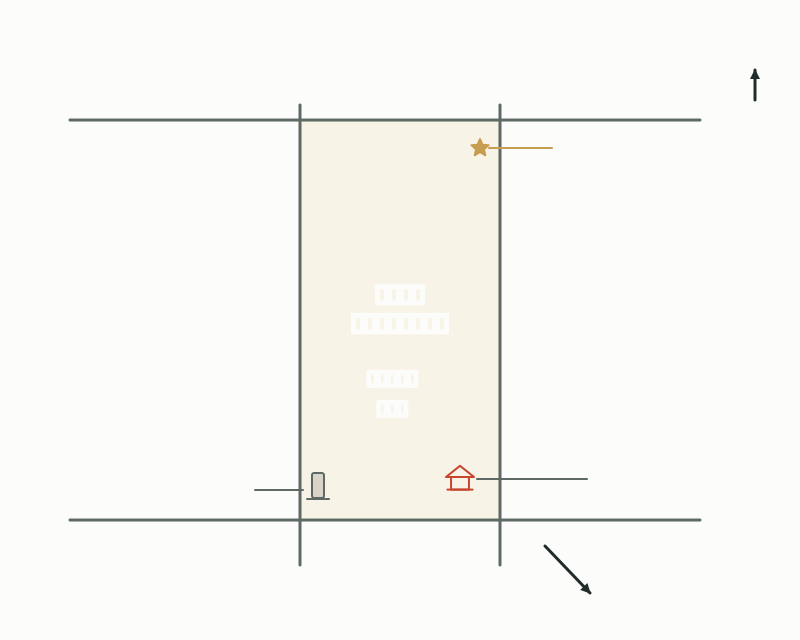
It covered one chō east to west and two chō north to south, bounded by Imadegawa, Kamidachiuri, Karasuma, and Muromachi
It burned down completely in 1476, during the Ōnin–Bunmei War
A Shogunate Based in Kyoto
After Ashikaga Takauji overthrew the Kamakura shogunate, the shoguns established the Muromachi shogunate in Kyoto.
A Name Born from a Beautiful Garden
The third shogun, Ashikaga Yoshimitsu, completed Muromachi-dono in 1378 and moved to the Hanatei to its north the following year.
Its garden, which drew water from the Kamo River and was planted with many flowers, was so beautiful that the residence came to be called the Hana no Gosho (Palace of Flowers).
The Hana no Gosho is thought to have covered an area one chō east to west and two chō north to south.
In 1476 (Bunmei 8), arson at nearby dosō (pawnbrokers) and sake brewers spread, and Muromachi-dai burned down completely.
Satire Posted on the Kamo Riverbank
The Nijō-gawara Rakusho (an anonymous satirical lampoon posted at Nijō-gawara) is said to have been posted in August 1334 (Kenmu 1).
It is said to have been posted at Nijō-gawara, the Kamo River bank near today's Nijō Ōhashi bridge.
Where Was the Shogunate Before the Hana no Gosho?
Before the Hana no Gosho was built, the Muromachi shogunate was located at Sanjō-bōmon Madenokōji (around today's Yanaginobanba-dōri Oike in Nakagyō Ward) and was called the Sanjō Gosho. When the shogunate moved to just north of the imperial palace, this area became the center of politics. The site of the Hana no Gosho is said to have originally held the palace of the retired Emperor Sukō; after it burned in 1377, a residence of the Kikutei family was built there, and that too had burned down.
With the Hana no Gosho, Kamigyō became a town of warrior families as well as court nobles, and monzeki temples (temples headed by members of the imperial or noble families) and warrior families' family temples were built nearby. In this way, Kamigyō became the home of those who ruled, in contrast to Shimogyō, which became a town of merchants and craftspeople.
How Did the Shoguns' Palace Change over Time?
Yoshimitsu's era was the height of the shogunate. Even after he retired to his Kitayama-dai estate (today's Rokuon-ji), his authority remained great: in 1406 he levied payments across Yamashiro Province to cover repairs to Muromachi-dai. The sixth shogun, Yoshinori, added a kaisho (reception hall) and an izumidono (spring pavilion) in 1429, and in 1437 he welcomed an imperial visit from Emperor Go-Hanazono. Records of that visit show that there was a four-legged gate (yotsuashimon) facing Muromachi-dōri, a shinden (main hall), a tsune-gosho (daily residence), and other buildings.
The eighth shogun, Yoshimasa, also moved to a new residence at Muromachi in 1459, but in 1467, when the Ōnin–Bunmei War began, the Western Army attacked Muromachi-dai, and in 1476 arson at nearby dosō and sake brewers spread and burned it down completely. The shinden was rebuilt in 1479 but burned again in a nearby fire the following year, and in 1488 the ruins are recorded as having become a gathering place for night bandits.
The changing fortunes of the Hana no Gosho (Muromachi-dai)
| Year | Event |
|---|---|
| 1378 (Eiwa 4) | Ashikaga Yoshimitsu completes Muromachi-dono at Kitakōji Muromachi |
| 1379 (Kōryaku 1) | Yoshimitsu moves to the Hanatei to the north; together, the two residences are called the Hana no Gosho |
| 1406 (Ōei 13) | Repaired with payments levied across Yamashiro Province |
| 1429 (Eikyō 1) | The sixth shogun, Yoshinori, adds a kaisho and an izumidono |
| 1437 (Eikyō 9) | Imperial visit by Emperor Go-Hanazono |
| 1459 (Chōroku 3) | The eighth shogun, Yoshimasa, moves to a new residence at Muromachi |
| 1467 (Ōnin 1) | The Western Army attacks Muromachi-dai in the Ōnin War |
| 1476 (Bunmei 8) | Arson at nearby dosō and sake brewers spreads and the residence burns down |
| 1479–1480 | The shinden is rebuilt but burns again in a nearby fire the following year |
| 1488 (Chōkyō 2) | The ruins become a meeting place for night bandits |
Walking the Site Today
The Hana no Gosho is thought to have covered one chō east to west and two chō north to south, bounded by Imadegawa-dōri to the south, Kamidachiuri-dōri to the north, Karasuma-dōri to the east, and Muromachi-dōri to the west. On the northeast corner of the Muromachi-dōri Imadegawa intersection stands a stone marker reading "Site of the Ashikaga Shoguns' Muromachi-dai," and traces remain in town names such as Goshohachiman-chō (named after the residence's guardian Hachiman shrine) and Okamatsu-chō (named after the Okamatsu-dono inside the palace). In 2002, remains thought to be from Muromachi-dono in the early 16th century were found on Doshisha University grounds at the corner of Kamidachiuri-dōri and Karasuma.
In the grounds of Daishō-ji, at Karasuma Imadegawa-agaru, there is a stone marker reading "Hana no Gosho." Daishō-ji is a monzeki convent said to have become a temple by the will of a nun whom Yoshimitsu had welcomed to the Okamatsu-dono within the Muromachi residence; it is not open to the public. Note that the stone marker reading "Site of Hana no Gosho Hachimangū" in the grounds of Kamigoryō Shrine is unrelated to the Goshohachimangū in Nakagyō Ward, which Ashikaga Takauji enshrined there.
The extent of the Hana no Gosho and today's streets
Mini quiz for this entry
Check what you've read with 3 multiple-choice questions.
In which city was the Muromachi shogunate based?
Which of these events happened in 1334?
Where was the Nijo Kawara Rakusho reportedly displayed?
Sources and verification
Content checked: October 11, 2026
Updated: October 11, 2026
References are in Japanese.