
Japanese応仁の乱と西陣の名前
The Onin War and the Name Nishijin
Other spellings and namesŌnin War / Ōnin–Bunmei War / Western Army / Yamana Sōzen / Hosokawa Katsumoto
In short
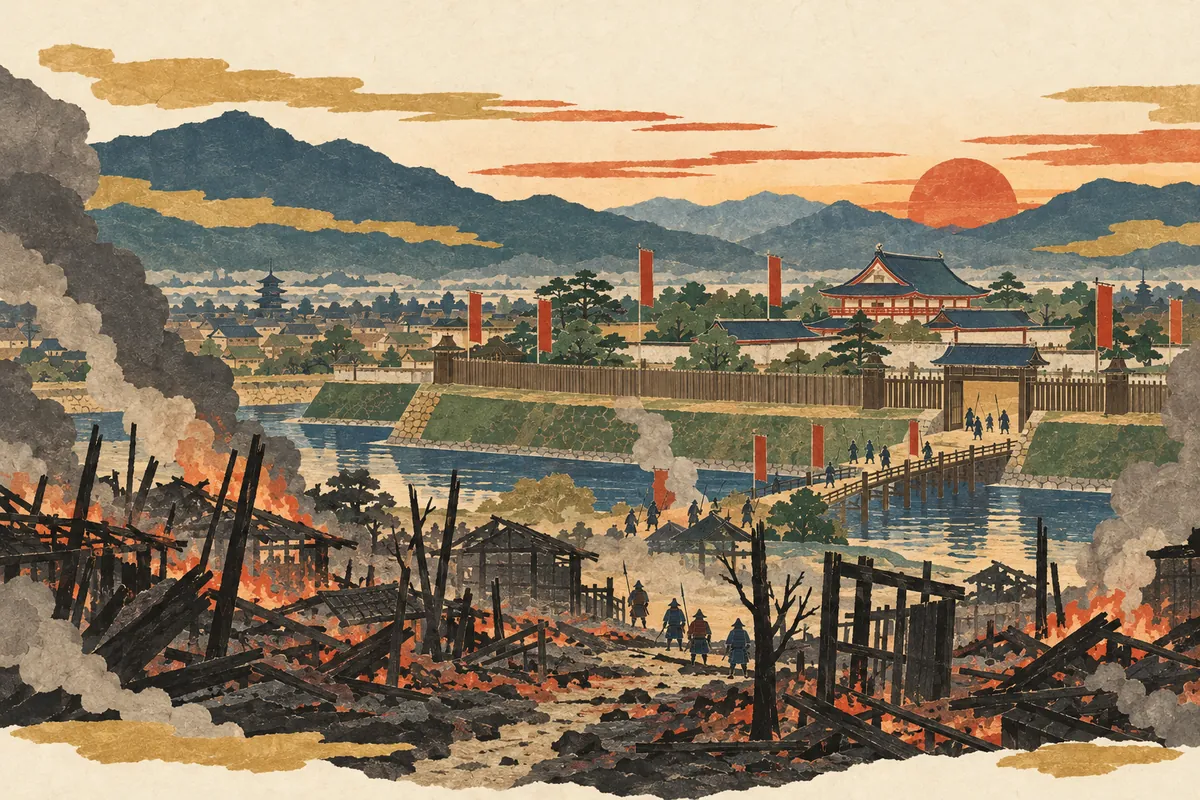
The Ōnin–Bunmei War was a civil war that began in 1467 and lasted about 11 years until 1477, with Kyoto as its main battlefield. The Eastern Army built a fortified camp called the Okamae around the Hana no Gosho, and most of the town of Kamigyō burned. The name Nishijin ("Western Camp") comes from the Western Army, led by Yamana Sōzen, setting up camp around Horikawa-Kamidachiuri.Key points in 30 seconds
Began in 1467 and ended in 1477
The Eastern Army was led by Hosokawa Katsumoto, the Western Army by Yamana Sōzen
It began at Kamigoryō Shrine, where a stone marker reading "Site of the Outbreak of the Ōnin War" stands in front of the grounds
The name Nishijin comes from the Western Army's camp
Eleven Years of War in Kyoto
The Ōnin War began in 1467 (Ōnin 1).
The Ōnin War lasted 11 years, from 1467 to 1477.
The Western Army, led by Yamana Sōzen, set up camp here, and this was the beginning of the place name Nishijin.
The Eastern and Western Armies, and the End
The Eastern Army was led by Hosokawa Katsumoto and the Western Army by Yamana Sōzen.
The Ōnin–Bunmei War ended in 1477, when the daimyo withdrew to their home provinces.
Why Was Kyoto a Battlefield for 11 Years?
It began with a dispute over the shogun's successor. The eighth shogun, Yoshimasa, named his younger brother Yoshimi as his heir in 1464, but the following year his wife, Hino Tomiko, gave birth to Yoshihisa, and Hosokawa Katsumoto, who backed Yoshimi, came into conflict with Yamana Sōzen, who sided with Yoshihisa. Succession disputes in the Hatakeyama and Shiba families—two of the houses that held the post of kanrei (shogunal deputy)—along with the interests of provincial governors (shugo) and local warriors, became entangled, and the conflict deepened.
The war broke out on the night of January 17, 1467, when Hatakeyama Masanaga set fire to his own residence, camped at the Kamigoryō woods (near today's Kamigoryō Shrine), and fought Hatakeyama Yoshinari. That autumn there were major battles near Nanzen-ji, at Shōkoku-ji, at Funaokayama, and elsewhere, but afterward the war became a repeated cycle of fighting outside the city and arson and cutting of supply lines by ashigaru (foot soldiers). The fighting continued even after Sōzen and Katsumoto died one after the other in 1473, and finally ended in 1477 when the daimyo withdrew to their home provinces.
Main events of the Ōnin–Bunmei War
| Year | Event |
|---|---|
| 1441 (Kakitsu 1) | The sixth shogun, Yoshinori, is assassinated (the Kakitsu Incident), and the shogunate begins to waver |
| 1464 (Kanshō 5) | Yoshimasa names his younger brother Yoshimi as his heir |
| 1465 | Hino Tomiko gives birth to Yoshihisa; the conflict between the Hosokawa and Yamana sides deepens |
| January 17, 1467 | Hatakeyama Masanaga camps at the Kamigoryō woods, and the war begins |
| September–October 1467 | Large-scale battles near Nanzen-ji, at Shōkoku-ji, at Funaokayama, and elsewhere |
| 1473 (Bunmei 5) | Yamana Sōzen and Hosokawa Katsumoto die one after the other |
| 1477 (Bunmei 9) | The daimyo withdraw to their home provinces, and the war ends |
The Eastern Army's Okamae and the Burning of Kamigyō
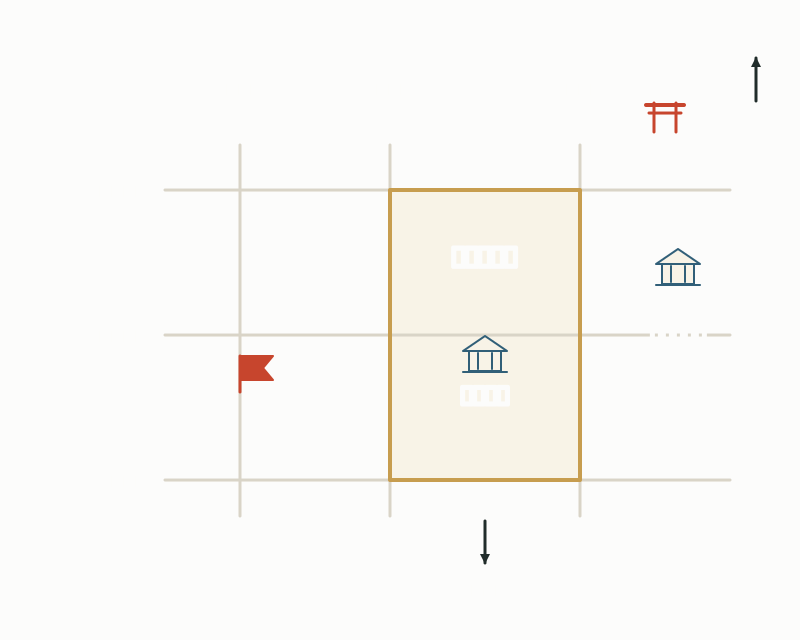
Facing the militarily stronger Western Army, the Eastern Army built the Okamae (御構), a fortified enclosure surrounded by earthen ramparts and moats, centered on the Hana no Gosho. It covered the area bounded by Ichijō to the south, today's Teranouchi-dōri to the north, Ogawa to the west, and Karasuma to the east, and the emperor, the retired emperor, court nobles, warrior families, and wealthy townspeople took refuge there. Epidemics and fires broke out repeatedly within the cramped Okamae, and when measles spread in 1471, a goryōe (a rite to appease vengeful spirits) was held to pray for the end of the epidemic.
The fighting centered on Kamigyō, and most of the town of Kamigyō burned, along with temples, shrines, and the residences of court nobles and warriors. By contrast, Shimogyō, where merchants and craftspeople lived, was hardly set on fire. After the war, Kamigyō and Shimogyō remained separate towns divided by a dry moat along Ichijō-dōri, and it is thought that amid this turmoil people learned how to protect their towns and laid the groundwork for self-government.
The Eastern Army's Okamae and the Western Army's camp
The Name Nishijin, and Walking the War's Traces
The residence of Yamana Sōzen, commander of the Western Army, was at Horikawa-dōri Kamidachiuri-sagaru; the area was later named Yamana-chō, and within the town is a monument marking the "Former Site of Yamana Sōzen." The Yamana side's camp was called Nishijin ("western camp"), and this name later became the place name known for Nishijin-ori textiles. In front of the Kyoto City Archaeological Museum at Imadegawa-dōri Ōmiya higashi-iru stands the Nishijin Monument, erected in 1928, inscribed with the origins of Nishijin and the history of its weaving industry.
In front of Kamigoryō Shrine, where the war began, there is a stone marker reading "Site of the Outbreak of the Ōnin War," and in Funaokayama Park there is a stone marker reading "Funaokayama, Battlefield of the Ōnin and Eishō Eras." Daihōon-ji (Senbon Shaka-dō) in Kamigyō Ward lost its halls and pagodas in the war, but its main hall alone survived the fires; it is designated a National Treasure as the oldest Buddhist hall remaining in Kyoto's urban area.
Mini quiz for this entry
Check what you've read with 3 multiple-choice questions.
Which of these events happened in 1467?
Which pairing correctly names the commanders in the Onin War?
Which of these events happened in 1477?
Sources and verification
Content checked: October 11, 2026
Updated: October 11, 2026
References are in Japanese.