
Japanese豊臣秀吉の京都改造と聚楽第
Toyotomi Hideyoshi's Remaking of Kyoto and the Jurakudai
Other spellings and namesJurakudai (聚楽第) / Odoi (御土居) / Emperor Go-Yōzei's visit / Hideyoshi's reconstruction of Kyoto
In short
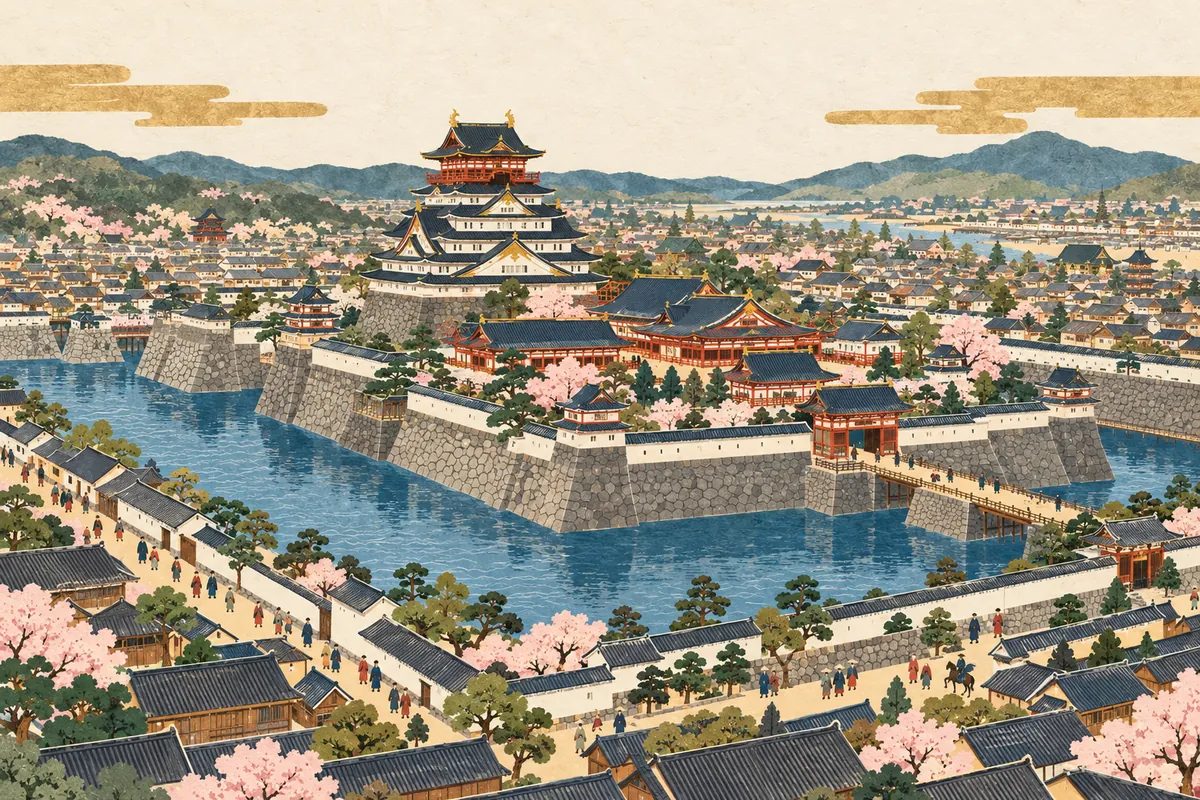
Toyotomi Hideyoshi built the Jurakudai at Uchino, the former site of Heian-kyō's Daidairi (Greater Imperial Palace), and greatly remade the city of Kyoto by building the Odoi earthworks and the Great Buddha Hall in Higashiyama. The Jurakudai was completed in 1587 but demolished just eight years later; today its traces survive in town names such as Josui-chō and Ukita-chō and in the name jurakutsuchi (Juraku clay).Key points in 30 seconds
The Jurakudai was completed in 1587, built on the former site of Heian-kyō's Daidairi (Uchino)
Emperor Go-Yōzei visited in 1588
In 1591 Hideyoshi built the Odoi and handed the Jurakudai over to his nephew Hidetsugu
Demolished in 1595; some of its structures were moved to Fushimi Castle
Hideyoshi, builder of the Jurakudai and the Odoi
Toyotomi Hideyoshi built the lavish Jurakudai as his residence in Kyoto.
The Odoi provided military defense and flood control, and also served to separate Rakuchū (inside the city) from Rakugai (outside the city).
The Odoi had a total length of about 23 kilometers.
A huge moat revealed by excavation
Construction of the Jurakudai began in 1586, and it was completed in 1587 (Tenshō 15).
The Odoi was built in 1591 as part of Hideyoshi's urban redevelopment of Kyoto.
It is known that a large moat more than 30 meters wide surrounded the Jurakudai.
In 1588 (Tenshō 16), Emperor Go-Yōzei made an imperial visit to the Jurakudai.
In 1595 (Bunroku 4), the year Hideyoshi forced Hidetsugu to take his own life, the Jurakudai was also demolished.
The Odoi's earthen embankment was about 3 meters high and about 9 meters wide at its base.
Where was the Jurakudai?
The Jurakudai was built at Uchino, the former site of Heian-kyō's Daidairi. After Hideyoshi became kanpaku (imperial regent) in 1585, he began construction the following year and completed it in 1587. Juraku means "gathering the pleasures of long life without aging," and the name is also read Jurakutei.
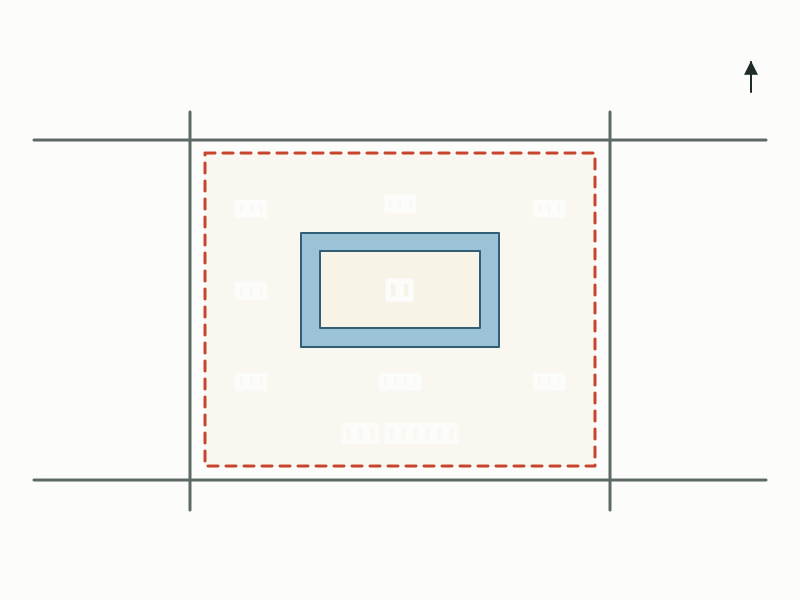
Its outer enclosure is thought to have covered an area bounded roughly by Motoseiganji-dōri to the north, Horikawa-dōri to the east, Oshikōji-dōri to the south, and Senbon-dōri to the west, with an inner enclosure centered on the Honmaru (main bailey) along with the Kitanomaru, Minami-ninomaru, and Nishinomaru. However, because it was thoroughly destroyed and full-scale excavation is impossible, its exact extent is unknown. Samurai residences lined the outside of the moat, and traces remain in names such as Josui-chō (after Kuroda Josui), Ukita-chō (after Ukita Hideie), Kagaya-chō, Fukushima-chō, Danjō-chō, Higurashi-dōri, and Kuromon-dōri.
The Jurakudai's outer enclosure and today's streets
Kyoto vegetables and "Juraku clay" born after its destruction
In 1591, Hideyoshi made his nephew Hidetsugu kanpaku and handed the Jurakudai over to him, but in 1595, after forcing Hidetsugu to take his own life, he also demolished the Jurakudai and moved some of its structures to Fushimi Castle, then under construction. The Hiunkaku pavilion at Nishi Hongan-ji and the Karamon gate at Daitoku-ji are also said to be remains of the Jurakudai. At Shōrin-ji, south of Demizu on Chiekōin-dōri (Chiekōin-dōri Demizu sagaru) in Kamigyō Ward, the temple grounds are lower than their surroundings, and a 1997 excavation suggests they were part of the Jurakudai's outer moat.
On the former site, fundraising Noh performances (kanjin-nō) were held, and eventually houses lined the area, which became one of Kamigyō's chōgumi, the Juraku-gumi. In the former moats, filled in with the town's refuse, Kyoto vegetables such as Juraku kabura (turnips) and Juraku (Horikawa) gobō (burdock) were grown. The brownish soil dug from underground was called jurakutsuchi (Juraku clay) and used as wall plaster for storehouses; today it is known as the finest-grade clay, used only for the finishing coat of tearooms and the like.
Hideyoshi's remaking of Kyoto went beyond the Jurakudai
The city, which had been split into Kamigyō and Shimogyō after the Ōnin-Bunmei War, is said to have been transformed into a single continuous metropolis, triggered by the building of the Jurakudai. The Odoi, built in 1591, had a total length of about 23 kilometers, and its openings were collectively called the Nanakuchi (Seven Entrances), from which highways led throughout the country.
In Higashiyama, in 1586, a Great Buddha rivaling the Great Buddha of Nara was planned. The Great Buddha was a seated wooden statue about 19 meters high, and the Great Buddha Hall, a huge building about 49 meters high, was completed around 1595, but in the Great Keichō Earthquake of the following year, 1596, the Buddha collapsed, and Hideyoshi died in 1598. The temple precinct was large enough to include today's Hōkō-ji, Toyokuni Shrine, and Kyoto National Museum, and massive stone walls from that time remain on the west side of the Kyoto National Museum.
Main timeline of Hideyoshi's remaking of Kyoto
| Year | Event |
|---|---|
| 1585 (Tenshō 13) | Hideyoshi becomes kanpaku |
| 1586 (Tenshō 14) | Construction of the Jurakudai begins. A Great Buddha is planned in Higashiyama |
| 1587 (Tenshō 15) | The Jurakudai is completed |
| 1588 (Tenshō 16) | Emperor Go-Yōzei visits the Jurakudai |
| 1591 (Tenshō 19) | The Odoi is built. Hidetsugu is made kanpaku and given the Jurakudai |
| 1595 (Bunroku 4) | Hidetsugu is forced to take his own life, and the Jurakudai is demolished. The Great Buddha Hall is completed around this time |
| 1596 (Keichō 1) | The Great Buddha collapses in the Great Keichō Earthquake before its eye-opening ceremony |
| 1598 (Keichō 3) | Hideyoshi dies on August 18 |
Mini quiz for this entry
Check what you've read with 3 multiple-choice questions.
Who built Jurakudai in Kyoto?
Which of these events happened in 1587?
How wide was the large moat discovered at Jurakudai?
Sources and verification
Content checked: October 11, 2026
Updated: October 11, 2026
References are in Japanese.