
Japanese寺町通と新京極通(てらまちどおりとしんきょうごくどおり)
Teramachi-dori and Shinkyogoku-dori
Other spellings and namesTeramachi (寺町) / Shinkyogoku (新京極) / Shinkyogoku Shopping Street / Teramachi Street
In short
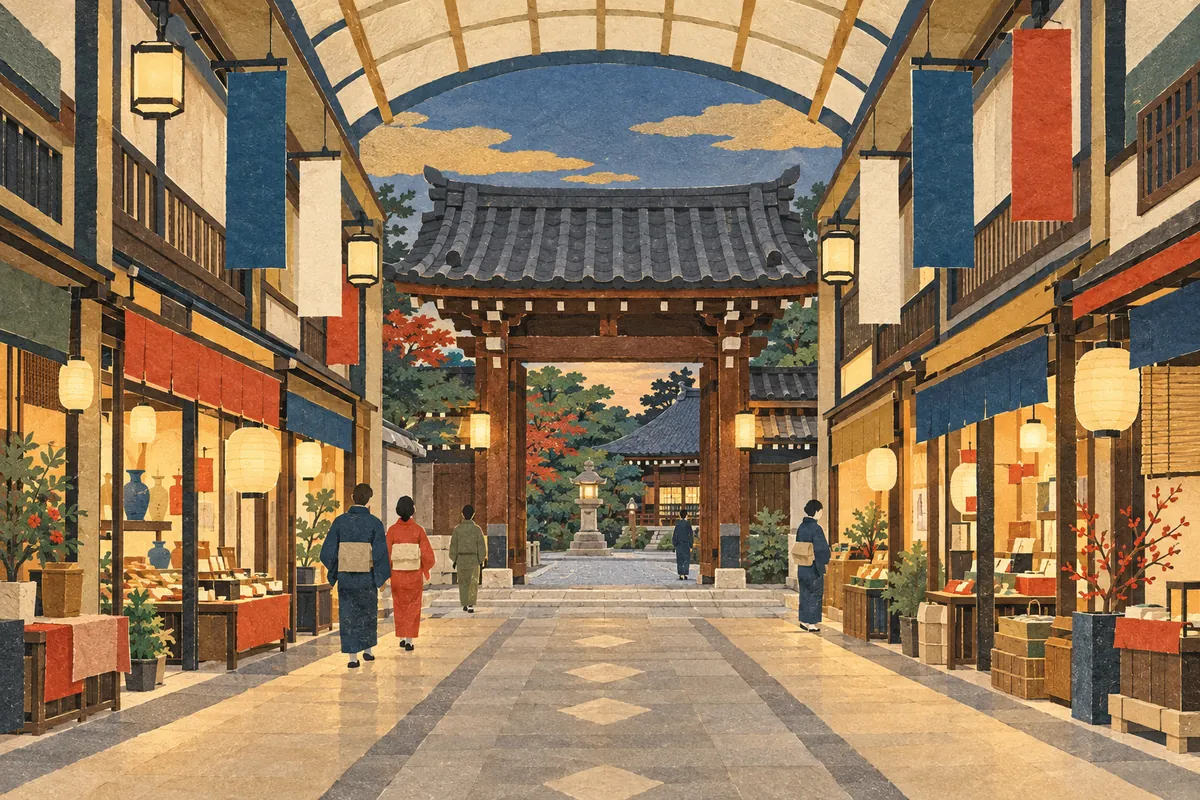
Teramachi-dōri corresponds to Higashi-Kyōgoku Ōji, the avenue at the eastern edge of Heian-kyō, and many temples were gathered along it in Toyotomi Hideyoshi's remodeling of the city. In 1872, Shinkyōgoku-dōri was created to its east by reorganizing the temple grounds, becoming a busy shopping and entertainment street running about 500 meters from Sanjō-dōri to Shijō-dōri.Key points in 30 seconds
Teramachi-dōri corresponds to Higashi-Kyōgoku Ōji of Heian-kyō
Toyotomi Hideyoshi gathered the city's temples in Teramachi
Shinkyōgoku-dōri was created in 1872 (Meiji 5)
About 500 meters from Sanjō-dōri to Shijō-dōri, lined with seven temples and one shrine
Teramachi-dōri, Where Temples Were Gathered
As the name Teramachi ("temple town") suggests, many temples stand along the street. In the Tenshō era (1573–1592), Toyotomi Hideyoshi gathered many of the city's temples along Teramachi-dōri. The street's name is said to come from the temples being moved to its east side during Hideyoshi's remodeling of the city.
In 1590 (Tenshō 18), Hideyoshi divided the square city blocks into long, narrow rectangular ones and gathered the scattered temples into today's Teramachi and Teranouchi. Around the time the Odoi earthen ramparts were built in 1591 (Tenshō 19), the temples of the capital were gathered just inside the Odoi along the Kamo River, and the development of Teramachi moved forward.
"Kyōgoku": The Eastern Edge of Heian-kyō
Teramachi-dōri is said to correspond to Higashi-Kyōgoku Ōji, the avenue at the eastern edge of Heian-kyō (kyōgoku means "the edge of the capital"), and some explanations give Higashi-Kyōgoku Ōji as Teramachi-dōri's former name. The Teramachi area near Marutamachi-dōri has been called Kyōgoku Teramachi because it lay on the Higashi-Kyōgoku of Heian-kyō.
Teramachi also changed in the Edo period. The great fire of 1708 (Hōei 5) greatly altered Teramachi: the temples near Marutamachi-dōri moved east of the Kamo River, and townhouses were built on the vacated land. This shows that the temples of Teramachi did not always stay in the same place.
Shinkyōgoku-dōri Was Born in 1872
The grounds of the temples Hideyoshi had gathered were used for temple fairs, and in the Edo period they became lively with sideshows and entertainments. In 1872 (Meiji 5), Makimura Masanao, a senior official of Kyoto Prefecture, reorganized the temple grounds and created a new street to lift the spirits of citizens, who had been downcast since the capital moved to Tokyo. This was the beginning of Shinkyōgoku-dōri.
After temple and shrine lands were confiscated under the jōchi-rei land orders of the early Meiji era, part of Teramachi's temple quarter was reborn as an entertainment district: today's Shinkyōgoku. The street runs about 500 meters, from Sanjō-dōri in the north to Shijō-dōri in the south.
A New Street East of "Higashi-Kyōgoku"
The name Shinkyōgoku ("New Kyōgoku") comes from its being a new street built east of Higashi-Kyōgoku Ōji (today's Teramachi-dōri). Walking the two neighboring streets lets you trace, one after another, the eastern edge of Heian-kyō, Hideyoshi's remodeling of the city, and the creation of a Meiji-era entertainment district.
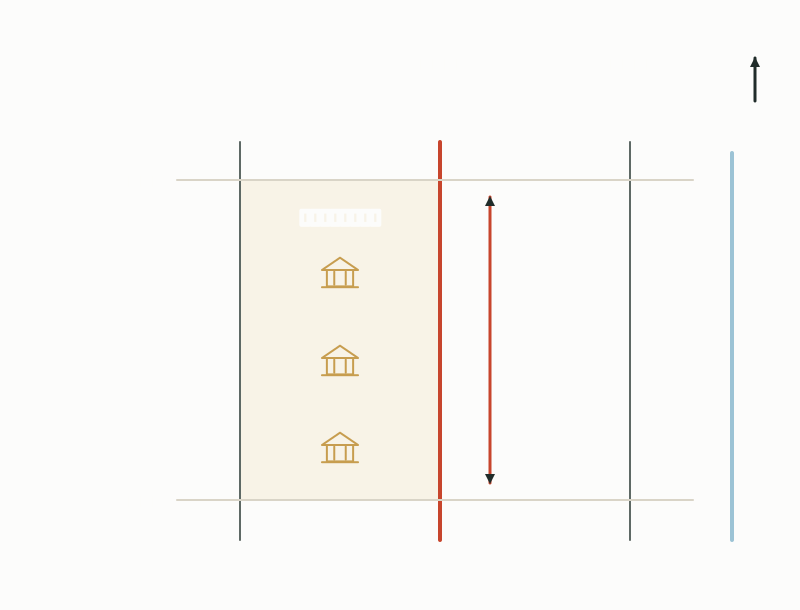
Teramachi-dōri, Shinkyōgoku-dōri, and Kawaramachi-dōri
The history of Teramachi-dōri and Shinkyōgoku-dōri
| Period | Event |
|---|---|
| Heian period | Higashi-Kyōgoku Ōji (later Teramachi-dōri) at the eastern edge of Heian-kyō |
| Around 1590–1591 (Tenshō 18–19) | Toyotomi Hideyoshi gathers the city's temples in Teramachi and builds the Odoi |
| 1708 (Hōei 5) | A great fire greatly alters Teramachi; temples near Marutamachi-dōri move east of the Kamo River |
| 1872 (Meiji 5) | Shinkyōgoku-dōri is created by reorganizing the temple grounds |
| Around 1877 (Meiji 10) | Venues for kamishibai picture-story shows, jōruri, and yose variety theater, as well as restaurants, line the street |
| 1897–1906 (Meiji 30s) | Known as one of Japan's three great entertainment districts, along with Asakusa in Tokyo and Sennichimae in Osaka |
What You Can See in Shinkyōgoku Today
Around 1877 (Meiji 10), Shinkyōgoku became lined with venues for kamishibai, jōruri, yose, and other entertainments, along with restaurants, and in the Meiji 30s (1897–1906) it became known as one of Japan's three great entertainment districts, together with Asakusa in Tokyo and Sennichimae in Osaka. Today it is a busy shopping street crowded with tourists—school-trip students above all—and shoppers.
Along the street are seven temples and one shrine that convey its history. They include Seigan-ji, where Anrakuan Sakuden, regarded as the founder of Kamigata (Kyoto–Osaka) rakugo, served as head priest; Seishin-in, associated with the poet Izumi Shikibu; and Takoyakushi-dō; Nishiki Tenmangū shrine also faces the street. Temple and shrine gates appearing between the shops make a scene fitting for a street born from temple grounds.
- Seigan-ji
- Seishin-in
- Saikō-ji
- Takoyakushi-dō
- Anyō-ji
- Zenchō-ji
- Somedono-in
- Nishiki Tenmangū
If You Visit or Want to Learn More
Teramachi-dōri runs parallel to Shinkyōgoku-dōri just to its west, and if you follow it north you reach Kyoto City Hall at the corner of Oike-dōri (Teramachi-dōri Oike agaru). Between Sanjō and Shijō, walking Teramachi-dōri one way and Shinkyōgoku-dōri the other makes the difference in how the two streets came about easy to see.
If you want to learn more about Hideyoshi's remodeling of the city, the Kyoto City Museum of Historical Materials at Teramachi-dōri Kōjinguchi sagaru is a good place to start. As of October 2026, its special exhibition "Toyotomi Hideyoshi and Kyoto: The Large-Scale Remodeling of the Capital and Its Surroundings" runs until October 25, introducing the construction of Teramachi and Teranouchi, the building of the Odoi, and more through old documents and maps. Admission is free.
Mini quiz for this entry
Check what you've read with 3 multiple-choice questions.
What major event caused many temples to gather along Teramachi-dōri?
Where does the name Shinkyogoku come from?
Which of these events happened in 1872?
Sources and verification
Content checked: October 11, 2026
Updated: October 11, 2026
References are in Japanese.