
Japanese宝永の大火と「新」の付く通り
The Great Hoei Fire and Kyoto's "Shin" Streets
Other spellings and namesGreat Hōei Fire / Hōei Fire of 1708 / Shin-Higashinotōin-dōri / Shin-Kurumayachō-dōri / 宝永の大火
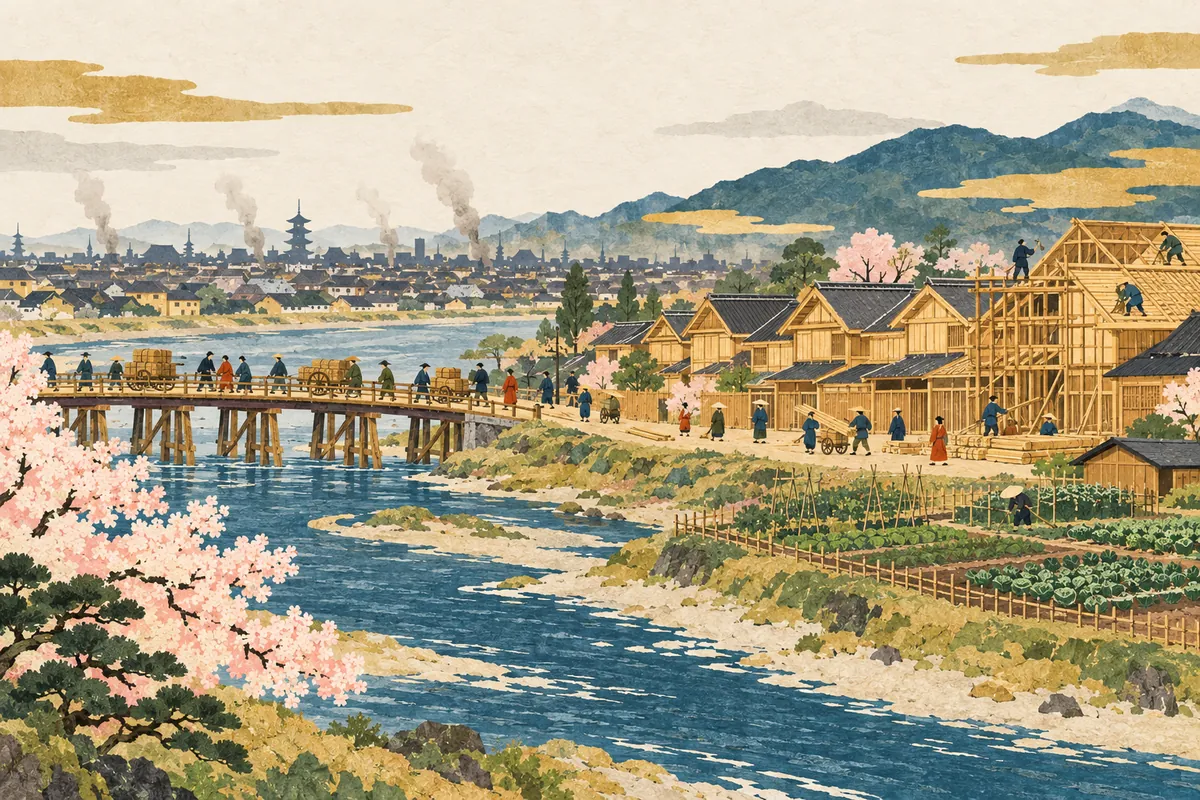
In short
The Great Hōei Fire of 1708 spread from near Aburanokōji-dōri south of Aneyakōji. After the fire, to enlarge the court-noble district (kuge-machi) around the Imperial Palace, townhouses were moved to places such as Nijō-kawahigashi east of the Kamo River, and the streets there kept their original names with Shin (新, "new") added in front, as in Shin-Higashinotōin-dōri.Key points in 30 seconds
Broke out before dawn on March 8, 1708 (Hōei 5)
A record says 10,351 houses burned
The court-noble district was enlarged to roughly the area of today's Kyoto Gyoen
Streets named Shin ("new"), such as Shin-Higashinotōin-dōri, appeared where townhouses were relocated
1708: fire breaks out on Aburanokōji-dōri south of Aneyakōji
The Great Hōei Fire is recorded as having started before dawn on March 8, 1708 (Hōei 5), at the house of Zeniya Ichibē in Sōrin-chō, on Aburanokōji-dōri south of Aneyakōji. Spreading in strong winds, it burned a wide area of Kyoto.
Fanned by a southwest wind, the fire reached the Imperial Palace, and it spread as far as Imadegawa-dōri to the north, Nishikikōji-dōri to the south, Aburanokōji-dōri to the west, and the banks of the Kamo River to the east. The point of origin lay near the southwest corner of the burned area, so the fire swept northeast from there over a wide area that included the palace.
A record of 10,351 houses burned
It is hard to pin down exactly how many houses were lost, but there is a record that 10,351 houses burned. The fire reached not only townhouses but also the residences of court nobles and temples, and it became a major turning point that changed the layout of the city.
The exact number of damaged houses is unknown, but the following records remain, covering the palace and court-noble residences, neighborhoods, temples and shrines, and the residences of feudal lords.
Recorded losses in the Great Hōei Fire
| Category | Number |
|---|---|
| Imperial Palace and court-noble residences | 95 |
| Neighborhoods (chō) | 417 |
| Houses | 10,351 |
| Temples and shrines | 119 |
| Residences of feudal lords (daimyō) | 21 |
Enlarging the court-noble district and moving townhouses east of the Kamo River
Before the fire, the residences of court nobles were clustered in what is now Kyoto Gyoen, but ordinary houses were mixed in among them. To enlarge the court-noble district while rebuilding the burned palace, townhouses east of Karasuma-dōri and north of Marutamachi-dōri were moved to Nijō-kawahigashi east of the Kamo River (now part of Sakyō Ward) and to Uchino (the former site of Heian-kyō's Greater Palace, the Daidairi), among other places.
As a result, the entire area bounded by Karasuma-dōri, Teramachi-dōri, Marutamachi-dōri, and Imadegawa-dōri became the court-noble district. Townhouses around the palace were moved to areas east of the Kamo River and elsewhere, forming new urban districts, and the palace area, including the court-noble district, reached nearly its present size. This was also one of the triggers for the city spreading beyond the Odoi earthworks.
Enlarging the court-noble district and relocating townhouses after the Great Hōei Fire
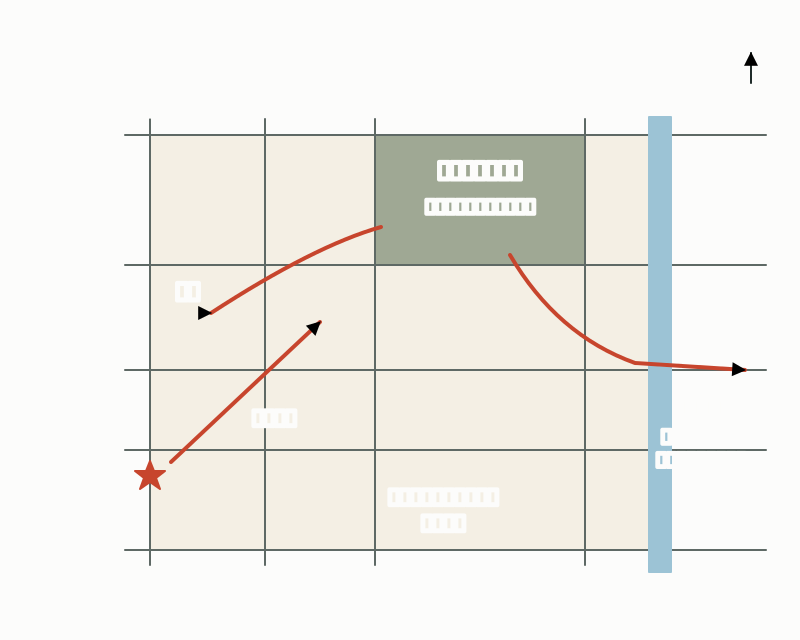
Neighborhoods moved east of the Kamo River and their "Shin" street names
Nijō-kawahigashi was originally farmland belonging to Shōgoin Village and Okazaki Village, and before the fire only Chōmyō-ji and Hōrin-ji temples stood there. After the fire, many neighborhoods and temples moved here. The streets in the new locations were named after the old sites, taking the original street name and adding Shin (新, "new").
Nijō-kawahigashi has many north–south streets beginning with Shin because the street names record the history of neighborhoods being moved there. West of the Kamo River, too, Shin-Karasuma-dōri, which runs north–south one block west of Kawaramachi-dōri, is said to be a remnant of houses moved from along Karasuma-dōri.
- Shin-Marutamachi-dōri (新丸太町通)
- Shin-Fuyachō-dōri (新麩屋町通)
- Shin-Kurumayachō-dōri (新車屋町通)
- Shin-Tominokōji-dōri (新富小路通)
- Shin-Higashinotōin-dōri (新東洞院通)
- Shin-Yanaginobanba-dōri (新柳馬場通)
- Shin-Ainomachi-dōri (新間之町通)
- Shin-Sakaimachi-dōri (新堺町通)
- Shin-Takakura-dōri (新高倉通)
- Shin-Karasuma-dōri (新烏丸通; west of the Kamo River, one block west of Kawaramachi-dōri)
How it differs from the Great Tenmei Fire
Another well-known great fire of Edo-period Kyoto is the Great Tenmei Fire of 1788 (Tenmei 8), 80 years later. The Great Tenmei Fire is considered the largest fire in Kyoto's history. Starting from a house in Donguri-zushi east of the Kamo River, it was carried across the river by an east wind and burned as far as Kuramaguchi-dōri to the north, Shichijō-dōri to the south, and Senbon-dōri to the west, destroying about 37,000 houses.
The Great Hōei Fire burned a smaller area, but it is distinctive in that, along with the rebuilding of the burned palace, the court-noble district was enlarged and townhouses were moved en masse. To avoid mixing up the two fires, it helps to remember that the "Shin" street names are tied to the Great Hōei Fire.
The Great Hōei Fire and the Great Tenmei Fire
| Great Hōei Fire | Great Tenmei Fire | |
|---|---|---|
| Date | Before dawn, March 8, 1708 (Hōei 5) | Early morning, 1st month, 30th day, 1788 (Tenmei 8) |
| Point of origin | Sōrin-chō, Aburanokōji-dōri south of Aneyakōji | Donguri-zushi, east of the Kamo River |
| Area burned | North to Imadegawa-dōri, south to Nishikikōji-dōri, west to Aburanokōji-dōri, east to the Kamo River banks | North to Kuramaguchi-dōri, south to Shichijō-dōri, west to Senbon-dōri, east of the Kamo River in the east |
| Recorded losses | 10,351 houses, among others | 37,000 houses; 65,000 households lost their homes |
| Later impact on the city | Court-noble district enlarged; townhouses moved to Nijō-kawahigashi and elsewhere | Kyoto's industries came to a temporary halt and hardship spread |
To see it for yourself on foot
A good route is to head east along Nijō-dōri and cross the Kamo River. The area around the far end of the bridge is what was called Nijō-kawahigashi in the Edo period, and street names with Shin appear one after another. The original streets, such as Higashinotōin-dōri, Takakura-dōri, and Yanaginobanba-dōri, run north–south west of the Kamo River, between Karasuma-dōri and Teramachi-dōri. Comparing them with the originals on a map makes it easy to picture neighborhoods moving east together.
Note, however, that not every street with Shin in its name comes from the Great Hōei Fire. The streets traditionally linked to the Great Hōei Fire are the Nijō-kawahigashi streets listed above and Shin-Karasuma-dōri.
Mini quiz for this entry
Check what you've read with 3 multiple-choice questions.
Why do many streets east of the Kamo River have names beginning with Shin, meaning “new”?
Which of these events happened in 1708?
Where did the Great Hōei Fire begin?
Sources and verification
Content checked: October 11, 2026
Updated: October 11, 2026
References are in Japanese.