
Japanese天明の大火と焼けた京都
The Great Tenmei Fire and the Burning of Kyoto
Other spellings and namesGreat Tenmei Fire (天明の大火) / Donguri-yake (団栗焼け) / Great Fire of 1788 / Kyoto fire 1788
In short
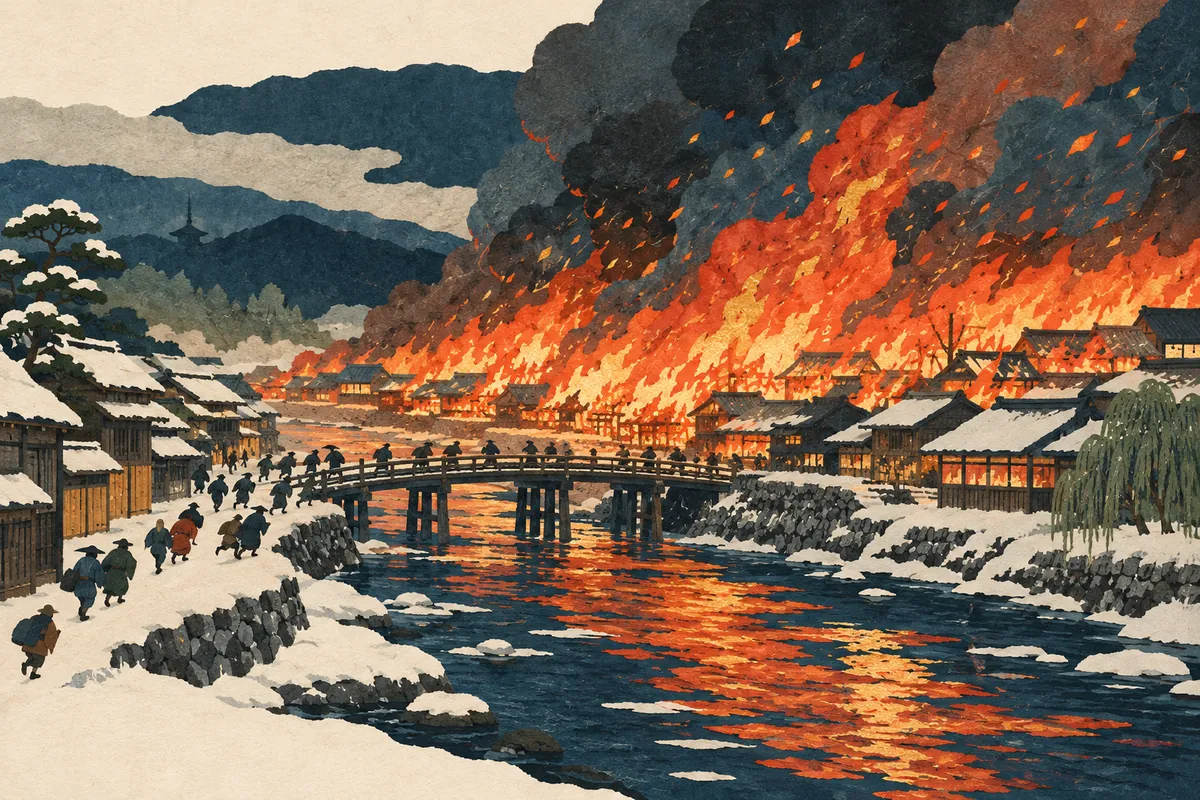
The Great Tenmei Fire was the largest fire in Kyoto's history. It broke out early in the morning of the 30th day of the first month of 1788 (by the old lunar calendar) at Donguri-zushi, east of the Kamo River. Driven by an east wind, it crossed the Kamo River and burned almost all of the city of the time, from Kuramaguchi-dōri in the north to Shichijō-dōri in the south and Senbon-dōri in the west; about 37,000 houses burned and about 65,000 households lost their homes. The Imperial Palace, Nijō Castle, and both the Higashi and Nishi Hongan-ji temples also burned.Key points in 30 seconds
Broke out on the 30th day of the first month of 1788 (Tenmei 8) and burned for two days and nights, until the morning of the 2nd day of the second month
It started at Donguri-zushi east of the Kamo River (around today's Donguri Bridge)
About 37,000 houses burned and about 65,000 households lost their homes
Also called the "Great Fire of the Year of the Monkey" (Sarudoshi no Taika)
A Wind-Driven Fire That Burned the Capital
The Great Tenmei Fire occurred in 1788 (Tenmei 8).
The Great Tenmei Fire started in a house at Donguri-zushi, east of the Kamo River, near today's Donguri Bridge.
About 37,000 houses burned in the Great Tenmei Fire.
About 65,000 households lost their homes in the Great Tenmei Fire.
Why Did It Spread Across the Whole City?
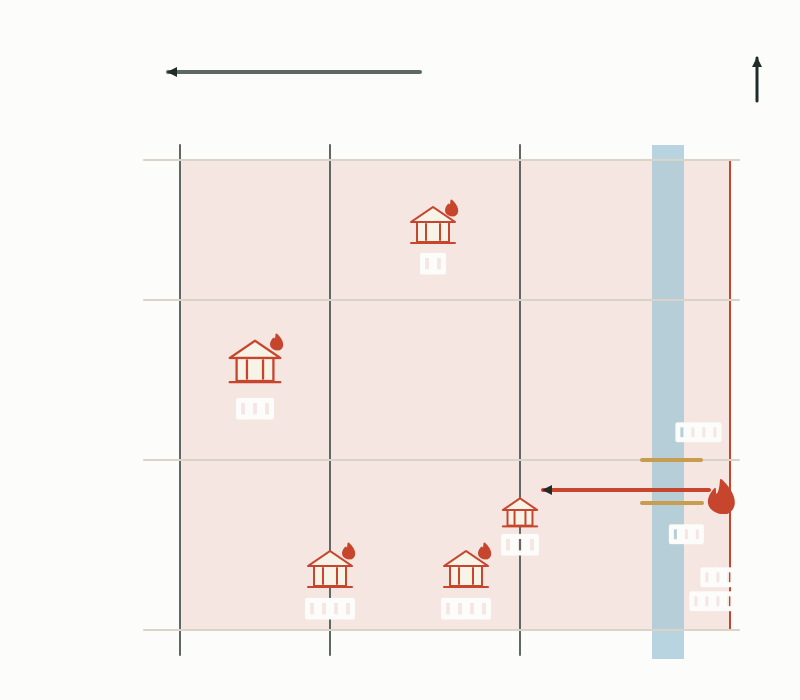
The fire broke out early in the morning of the 30th day of the first month of 1788 (Tenmei 8) in a house at Donguri-zushi, east of the Kamo River. Donguri-zushi was around today's Donguri Bridge, which spans the river just south of Shijō Ōhashi Bridge. Left alone, the damage should have stayed east of the Kamo River, but a strong east wind drove the fire across the river to Eiyō-ji temple at Teramachi-dōri Takatsuji agaru on the opposite bank, and from there it spread west and north, and then south.
In the old lunar calendar the last day of a month was the 30th or the 29th, so the fire burned for two days and nights—the 30th of the first month and the 1st and 2nd of the second month—and was finally put out on the morning of the 2nd. The burned area reached Kuramaguchi-dōri in the north, Shichijō-dōri in the south, the east side of the Kamo River in the east, and Senbon-dōri in the west. Since the city of the time lay almost entirely within this area, a great city was reduced to scorched ruins. At Nijō Castle, too, the Honmaru Palace and other buildings were lost to this fire.
Where the Great Tenmei Fire Began and the Area It Burned
Comparing Three Great Fires of Kyoto
Kyoto suffered many great fires in the Edo period. Comparing the Great Hōei Fire (1708), the Great Tenmei Fire (1788), and the Dondon-yake (1864), which accompanied the Hamaguri Gate Rebellion, shows that the area of the Tenmei fire was far larger than the others. The Dondon-yake is considered the second-largest fire after the Great Tenmei Fire.
Great fires also changed the shape of the city. After the Great Hōei Fire, townhouses around the Imperial Palace were moved to places such as Nijō-kawahigashi, east of the Kamo River, to make way for the palace's rebuilding, and the area of today's Kyoto Gyoen became a district of court nobles' residences. Street names containing shin ("new") remain in the areas where people were relocated. After the Great Tenmei Fire, a segaki memorial service for the victims was held at Shōjōke-in temple for seven days starting on the 24th day of the third month.
Major fires in Edo-period Kyoto
| Fire | Origin | Area burned | Recorded damage |
|---|---|---|---|
| Great Hōei Fire (8th day of the 3rd month, 1708) | A house in Sōrin-chō, Aburanokōji-dōri Aneyakōji sagaru | North to Imadegawa-dōri, south to Nishikikōji-dōri, west to Aburanokōji-dōri, east to the banks of the Kamo River | 417 towns, 10,351 houses, 119 temples and shrines, and more (one example of the records) |
| Great Tenmei Fire (30th day of the 1st month, 1788) | A house at Donguri-zushi east of the Kamo River | North to Kuramaguchi-dōri, south to Shichijō-dōri, west to Senbon-dōri, east to the east side of the Kamo River | About 37,000 houses; about 65,000 households |
| Dondon-yake (7th month, 1864, during the Hamaguri Gate Rebellion) | Around the Chōshū domain residence and the Sakaimachi Gate | North to Marutamachi-dōri, south to Shichijō-dōri, east to Teramachi, west to Higashi-Horikawa | 800 towns, 27,000 households, storehouses, temples, and shrines |
What the Great Fire Left Behind
The fire dealt a heavy blow to Kyoto's economy. Even before it, Kyoto's advanced techniques had spread to the provinces, and goods made there—such as textiles from Kiryū (Gunma Prefecture) and soy sauce from Chōshi (Chiba Prefecture)—were circulating nationwide and putting pressure on Kyoto's industries. The fire temporarily halted production, deepening those difficulties further. The fire was long remembered as the Great Tenmei Fire, or the Great Fire of the Year of the Monkey (申年の大火, Sarudoshi no Taika).
For such a large fire, few historic sites connected with it remain in the city. At Shōjōke-in, at Teramachi Hirokōji agaru in Kamigyō Ward, there is a gorintō (five-tiered stone stupa) for the victims, inscribed "Grave of 150 who died violently in the fire" (横死焼亡百五十人之墓), with a stone monument beside it explaining the memorial. At Entsū-ji, at Higashi-Sanbongi-dōri Marutamachi agaru in Kamigyō Ward, there is also a memorial stone inscribed "For those who died violently in the fire" (為焼亡横死).
Mini quiz for this entry
Check what you've read with 3 multiple-choice questions.
Which of these events happened in 1788?
Where did the Great Tenmei Fire begin?
About how many houses burned in the Great Tenmei Fire?
Sources and verification
Content checked: October 11, 2026
Updated: October 11, 2026
References are in Japanese.