
Japanese1864年の京都・池田屋事件と禁門の変
Kyoto in 1864: The Ikedaya Incident and the Kinmon Incident
Other spellings and namesIkedaya Incident / Hamaguri Gate Incident / Kinmon Incident / Dondon-yake fire
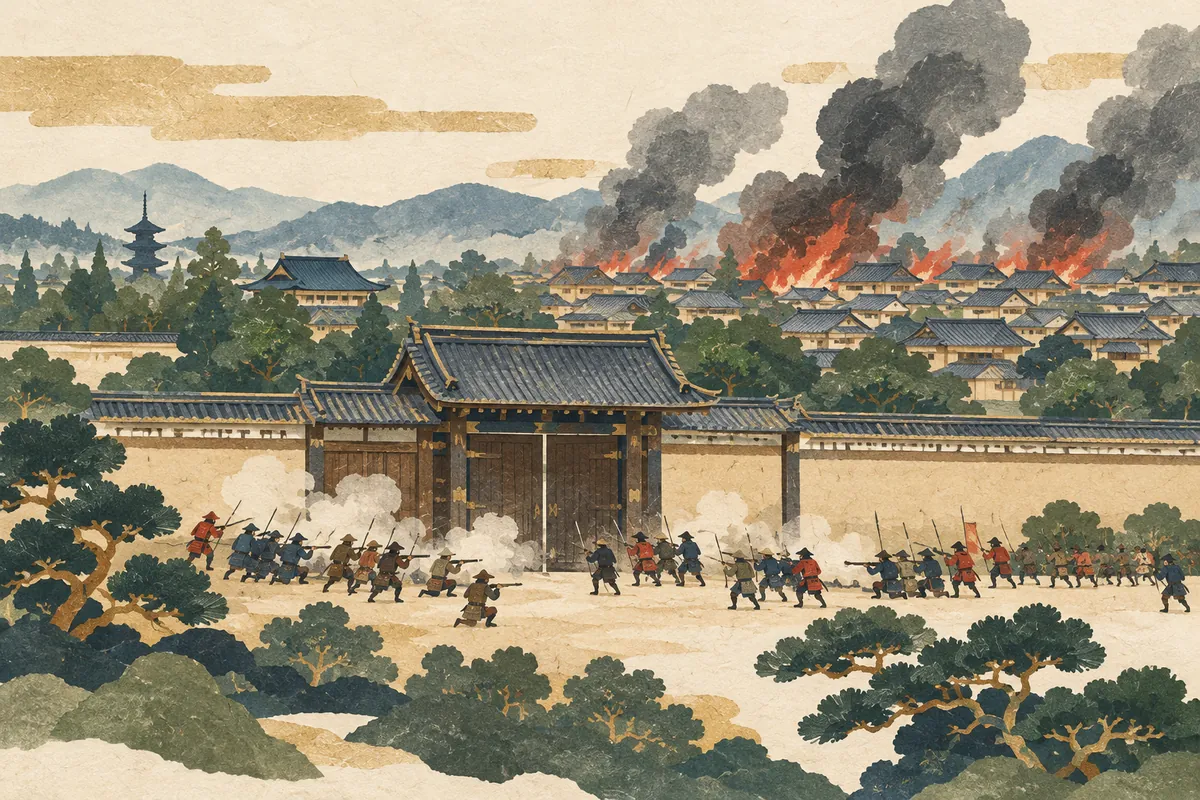
In short
In Kyoto in 1864 (Genji 1), the Ikedaya Incident on June 5 was followed on July 19 by the Kinmon Incident, in which the Chōshū domain fought the forces of Aizu, Satsuma, and the shogunate at the Hamaguri Gate and elsewhere around the Kyoto Imperial Palace. The Dondon-yake fire that spread from the fighting damaged about 800 neighborhoods and 27,000 households, from Marutamachi-dōri in the north to Shichijō-dōri in the south.Key points in 30 seconds
The Shinsengumi raided the Ikedaya (June 5, 1864)
The Kinmon Incident is also called the Hamaguri Gate Incident and the Genji Kasshi Incident
Fire from the fighting spread into the great Dondon-yake fire
Higashi Hongan-ji, Honnō-ji, and Rokkaku-dō burned; the Imperial Palace, Nijō Castle, and Nishi Hongan-ji were spared
The Ikedaya, stormed by the Shinsengumi
On June 5 of Genji 1 (1864), the Shinsengumi raided activists (shishi) meeting at the Ikedaya inn on Sanjō.
The Kinmon Incident and the Dondon-yake fire
The Hamaguri Gate Incident took place in Genji 1, that is, 1864.
The Hamaguri Gate Incident is also called the Kinmon Incident or the Genji Kasshi Incident.
In the Dondon-yake fire, about 800 neighborhoods and 27,000 households, as well as storehouses, temples, and shrines, were damaged.
What happened between the Ikedaya and the Kinmon Incident?
It began with the coup of August 18 the previous year, 1863 (Bunkyū 3), in which the Chōshū domain lost its position in Kyoto. In Kyoto, the faction favoring union of the court and shogunate (kōbu gattai) gained strength, and activists of the sonnō jōi ("revere the emperor, expel the barbarians") movement are said to have plotted to assassinate Prince Nakagawa (Nakagawa-no-miya) and the Kyoto Protector (Kyoto Shugoshoku), Matsudaira Katamori, in order to regain their influence. On June 5, 1864, more than 30 activists meeting at the Ikedaya on Sanjō were attacked by the Shinsengumi, and many were killed or wounded.
The Chōshū domain asked that the honor of its lord and his son be restored and that the seven court nobles driven out of Kyoto be pardoned, but these requests were refused, and it had also lost many retainers in the Ikedaya Incident. Three of its senior retainers (karō) therefore led troops to Kyoto, and on July 19 they fought the allied forces of Aizu, Satsuma, and the shogunate near the Hamaguri Gate and the Sakaimachi Gate of the Kyoto Imperial Palace (now Kyoto Gyoen), and were defeated.
Main events in Kyoto, 1863–1864
| Date (lunar calendar) | Event |
|---|---|
| August 18, 1863 | Coup of August 18. The Chōshū domain loses its position in Kyoto |
| June 5, 1864 | Ikedaya Incident. More than 30 activists at the Ikedaya on Sanjō are attacked by the Shinsengumi |
| June 28, 1864 | The Chōshū army makes Tenryū-ji in Saga its lodgings and headquarters |
| July 19, 1864 | Fighting near the Hamaguri Gate and Sakaimachi Gate; the Chōshū domain is defeated (Kinmon Incident) |
| July 20, 1864 | As the fire approaches the Rokkaku Prison, 33 activists held there are beheaded. Tenryū-ji is also burned by the Satsuma army |
| Around July 21, 1864 | The Dondon-yake fire is put out |
How far did the Dondon-yake fire spread?
The fighting ended in a single day, but the fires that broke out at the Chōshū domain residence and at the Sakaimachi Gate spread beyond all control, and people called it the Dondon-yake ("booming fire") or Teppō-yake ("gunfire fire"). The burned area reached Marutamachi-dōri to the north, Shichijō-dōri to the south, Teramachi to the east, and Higashihorikawa to the west—most of what is now Nakagyō and Shimogyō wards. Among well-known temples, Higashi Hongan-ji, Honnō-ji, and Rokkaku-dō burned, while the Kyoto Imperial Palace, Nijō Castle, and Nishi Hongan-ji escaped destruction even though the flames came very close.
The Dondon-yake is regarded as the largest fire after the Great Tenmei Fire of 1788. Because it happened in the midst of the upheavals at the end of the Edo period, the city struggled to recover, and five years later the capital moved to Tokyo, which is said to have further accelerated Kyoto's decline.
Walking the related sites
On the north side of Sanjō-dōri west of Kiyamachi (Sanjō-dōri Kiyamachi nishi-iru), Nakagyō Ward, stands the stone marker "Site of the Ikedaya Disturbance," erected by the Kyoto City Education Association in 1927. The Hamaguri Gate of Kyoto Gyoen faces Karasuma-dōri. Because the Chōshū army concentrated its main force there and fierce fighting took place, the name "Hamaguri Gate Incident" was born, and bullet marks from that time remain on its doors. In the Edo period the gate stood farther east than it does today. It was originally called the Shinzaike Gate, and it is said that because it was opened during the Great Hōei Fire, it was named after the saying "a clam (hamaguri) opens up when it is grilled"; there is also a theory that the name Hamaguri Gate existed even before that.
The site of the Chōshū domain residence, north of Oike on Kawaramachi-dōri (Kawaramachi-dōri Oike agaru), became the Tokiwa Hotel and then the Kyoto Hotel after the Meiji period, and is now Hotel Okura Kyoto. A memorial to Hirano Kuniomi, Furutaka Shuntarō, and others who died at the Rokkaku Prison stands at Chikurin-ji, west of Onmae on Shimodachiuri-dōri (Shimodachiuri-dōri Onmae nishi-iru) in Kamigyō Ward. At Kōgen-ji, a sub-temple of Tenryū-ji, where the Chōshū army set up its headquarters, sword marks left by Chōshū retainers who fought back at the time are said to remain.
Mini quiz for this entry
Check what you've read with 3 multiple-choice questions.
Which group raided the Ikedaya inn in 1864?
Which of these events happened in 1864?
Which is another name for the Hamaguri Gate Incident?
Sources and verification
Content checked: October 11, 2026
Updated: October 11, 2026
References are in Japanese.