
Japanese二条城と徳川将軍の京都
Nijo Castle and the Tokugawa Shoguns' Kyoto
Other spellings and namesNijō Castle / Tokugawa Ieyasu / Emperor Go-Mizunoo / Taisei Hōkan (Restoration of Imperial Rule) / Ninomaru Palace Shiroshoin
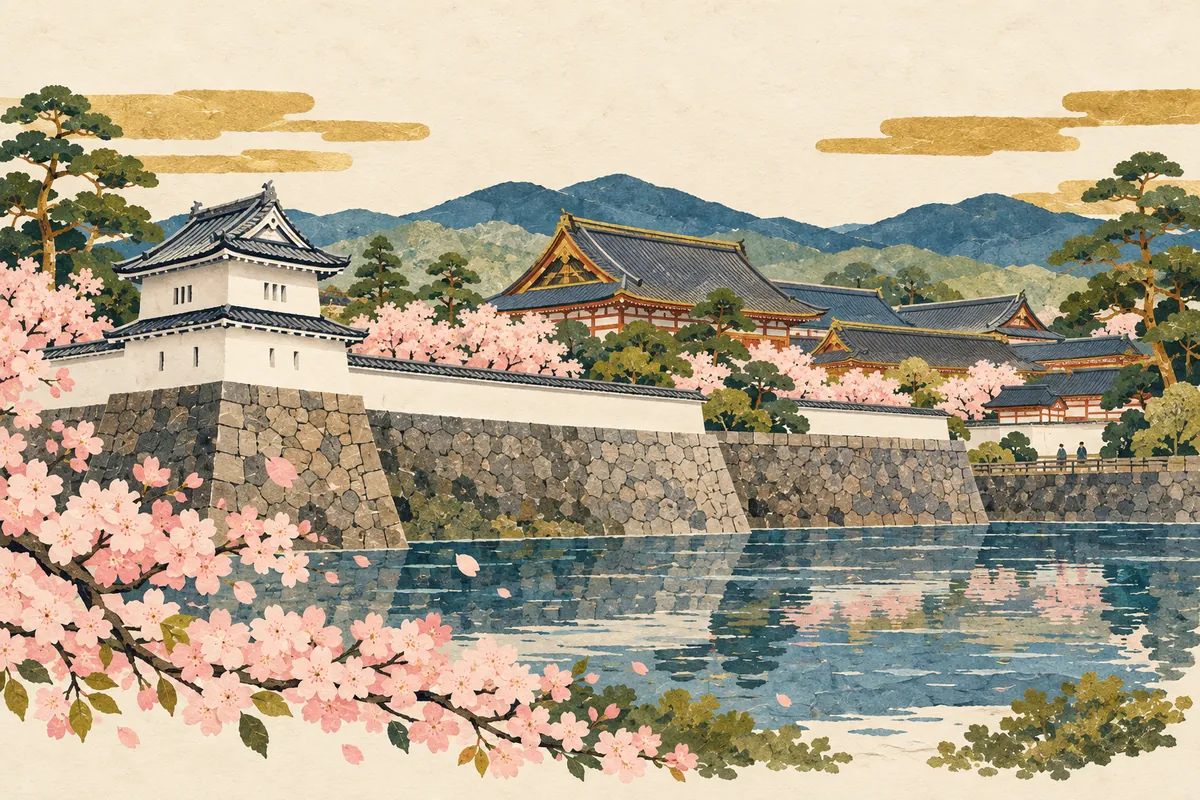
In short
Nijō Castle was built by Tokugawa Ieyasu to guard the Kyoto Imperial Palace and to serve as the shogun's lodging when visiting Kyoto. It reached its present size for Emperor Go-Mizunoo's imperial visit, and at the end of the Edo period it was the stage for Tokugawa Yoshinobu's Taisei Hōkan, the return of political power to the imperial court. After the Meiji era it became a detached imperial palace and was granted to Kyoto City in 1939; six buildings of the Ninomaru Palace are National Treasures.Key points in 30 seconds
Construction began in 1602; Ieyasu entered the castle as shogun in 1603
Emperor Go-Mizunoo visited in 1626, when the castle was expanded to its present size
The intention to return power to the court (Taisei Hōkan) was announced here in 1867
The castle keep burned after a lightning strike in 1750 and was never rebuilt
A Castle Ieyasu Built in Kyoto
Nijō Castle was built by Tokugawa Ieyasu in 1603 as his residence in Kyoto.
Nijō Castle was built by Tokugawa Ieyasu in 1603, the year the Edo shogunate was established.
Nijō Castle was built to protect the Kyoto Imperial Palace and to serve as lodgings for the shogun when he came to Kyoto.
Construction of Nijō Castle began in May 1602, with Murakoshi Mosuke as commissioner.
Nijō Castle was begun in May 1602 under the supervision of Murakoshi Mosuke as commissioner.
An Imperial Visit and the Return of Power
On October 14, 1867, Tokugawa Yoshinobu offered to return political power to the imperial court.
In 1626, at the invitation of Tokugawa Hidetada and Iemitsu, Emperor Go-Mizunoo made an imperial visit to Nijō Castle.
The Shiroshoin of the Ninomaru Palace
The Shiroshoin of Nijō Castle's Ninomaru Palace is one of the National Treasure buildings that make up the Ninomaru Palace.
The Shiroshoin is dated to 1625–1626, in the Momoyama period.
Why Does Nijō Castle Have No Keep?
After a major renovation begun by Tokugawa Hidetada in 1624 (the Kan'ei renovation), the Honmaru (inner citadel), the Ninomaru (second citadel), and the castle keep were all completed in time for Emperor Go-Mizunoo's visit in 1626, and the castle reached its present size. New sliding-door and wall paintings by the Kanō school are also said to have been painted for the visit.
However, the five-story keep burned after a lightning strike in August 1750 (Kan'en 3) and was never rebuilt. Then, in January 1788 (Tenmei 8), a great fire in the city spread to the castle, destroying the Honmaru Palace and other buildings. The palace that now stands in the Honmaru is the former Katsura-no-miya Palace, moved here in 1893 (Meiji 26). The Ninomaru Palace preserves the appearance of the early Edo period, and six of its buildings are designated National Treasures.
What Happened in the Ōhiroma the Day Before the Return of Power?
On October 13, 1867 (Keiō 3), Tokugawa Yoshinobu gathered senior retainers of the 40 domains then in Kyoto in the Ōhiroma (Grand Hall) of the Ninomaru Palace to hear their views, and on the following day, the 14th, he offered to return political power to the imperial court. The court accepted on the 15th, and the Edo shogunate came to an end. Yoshinobu had also succeeded to the post of 15th shogun within Nijō Castle the year before, in 1866.
In the Meiji era, the castle's role changed again and again. In 1868 a temporary office of the Dajōkan (Council of State) was set up in the castle; in 1871 the Kyoto Prefectural Office moved into the Ninomaru Palace; and in 1884 the castle became the Nijō Detached Palace, an imperial villa. During the enthronement ceremonies of Emperor Taishō in 1915 it served as a banquet venue, and the South Gate completed at that time still stands.
From Ieyasu's Castle to Kyoto City's Castle
Nijō Castle was a political stage from Ieyasu's time onward. In 1611, Ieyasu met Toyotomi Hideyori here, and during the Siege of Osaka from 1614 to the following year, war councils were held in the castle and troops set out from here. In 1634 the third shogun, Iemitsu, entered the castle at the head of a large army, but the next shogun to enter it was the 14th, Iemochi, in 1863.
In 1939 (Shōwa 14) the castle was granted to Kyoto City by the Imperial Household Ministry, and on February 11, 1940, it opened to the public as Onshi Moto-Rikyū Nijō-jō (Former Imperial Villa Nijō Castle, an imperial gift). Kyoto City still owns and manages the castle today, and it is the only castle among the 17 component sites of the World Heritage Site "Historic Monuments of Ancient Kyoto." The Ninomaru Palace's wall and sliding-door paintings were designated Important Cultural Properties in 1982, and the Nijō Castle Painting Exhibition and Storage Hall opened in 2005. In 2011, a full-scale restoration project for the whole castle began.
Key moments in Nijō Castle's history
| Year | Event |
|---|---|
| 1601 (Keichō 6) | Ieyasu orders daimyo of western Japan to build the castle |
| 1603 (Keichō 8) | Completed; Ieyasu enters the castle for the first time |
| 1611 (Keichō 16) | Ieyasu and Toyotomi Hideyori meet in the castle |
| 1626 (Kan'ei 3) | The major renovation is completed; in September, Emperor Go-Mizunoo visits for five days |
| 1750 (Kan'en 3) | The five-story keep burns after a lightning strike |
| 1788 (Tenmei 8) | A great fire in the city destroys the Honmaru Palace and other buildings |
| 1863 (Bunkyū 3) | The 14th shogun, Iemochi, enters the castle, the first shogun to do so since Iemitsu |
| 1867 (Keiō 3) | Yoshinobu announces his intention to return power to the court at the Ninomaru Palace |
| 1884 (Meiji 17) | Becomes the Nijō Detached Palace, an imperial villa |
| 1893 (Meiji 26) | The Katsura-no-miya Palace is moved to the Honmaru |
| 1939 (Shōwa 14) | Granted to Kyoto City by the Imperial Household Ministry |
| 1952 (Shōwa 27) | Six buildings of the Ninomaru Palace become National Treasures and 22 buildings Important Cultural Properties |
| 1994 (Heisei 6) | Inscribed as a World Cultural Heritage Site |
Mini quiz for this entry
Check what you've read with 3 multiple-choice questions.
Who built Nijo Castle?
Which of these events happened in 1603?
Who served as construction magistrate when work on Nijo Castle began in 1602?
Sources and verification
Content checked: October 11, 2026
Updated: October 11, 2026
References are in Japanese.