
Japanese能楽・西陣織・京焼のつながり
How Nōgaku, Nishijin-ori, and Kyō-yaki Are Connected
Other spellings and namesNoh and Kyogen / Sarugaku / Nishijin-ori / Kyo-yaki and Kiyomizu-yaki
In short
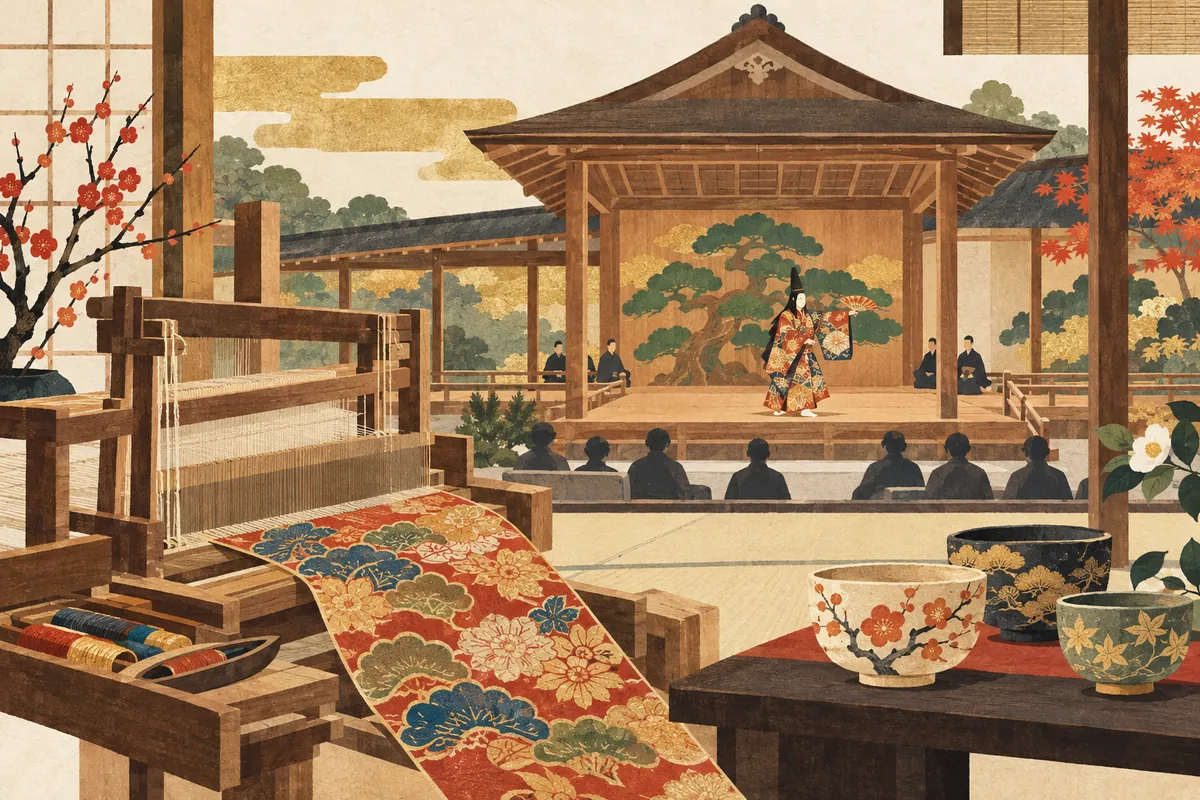
Kyoto's traditions extend beyond the performing arts to the textiles that adorn stage costumes and the vessels of everyday life. Nōgaku, Nishijin-ori, and Kyō-yaki/Kiyomizu-yaki are examples of skills and aesthetics handed down across generations.Key points in 30 seconds
Noh and Kyōgen together are called nōgaku
Nōgaku descends from sarugaku
Nishijin-ori is a textile; Kyō-yaki and Kiyomizu-yaki are ceramics
From sarugaku to nōgaku
Noh and Kyōgen together are called nōgaku. It is a traditional performing art that has also been handed down in Kyoto.
Nōgaku is said to descend from sarugaku, which took shape in the mid-Heian period.
A city of textiles and ceramics
Nishijin-ori is one of Kyoto's leading traditional industries, weaving threads into beautiful fabrics.
Kyō-yaki and Kiyomizu-yaki are Kyoto's representative ceramics. They have also been made around Gojōzaka.
How do Noh and Kyōgen differ?
Kan'ami established the practice of performing Noh as drama with a story, and his son Zeami perfected the art. Oda Nobunaga and Toyotomi Hideyoshi also enjoyed Noh, and the Tokugawa shogunate made it shikigaku, its official ceremonial performing art. The name "nōgaku" was adopted in the Meiji era.
Noh is a sung and danced drama in which the story unfolds through dance-like movements accompanied by chanting (utai) and instrumental music (hayashi), while Kyōgen is comedy performed through dialogue. Nōgaku was designated an Important Intangible Cultural Property of Japan in 1957 and inscribed on UNESCO's list of Intangible Cultural Heritage in 2008. Programs often combine two or three Noh plays with one Kyōgen play.
Differences between Noh and Kyōgen
| Item | Noh | Kyōgen |
|---|---|---|
| Form | Sung and danced drama built on chanting and dance | Dialogue drama centered on spoken lines and gestures |
| Content | Mostly solemn or tragic | Mainly humorous and comic |
| Characters | Figures from history and legend, among others | Ordinary people of the time |
| Language | Dignified, elevated chanting | Easy-to-follow everyday speech |
Seeing nōgaku in Kyoto
The main venues in the city include the Kongō Noh Theater, Kyoto Kanze Kaikan, Kawamura Noh Stage, and ROHM Theatre Kyoto. Among outdoor events, Kyoto Takigi Noh, which began in 1950, is performed by bonfire light with the Daigokuden of Heian Shrine as its backdrop, and the Citizens' Kyōgen Performances (Shimin Kyōgen-kai), which began in 1957, are held four times a year, mainly on Friday evenings (as of October 2026).
When you watch for the first time, paying attention to the music and calls of the shibyōshi—the four instruments of flute, small hand drum, large hand drum, and stick drum—makes the stage easier to follow. There are about 60 basic types of Noh masks, and some of the costumes worn by the shite (lead actor) have been in use for several hundred years. The stage is also supported by the craftsmanship that makes the masks and costumes.
New Meiji technology transformed Nishijin-ori and Yūzen
Kyoto's largest industry is not tourism but manufacturing. Nishijin-ori is still woven inside machiya townhouses, and a distinctive feature is that each house serves as a small factory.
In the Meiji era, weavers who studied abroad brought Jacquard looms back from France and Austria, making it possible to weave patterns automatically using punch cards. In Yūzen dyeing, artisans were quick to adopt chemical dyes, allowing them to produce many finely detailed, gorgeous pieces, and in the early Meiji era the Seimikyoku (a government chemistry institute) also worked on improving ceramic-making techniques. This shows that traditional industries have survived not just by preserving old techniques unchanged, but by taking in new technology.
Kyoto's traditional industries through 74 crafts
Kyoto City designates 74 traditional industry items, and the Kyoto Museum of Crafts and Design, on the first basement floor of Miyako Messe (Kyoto International Exhibition Hall) in Okazaki, presents all 74 together. It features a wall-sized display of the 74 items, panels and videos explaining production processes, and demonstrations by artisans.
The items include Nishijin-ori, Kyō-yaki/Kiyomizu-yaki, Kyō-yūzen, Kyō-kanoko shibori (tie-dyeing), Kyō-sensu (folding fans), and Kyō-shikki (lacquerware), as well as performing arts tools such as Noh masks, shakuhachi, and shamisen, and even Kyoto cuisine and Kyoto confectionery. It is very Kyoto that the performing arts, crafts, and food are all connected within the single framework of "traditional industries."
Mini quiz for this entry
Check what you've read with 3 multiple-choice questions.
What is the combined name for Noh and Kyogen?
What kind of product is made through the traditional craft of Nishijin-ori?
Which performing art is considered a root of Nohgaku?
Sources and verification
Content checked: October 11, 2026
Updated: October 11, 2026
References are in Japanese.