
Japanese西陣(にしじん)
Nishijin
Other spellings and namesNishijin district / Nishijin gakku / Nishijin-ori / 西陣
In short
Nishijin (西陣) is the name of an area spanning Kamigyō and Kita wards in Kyoto City and the birthplace of Nishijin-ori textiles. It came to be called Nishijin ("Western Camp") because Yamana Sōzen's Western Army set up camp here during the Ōnin War. There is no administrative district called Nishijin, and the area it refers to differs by context: historic Nishijin, the Nishijin gakku (a former school district), and the Nishijin district as the production area of Nishijin-ori.Key points in 30 seconds
The name comes from the camp of the Western Army (Yamana Sōzen) in the Ōnin War
There is no administrative district called Nishijin
Historic Nishijin is a square about 1 km on each side; the Nishijin gakku is smaller
Nishijin-ori was designated a national Traditional Craft in 1976
Why Is It Called Nishijin?
The Ōnin War was a civil war fought mainly in Kyoto for 11 years, from 1467 (Ōnin 1) to 1477 (Bunmei 9), between the Eastern Army of the kanrei (shogunal deputy) Hosokawa Katsumoto and the Western Army of Yamana Sōzen. The Yamana side's camp was called Nishijin ("western camp"), and this name later became the place name known for Nishijin-ori.
Yamana Sōzen's residence (in today's Yamana-chō) served as one of the bases, and the area around it came to be called Nishijin in the sense of the "western camp" facing the Hosokawa side to the east; it is said to have become established as a place name by the end of the Muromachi period. The Eastern Army had built a fortified enclosure called the Okamae, surrounded by earthen ramparts and moats, centered on the Muromachi Palace (the Hana no Gosho).
Most of Kamigyō burned in the war. During the fighting, many craftspeople moved to Sakai and elsewhere, and weaving in Ōtoneri-chō, until then the center of textile production, was all but wiped out. After the war, the weavers are said to have resumed their work near Ōmiya-Imadegawa, the site of the Western Army's headquarters, and this is said to be the origin of Nishijin as the name of a production area.
Nishijin Has More Than One Extent
Historic Nishijin is said to be a nearly square area about 1 kilometer on each side, running roughly from Nakadachiuri-dōri to Kuramaguchi-dōri north to south, and from Muromachi-dōri to Senbon-dōri east to west.
The Nishijin gakku, a former school district (motogakku), lies roughly west of Horikawa-dōri, east of Jōfukuji-dōri, north of Itsutsuji-dōri, and south of Teranouchi-dōri. The Nishijin gakku corresponds to Kamigyō Bangumi No. 5, created in the chōgumi reform of 1869 (Meiji 2).
There is no administrative district called Nishijin. The Nishijin district as the production area of Nishijin-ori is said to center on Kamigyō and Kita wards, bounded roughly by Marutamachi-dōri to the south, Kamigamo to the north, Karasuma-dōri to the east, and Nishiōji-dōri to the west. Comparing the three "Nishijins," the production area is the largest and the Nishijin gakku the smallest.
The extents of the three "Nishijins"
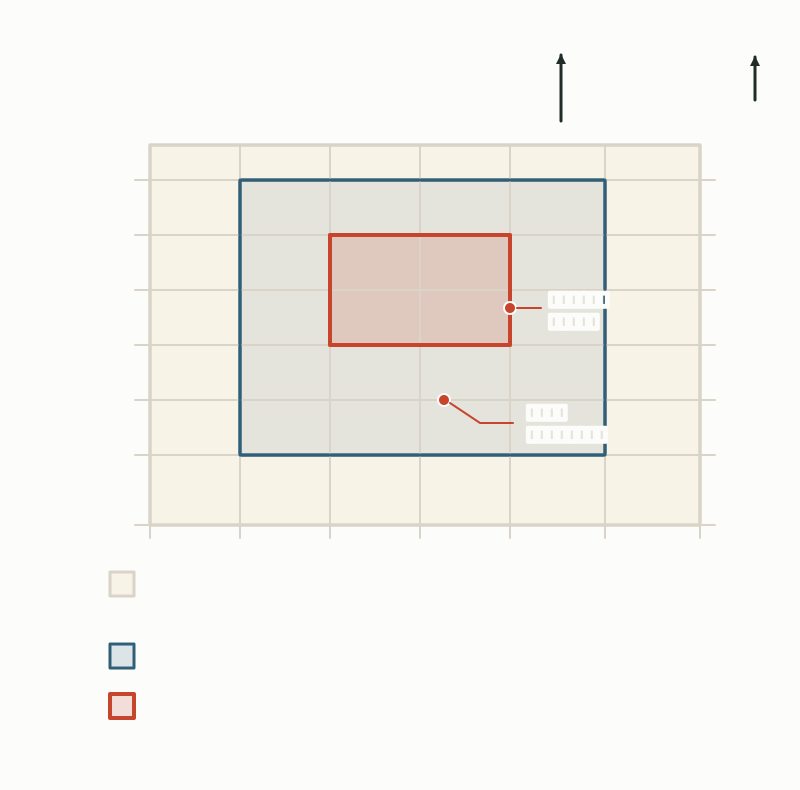
The extents of the three "Nishijins"
| Name | North–south | East–west |
|---|---|---|
| Historic Nishijin | Nakadachiuri-dōri to Kuramaguchi-dōri | Muromachi-dōri to Senbon-dōri |
| Nishijin gakku (former school district, approximate) | North of Itsutsuji-dōri, south of Teranouchi-dōri | West of Horikawa-dōri, east of Jōfukuji-dōri |
| Nishijin district as the Nishijin-ori production area | Marutamachi-dōri to Kamigamo | Karasuma-dōri to Nishiōji-dōri |
Nishijin as the Home of Nishijin-ori
Nishijin-ori is the general term for "yarn-dyed (sakizome) figured fabrics produced in Kyoto (Nishijin)." "Nishijin" is also a registered trademark of the Nishijin Textile Industrial Association.
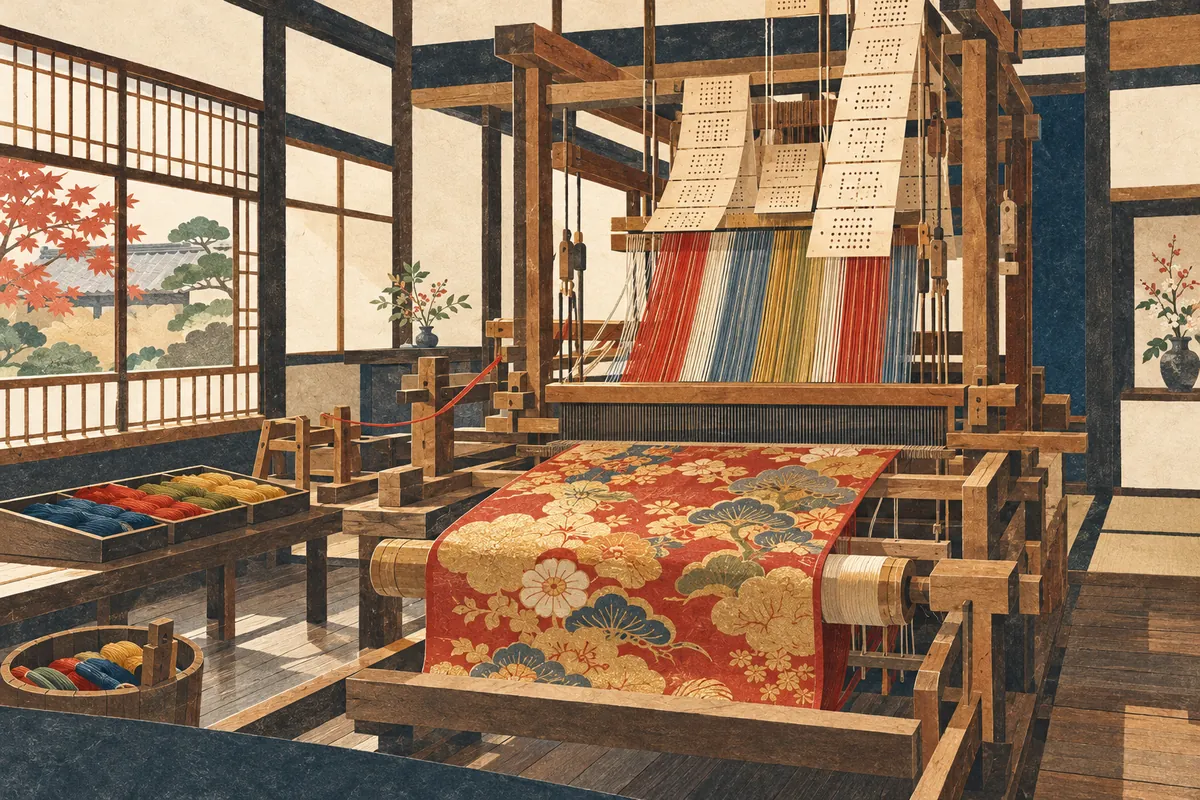
Weaving in Kyoto is said to have begun around the 5th century, before Heian-kyō, when members of the Hata clan brought the techniques of sericulture and silk weaving. After the capital moved to Heian-kyō, twill and brocade were woven under the court's Oribe no Tsukasa (Weaving Office); when the official workshops declined, the weavers gathered in Ōtoneri-chō to make fabrics such as "Ōtoneri twill," and in the Muromachi period they organized the Ōtoneri-za, a kind of trade guild.
Nishijin-ori was designated a national Traditional Craft in 1976 (Shōwa 51). In 1872 (Meiji 5), the Nishijin weaving industry sent people to France to introduce the Jacquard loom, and by around 1900 (Meiji 33) almost all ordinary Nishijin textiles are said to have been woven on Jacquard looms.
Twelve types of Nishijin-ori are designated as Traditional Crafts: tsuzure (tapestry weave), tate-nishiki (warp-patterned brocade), nuki-nishiki (weft-patterned brocade), donsu (damask), shuchin (satin brocade), shōha, fūtsū (double weave), mojiri-ori (leno weave), honshibo-ori (crepe), birōdo (velvet), kasuri-ori (ikat), and tsumugi (pongee). Today they are used not only for obi sashes and kimono but also for neckties, interior furnishings, and more.
Where to See It Today: The Nishijin Monument and Yamana Sōzen's Former Site
In front of the Kyoto City Archaeological Museum at Imadegawa-dōri Ōmiya higashi-iru stands the Nishijin Monument, inscribed with the origins of Nishijin and the history of its weaving industry. It was erected in 1928 (Shōwa 3). The museum building was originally built as the Nishijin Textile Hall.
At Horikawa-dōri Kamidachiuri-sagaru is Yamana-chō, named because Yamana Sōzen's residence stood here during the war, and within the town is a monument marking the "Former Site of Yamana Sōzen." Ōmiya-Imadegawa, where the Nishijin Monument stands, is inside historic Nishijin but outside the Nishijin gakku (north of Itsutsuji-dōri). You can really feel how the area on the map changes depending on which "Nishijin" is being discussed.
The "Kyoto Street-Name Song (North–South Edition)," posted by the Kyoto City Transportation Bureau in subway stations, ends with "jōfuku (Jōfukuji) senbon (Senbon) hate wa Nishijin" ("...and at the end, Nishijin"). It lists the north–south streets one by one, heading west from Teramachi-dōri, and after Senbon-dōri comes Nishijin—the name of an area rather than a street.
- The name comes from the camp of the Western Army (Yamana Sōzen) in the Ōnin War
- It is not an administrative district, and the area it refers to varies by context
- Nishijin Monument: Imadegawa-dōri Ōmiya higashi-iru, in front of the Kyoto City Archaeological Museum
- Monument to the Former Site of Yamana Sōzen: Horikawa-dōri Kamidachiuri-sagaru, Yamana-chō
Mini quiz for this entry
Check what you've read with 3 multiple-choice questions.
Which Kyoto City wards does the area called Nishijin span?
Which streets are considered the eastern and western limits of historic Nishijin?
Nishijin-ori is regarded as the general term for what kind of fabric produced in Kyoto (Nishijin)?
Sources and verification
Content checked: October 11, 2026
Updated: October 11, 2026
References are in Japanese.