
Japanese太秦(うずまさ)
Uzumasa
Other spellings and namesUzumasa area / 太秦エリア / Uzumasa Kyoto
In short
太秦 is read Uzumasa (うずまさ). The place name is linked to the Hata clan, an immigrant clan that made this area its base in ancient times, and it is explained through a legend in the Nihon Shoki (Chronicles of Japan): the clan's chief presented silk piled high (uzutakaku) to the court and was granted the title Uzumasa (禹豆麻佐).Key points in 30 seconds
Read Uzumasa (うずまさ)
A place name in Ukyō Ward, Kyoto City; 83 town names begin with "Uzumasa"
Considered the base of the Hata, an ancient immigrant clan, and temples and shrines linked to them, such as Kōryū-ji, remain
The origin of the name is linked to the Nihon Shoki legend of "Uzumasa" (禹豆麻佐)
"Uzumasa" in Ukyō Ward
Uzumasa is an area in Ukyō Ward, Kyoto City. You might be tempted to read 太秦 as Taishin or Futohata, but the correct reading is Uzumasa. Neither 太 nor 秦 yields uzumasa from its usual readings.
Looking at the town names of Ukyō Ward, 83 begin with "Uzumasa," such as Uzumasa Aokigahara-chō, Uzumasa Hachioka-chō, and Uzumasa Yasui Kasuga-chō. The area name is still widely used at the head of the detailed town names.
The Hata Clan and the Legend of "Uzumasa" (禹豆麻佐)
The Hata were a clan that came to Japan from the Korean Peninsula in ancient times; in fact, they are thought to have been a group of kin who came from Silla around the mid-5th century. They made the Uzumasa area of Kadono District in Yamashiro Province their base and built a strong foothold throughout the Kinki region.
The best-known legend about the Hata is a story in the Nihon Shoki. In the time of Emperor Yūryaku, the clan chief Hata no Sake no Kimi gathered 180 groups of suguri (Hata communities) that had been scattered across the country, piled high (uzutakaku) the silk they paid as tax, presented it to the court, and was granted the title Uzumasa (禹豆麻佐). The place name Uzumasa is also said to derive from this.
The fact that the Hata lived here is often cited as the origin of the place name. Keep in mind, however, that the etymology of "uzumasa" itself is an explanation based on legend and cannot be stated as established fact.
What Did the Hata Clan Do?
The Hata had advanced technology and economic power. They built a large weir on the Katsura River for irrigation, cleared land across the Sagano area, and introduced new techniques of sericulture and weaving. This weir is the Kadono Ōi (Kadono Great Weir), said to be the origin of the name Ōi River (Ōigawa) for the Katsura River near Arashiyama.
When Emperor Kanmu moved the capital to Nagaoka-kyō in 784 (Enryaku 3), the Hata are said to have cooperated fully in building the capital, since the mother of Fujiwara no Tanetsugu, the official in charge of palace construction, was a daughter of the Hata clan. There is also a legend that the Ukon no Tachibana, the mandarin orange tree in front of the Shishinden hall of the Imperial Palace, originally stood at the residence of Hata no Kawakatsu.
The Hata also worked hard when Heian-kyō was built, and their home base along the Katsura River became a depot for landing timber for construction. The place name Uzumasa carries the history of the people who opened up this land even before Heian-kyō.
Where Can You See It Today? Sites Linked to the Hata Clan
In and around Uzumasa, temples, shrines, and burial mounds said to be connected with the Hata clan still remain. The main sites are summarized in the table.
At the center is Kōryū-ji, also known as Uzumasa-dera or Hachioka-dera. The name Kōryū-ji first appears in documents in 838 (Jōwa 5), but Buddhist statues and excavated roof tiles dating back to the Asuka period suggest that its origins lie in that era. Because it suffered repeated fires, its present buildings date from the late Heian period onward.
Hata Clan Sites Around Uzumasa (West to East)
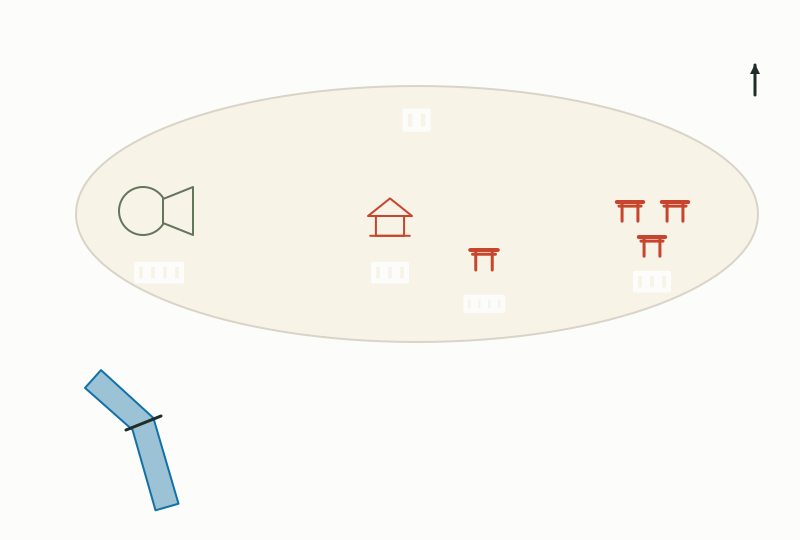
Sites linked to the Hata clan around Uzumasa
| Site | Location | Connection to the Hata clan |
|---|---|---|
| Kōryū-ji | Uzumasa Hachioka-chō, Ukyō Ward | According to the temple's own history, Hata no Kawakatsu received a Buddhist statue from Prince Shōtoku in 603 (Suiko 11) and built Hachioka-dera. Its wooden statue of Miroku Bosatsu (Maitreya) in a pensive pose was the first National Treasure designated after World War II |
| Ōsake Shrine | Uzumasa Higashi-Hachioka-chō, Ukyō Ward | The Hata clan's tutelary shrine. It was originally enshrined within the grounds of Kōryū-ji and moved to its present site with the Meiji-era separation of Shinto and Buddhism |
| Kaiko-no-Yashiro (Konoshima-ni-imasu Amaterumitama Shrine) | Uzumasa Morigahigashi-chō, Ukyō Ward | A shrine linked to the Hata clan. The Yōsan (Sericulture) Shrine in its grounds is the source of the popular name Kaiko-no-Yashiro ("Silkworm Shrine"). It has a three-legged torii, made by combining three torii gates |
| Hebizuka Kofun | Uzumasa Omokage-chō, Ukyō Ward | A burial mound thought to be the tomb of a leader of the Hata clan. Originally a keyhole-shaped mound about 75 m long, it now survives as a huge corridor-style stone chamber in a residential area |
Uzumasa as a Film Town
Today's Uzumasa is a residential area and is also known as a film town. Uzumasa still has working film studios, and Toei Kyoto Studio Park (Toei Uzumasa Eigamura) is its best-known attraction. The Daiei-dōri shopping street is also called "Kinema Street."
Three lines serve the Uzumasa area—the Randen (Keifuku Electric Railroad), the JR Sagano Line, and the Tōzai subway line—and station names also include "Uzumasa," such as Uzumasa Tenjingawa Station, Uzumasa Kōryūji Station, and JR Uzumasa Station. Part of Uzumasa's appeal is that a place name connected with an ancient clan is still spoken every day as the name of stations and a shopping street.
Mini quiz for this entry
Check what you've read with 2 multiple-choice questions.
How is the Kyoto place name 太秦 read?
In the Nihon Shoki tradition, which clan chief presented silk piled high to the court and was granted the title Uzumasa (禹豆麻佐)?
Sources and verification
Content checked: October 11, 2026
Updated: October 11, 2026
References are in Japanese.