
Japanese大堰川の名前の由来
Where the Name Oi River Comes From
Other spellings and namesŌi River / Ōigawa / Katsura River / Kadono Ōi weir / 大堰川
In short
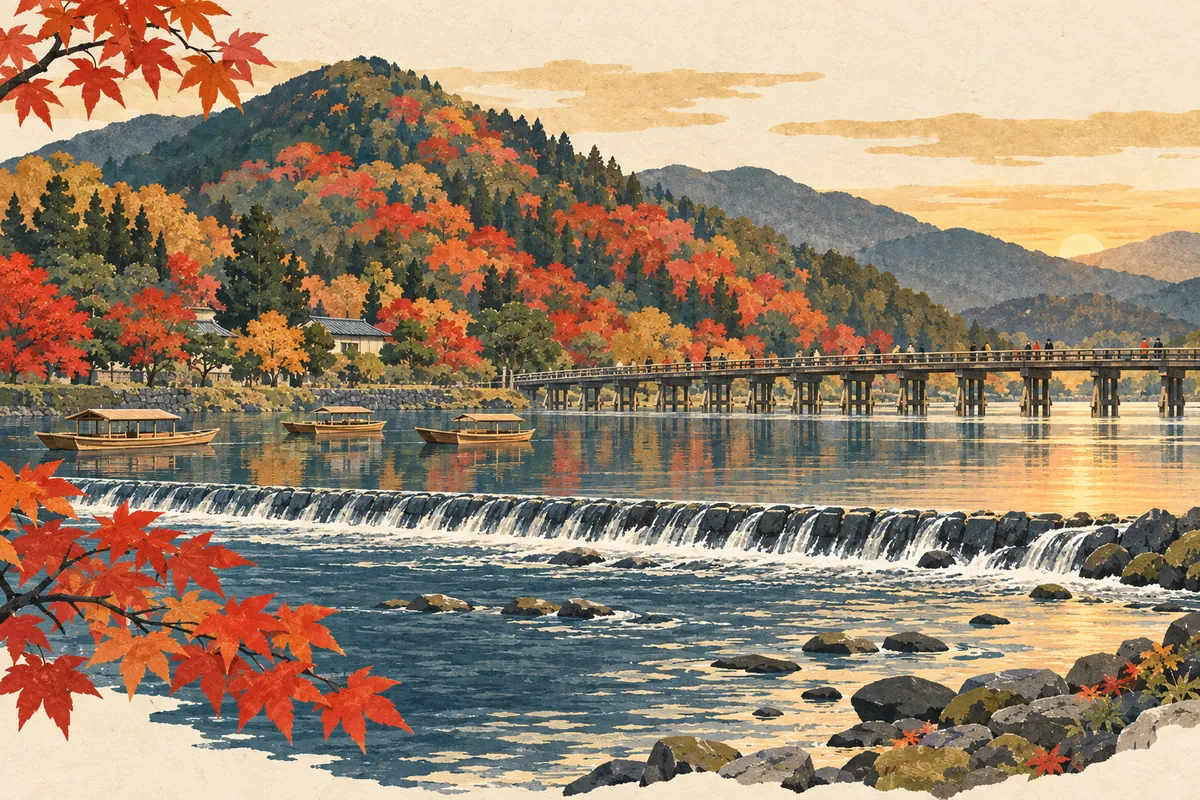
The Katsura River, which flows past Togetsukyō Bridge in Arashiyama, is also called the Ōi River (大堰川, Ōigawa). The name is said to come from the Kadono Ōi (葛野大堰), an irrigation weir said to have been built in ancient times by the Hata clan along this stretch of the river.Key points in 30 seconds
The Katsura River near Arashiyama is also called the Ōi River (大堰川 or 大井川)
The name comes from the Kadono Ōi weir, said to have been built by the Hata clan
The river's name was unified as "Katsura River" by the River Act of 1896 (Meiji 29)
The stretch flowing through central Kameoka City is called the Hozu River
Ōi River Is a Name for the Katsura River Around Arashiyama
Rivers in Kyoto sometimes have different names depending on the place and the era. The Katsura River, which flows past Togetsukyō Bridge in Arashiyama, is also called the Ōi River. 大堰川 is read Ōigawa (おおいがわ), and it is sometimes written 大井川.
In the description of Arashiyama as a National Historic Site and Place of Scenic Beauty, too, the roughly 2.2 km stretch flowing at the foot of Arashiyama is called "the mountain stream of the Ōi River." It is a name still in use when people talk about Arashiyama as a sightseeing spot.
The Name Comes from the Hata Clan's Kadono Ōi Weir
The Kadono Ōi (葛野大堰, かどのおおい) was an izeki (weir) for drawing water from the river, said to have been built by the Hata clan around the 5th century. It turned the surrounding area into land that could be farmed. The area is said to be called the Ōi River (大堰川 or 大井川) today because the Kadono Ōi weir was built here.
The name Ōi River is said to come from the Hata clan, immigrants from the Asian mainland, building a great weir (ōi) on the lower reaches and developing the land; it is also said to be a fitting name for a river that has had many weirs since ancient times.
In the Heian period, the monk Dōshō, whose family name before taking vows was Hata, is said to have restored Kōryū-ji, a temple founded by the Hata clan, and repaired the Kadono Ōi weir. However, the exact location of the Kadono Ōi weir is unknown; it is thought to have been near Togetsukyō Bridge.
One River, Many Names
The Katsura River rises near Sasari Pass in Hirogawara, Sakyō Ward, Kyoto City, flows through Nantan City and Kameoka City, enters Arashiyama through the Hozu Gorge, and joins the Kizu and Uji rivers near Ōyamazaki on the border with Osaka Prefecture to become the Yodo River. It is about 114 km long, with a basin area of about 1,152 km².
The river's name was unified as "Katsura River" when the River Act was enacted in 1896 (Meiji 29), but in ancient times it was called the Kadono River, and old records also write it in forms such as 大堰 (Ōi), 大井川 and 大堰川 (Ōigawa), 西河 ("West River"), and 葛河. Even today, its name changes from place to place.
In other words, the Katsura, Ōi, and Hozu rivers are not separate rivers but names for the same single river used in different places and eras. Katsura River is the official river name, but the river is still known locally by different names. If you see "Katsura River" on a map and "Ōi River" on signs in Arashiyama, you can take them to mean the same stream.
The Katsura River's names change by place
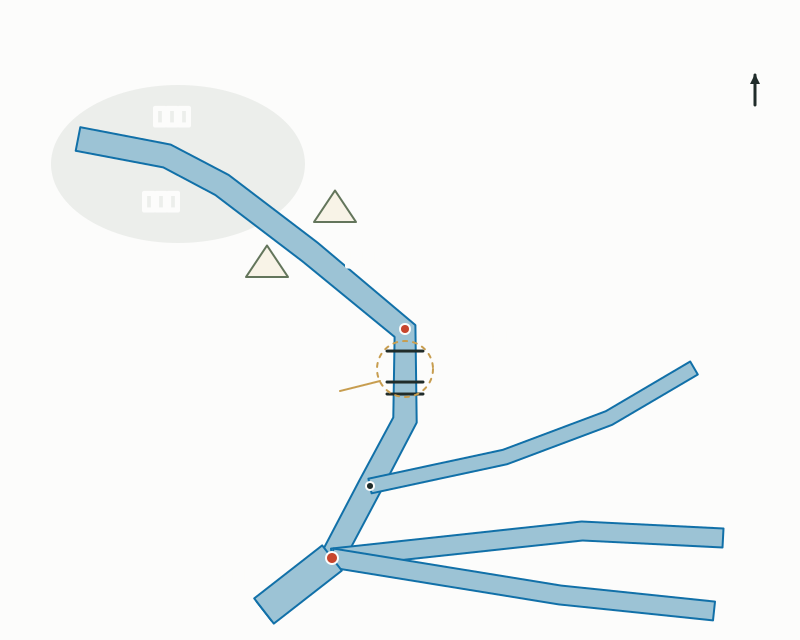
Main names for the Katsura River
| Name | Where and when it is used |
|---|---|
| Katsura River (桂川) | The name for the whole river, unified by the River Act of 1896 (Meiji 29) |
| Kadono River (葛野川) | Its name in ancient times |
| Ōi River (大堰川 / 大井川, Ōigawa) | Named after the Hata clan's great weir; used around Arashiyama and also locally in Kameoka |
| Hozu River (保津川) | The name for the stretch flowing through central Kameoka City; also known for boat rides down the Hozu Gorge |
| Kami-Katsura River (上桂川) / Chitose River (千歳川) | Names used in some places |
Where to See It Today: Arashiyama's Ichi-no-Iseki Weir
The ancient Kadono Ōi weir itself does not survive, but there is still a weir across the river at Arashiyama. The description of Arashiyama as a Historic Site and Place of Scenic Beauty names "Togetsukyō Bridge, the Ōi weir (Ichi-no-Iseki), and its embankment (the Fushihara embankment)" as famous features, and also praises the charm of boating down through the gorge from the Hozu River.
Ichi-no-Iseki was rebuilt into its present form in 1951 (Shōwa 26) to consolidate the more than ten weirs that had existed until then. It was originally a diagonal weir, but for maintenance and other reasons it became the current straight weir, and natural fieldstones were used out of consideration for the scenery. The view of the water pooled above the weir, the mountains, and the pleasure boats still remains.
The Hozu River Upstream, and What the River Carried
The Hozu River has not only watered the fields along its banks; when Nagaoka-kyō and Heian-kyō were built, it carried timber from the mountains of Tanba, and in the Edo period, after Suminokura Ryōi opened up the Hozu Gorge, it carried food and many other goods from Tanba to Kyoto.
During the construction of Heian-kyō, the Katsura River area, the Hata clan's home base, became a landing base for timber. Knowing the name Ōi River lets you see not only Arashiyama as a sightseeing spot but also the history of a land where people drew water to open up rice fields and carried goods by river.
Mini quiz for this entry
Check what you've read with 1 multiple-choice questions.
What gave rise to the name Ōi River for the Katsura River around Arashiyama?
Sources and verification
Content checked: October 11, 2026
Updated: October 11, 2026
References are in Japanese.