
Japanese角倉了以と京都の水運
Suminokura Ryoi and Kyoto's Water Transport
Other spellings and namesSuminokura Ryoi (角倉了以) / Takase River (高瀬川) / Oi River (大堰川) / Kyoto river transport
In short
Suminokura Ryōi was a merchant who, at the beginning of the Edo period, opened the Ōi River and the Takase River and created waterways for carrying goods to inland Kyoto. He is known as the man who turned rivers into part of the city's logistics network.Key points in 30 seconds
A wealthy Kyoto merchant who was also involved in overseas trade
Developed boat transport on the Ōi River
Opened the Takase River, linking the Fushimi area with the city center
A Waterborne Logistics Network Opened by a Merchant
The merchant Suminokura Ryōi opened the Ōi River and the Takase River to boats, making the transport of goods by boat much more active.
What the Takase River Carried
Suminokura Ryōi and his son Soan dug the Takase River and developed water transport between Kyoto and Fushimi.
From Trader to "the Man Who Opened Rivers"
Suminokura Ryōi (1554–1614) was active as a trader; in 1592 (Bunroku 1), for example, he sent trading ships to Annam (present-day Vietnam) with permission from Toyotomi Hideyoshi. In Japan he worked on river development and is known for opening the Ōi River and the Fuji River to boat traffic.
In 1606 (Keichō 11), Ryōi spent his own money to clear a channel from Seki to Saga, making it possible to carry large quantities of farm produce and other goods from Tanba by boat. A few years after this boat route on the Ōi River (Hozu River), he undertook the Takase River, which linked central Kyoto with Fushimi.
What Kind of Canal Was the Takase River?
The Takase River is a canal begun in 1611 (Keichō 16) and completed in 1614. In the early Edo period it was a waterway of about 10 kilometers that drew water from the Kamo River at the west end of Nijō Ōhashi Bridge, ran south along the west bank of the Kamo River, and flowed through Fushimi into the Uji River. Until then, goods from the Osaka area had been carried by boat up the Yodo River and unloaded at Toba, but once the Takase River was completed they could be carried by boat right into the center of the city.
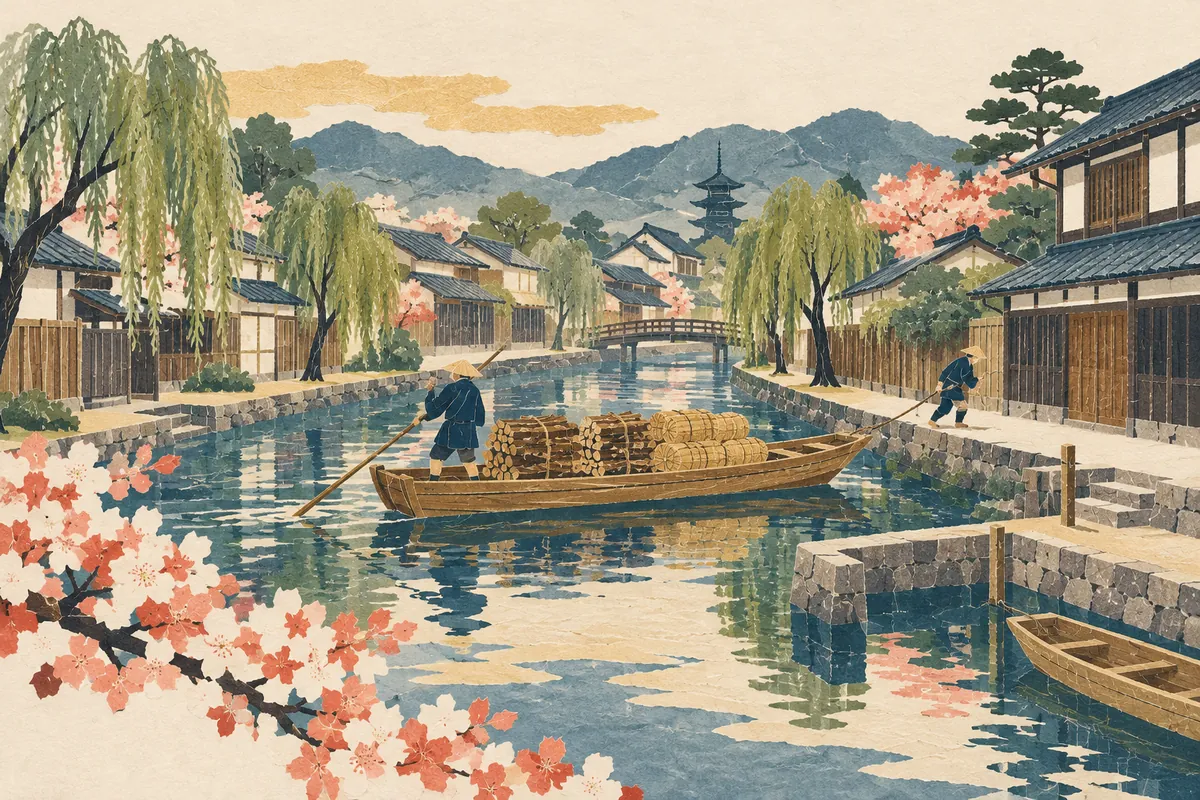
The name comes from the flat-bottomed takasebune boats used for transport. The boats averaged 13 meters long and about 2 meters wide; fully loaded, a boat heading up to Kyoto carried 15 koku (about 2.25 tons), and boats heading down carried half that. Around 1710 (Hōei 7), 188 boats plied between Fushimi and Nijō. Wholesalers and craftsmen gathered along the river, and town names arose from the goods they handled, such as Zaimoku-chō (timber), Kōri-chō (firewood), Ishiya-chō (stone), and Shioya-chō (salt).
Main goods carried by takasebune boats
| Direction | Main goods |
|---|---|
| Fushimi to Kyoto (upstream) | Firewood, timber, charcoal, rice, sake, soy sauce, luxury goods, seafood, and more |
| Kyoto to Fushimi (downstream) | Chests of drawers (tansu), storage chests (nagamochi), iron, manufactured goods, and more |
Walking to the Sites of the Funairi
The funairi of the Takase River were basins for loading and unloading cargo and turning boats around. When the river opened there were seven between Nijō and Shijō; by the end of the 17th century there were nine, and by the mid-18th century the number had fallen back to seven, which remained until the Meiji era. The only one whose shape survives today is the Ichi-no-Funairi ("First Funairi") on the west side of Kiyamachi-dōri just south of Nijō. It was designated a historic site in 1934 and is still a national historic site today.
Stone markers stand at the sites of the other funairi, and in 2009 markers for the fifth to ninth funairi were erected based on the period when there were nine. A little downstream from Oike-dōri remains a stone used to dam the water, which held boards to regulate the water level. Across Kiyamachi-dōri to the east of the Ichi-no-Funairi stands a stone marker for the site of Suminokura Ryōi's villa, and the graves of Ryōi and his son Soan are halfway up Mt. Ogura, behind the main hall of Nison-in temple in Saga.
The End of Boat Transport and the Takase River Today
After the Takase River was transferred to Kyoto Prefecture in 1869 (Meiji 2), it continued to be used to transport goods, but it lost its role with the opening of railways and other changes, and boat transport was abolished in 1920 (Taishō 9). In renovation work in 1932, the intake from the Kamo River was put underground, and the roughly 2.8-kilometer stretch from south of Jūjō to Takeda is called the Shin-Takase River (New Takase River) and follows a different course from the old one.
Today's Takase River is about 4.5 kilometers long. It takes its water from the Misosogi River near a point just downstream of Nijō Ōhashi Bridge and joins the Kamo River near a point just upstream of Jūjō-dōri; it is managed by Kyoto City. Besides goods, the takasebune also carried criminals being sent into exile and people going to Inari for the Hatsuuma pilgrimage, and Mori Ōgai's short story Takasebune depicts a conversation on one of the boats carrying such a criminal.
Mini quiz for this entry
Check what you've read with 2 multiple-choice questions.
Which merchant developed shipping in Edo-period Kyoto by opening the Oi and Takase rivers?
Which Kyoto merchant opened the Takase River in the early Edo period?
Sources and verification
Content checked: October 11, 2026
Updated: October 11, 2026
References are in Japanese.