
Japanese琵琶湖疏水と蹴上発電所
The Lake Biwa Canal and Keage Power Station
Other spellings and namesFirst Lake Biwa Canal / Keage Power Station / Kamogawa Canal / Tanabe Sakurō / Biwako Sosui
In short
Construction of the First Lake Biwa Canal began in 1885, and it was completed in 1890 by Tanabe Sakurō and his team. Keage Power Station, which uses the canal's water power, was completed in 1891 as Japan's first commercial hydroelectric power station; it powered factories and streetcars and supported Kyoto's modernization. The canal is still a source of Kyoto's tap water today.Key points in 30 seconds
Construction of the First Lake Biwa Canal began in 1885 and was completed in 1890
Civil engineer Tanabe Sakurō was in charge of construction
Keage Power Station, completed in 1891, was Japan's first commercial hydroelectric power station
With the completion of the Second Canal in 1912, it also became a source of water supply
Five years to bring Lake Biwa's water to Kyoto
Construction of the First Lake Biwa Canal began in 1885 (Meiji 18), and it was completed five years later in 1890. Tanabe Sakurō, fresh out of the Imperial College of Engineering, was hired as civil engineer and took charge of construction.
The canal was planned by Kitagaki Kunimichi, the third governor of Kyoto Prefecture, to revive Kyoto, whose industries had declined and whose population had fallen after the capital moved to Tokyo in 1869 (Meiji 2). The plan was to open boat transport linking Lake Biwa and the Uji River and to build up industry by also using the water for waterwheel power, irrigation, and firefighting. The budget was initially 600,000 yen, but it swelled to 1.25 million yen after the government called for more careful construction, and a special-purpose tax on citizens was also used to fund it.
The canal is regarded as Japan's first major civil engineering project carried out entirely by Japanese, from design to construction. Under Tanabe Sakurō, who was just 21 when hired, most materials other than dynamite and cement were produced locally, and the work proceeded by training engineers at night and putting their learning into practice during the day.
The difficult First Tunnel
The First Tunnel, which carries water from Ōtsu toward Kyoto, is 2,436 m long. It was a difficult project and the first in Japan to use the vertical shaft method.
This tunnel through Mount Nagara was then the longest in Japan, and many people doubted it would succeed. Besides digging from both sides of the mountain, workers dug a vertical hole (shaft) down from the top of the mountain and then tunneled out in both directions from it to speed up the work. When it broke through, those involved are said to have become convinced the project would succeed. The tunnel portals bear stone tablets with calligraphy by Itō Hirobumi, Yamagata Aritomo, Kitagaki Kunimichi, and others.
Keage Power Station: electricity from water power
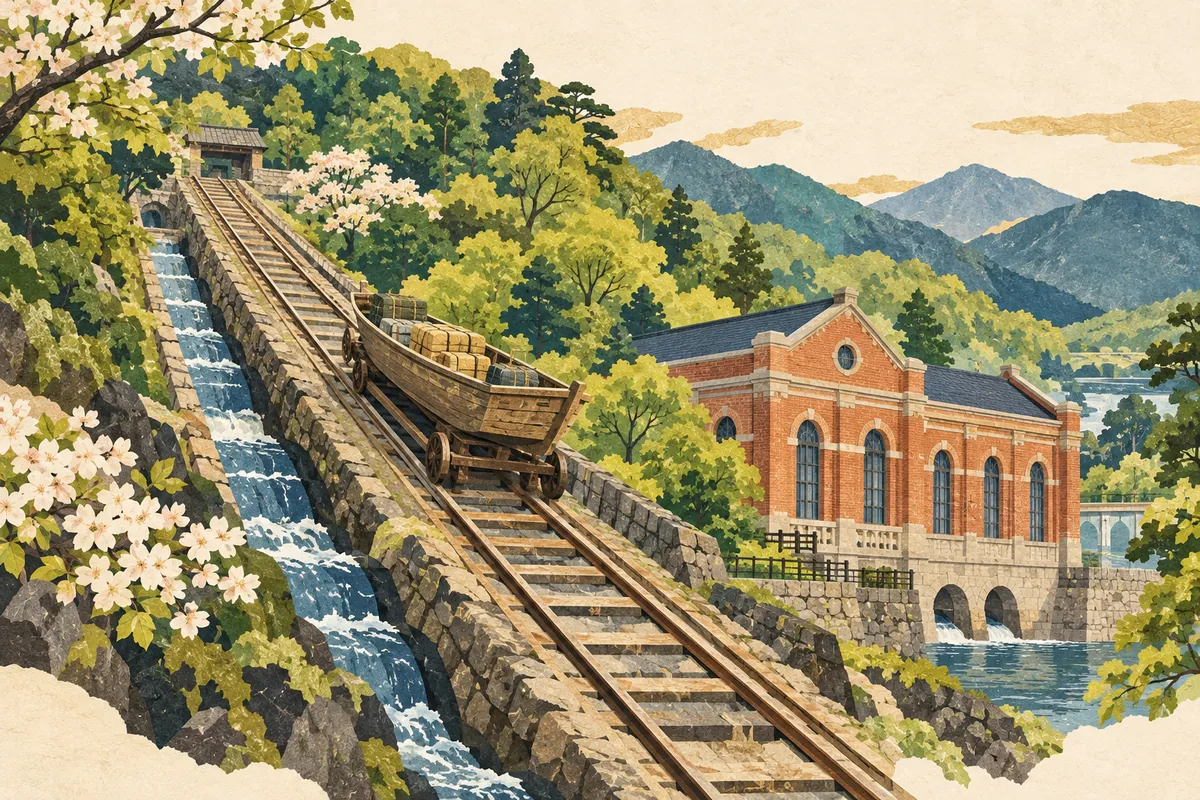
Keage Power Station, which uses the drop in the canal's elevation, was completed in 1891. It is known as Japan's first commercial hydroelectric power station, and the electricity it generated gave a boost to Kyoto's new industries and transportation, such as factories and electric railways.
Power generation was not part of the original plan. The biggest change to the plan came when Tanabe Sakurō and others traveled to the United States during construction to study ways of using the water, and decided to put hydroelectric power into practical use. Generation began in May 1891 (Meiji 24) with two Edison-type 80-kilowatt direct-current generators, and after repeated expansions the output reached 5,700 kilowatts in 1936 (Shōwa 11).
The electricity was used by new industries such as spinning, copper rolling, machinery, and tobacco, and in 1895 (Meiji 28) Japan's first streetcar ran from Kyoto Station to Fushimi. Ownership of the power station passed from the city to Kansai Electric Power in 1942 (Shōwa 17), and a stone monument on the grounds reads "Birthplace of the Hydroelectric Power Business."
The Lake Biwa Canal and Keage Power Station in numbers
| Item | Figure |
|---|---|
| Length of the First Tunnel | 2,436 m |
| Flow of the First Canal | 8.35 m³ per second |
| Drop of the Keage Incline | About 36 m |
| Keage Power Station's first generators | Two Edison-type 80 kW direct-current generators (1891) |
| Output of Keage Power Station | 5,700 kW (from 1936) |
| Flow and total length of the Second Canal | 15.3 m³ per second; about 7.4 km |
| Water sent from Lake Biwa | About 2 million m³ per day |
The Kamogawa Canal to Fushimi and the canal branch flowing north
The Lake Biwa Canal not only carried water into the city but also connected toward Fushimi. Construction of the Kamogawa Canal began in 1892, and it was completed in 1894. The canal served several purposes, including water transport, irrigation, firefighting, and power generation.
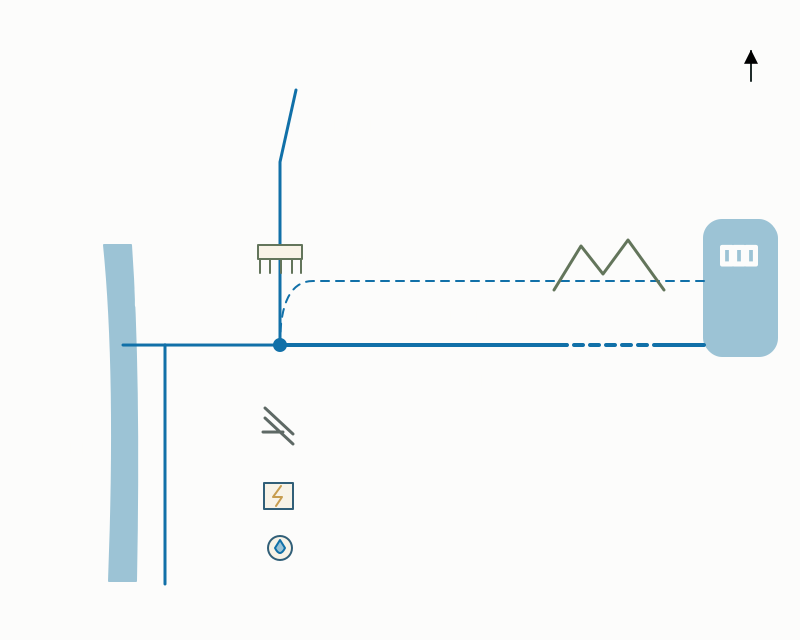
From Keage, the Canal Branch (Sosui Bunsen) split off and flowed north by way of Nanzen-ji, Nyakuōji, and the northeast of Mount Yoshida. When it was completed in 1890 (Meiji 23), having been started in 1887 (Meiji 20), it was about 8.4 km long, but it is now about 3.3 km. The Suirokaku aqueduct was built within the grounds of Nanzen-ji out of consideration for the surroundings along the route, which has many temples and shrines, and the walking path from Nyakuōji to Ginkakuji-michi is popular as the Philosopher's Path.
Route of the Lake Biwa Canal (schematic diagram)
The Second Canal and Kyoto's water supply
By the mid-1890s (the latter half of the Meiji 20s), the water volume of the First Canal could no longer meet the growing demand for electricity, and drinking water, which depended on groundwater, had also become a problem. Saigō Kikujirō, the second mayor of Kyoto City, pushed forward the "Three Great Projects": building the Second Canal, laying a water supply system, and widening roads and laying streetcar lines. Construction of the Second Canal began in 1908 (Meiji 41), and it was completed in 1912 (Meiji 45).
To protect the water source from pollution, the Second Canal was built entirely as tunnels and similar structures; it flows almost parallel to the north of the First Canal and joins it at Keage. The Keage Water Purification Plant, which began supplying water the same year, was the first in Japan to adopt rapid filtration. Even today, after power generation, water supply is said to account for a large share of the canal's water use.
Timeline and places to see today
The Keage Incline and the Nanzen-ji Suirokaku were designated national historic sites in 1996 (Heisei 8) as facilities of the First Lake Biwa Canal. The incline is an inclined railway that bridged the roughly 36 m drop from Keage toward the Kamo River, and it is now preserved in its original form. Walking along the canal from Keage to the Suirokaku and on to the Philosopher's Path lets you trace the remains of this great Meiji project in order. For an overview of the canal's history, there is also the Lake Biwa Canal Museum of Kyoto, which opened in 1989 (Heisei 1).
Main events in the history of the Lake Biwa Canal
| Year | Event |
|---|---|
| 1881 (Meiji 14) | Kitagaki Kunimichi takes office as governor of Kyoto Prefecture |
| 1885 (Meiji 18) | Permission to begin work is granted, and construction starts |
| 1890 (Meiji 23) | The First Canal (Ōtsu to the Kamo River confluence) and the Canal Branch are completed; completion ceremony held in April |
| 1891 (Meiji 24) | Keage Power Station completed in May |
| 1894 (Meiji 27) | Kamogawa Canal completed in September |
| 1895 (Meiji 28) | Kyoto Electric Railway's Fushimi Line opens |
| 1912 (Meiji 45) | Second Canal and Keage Water Purification Plant completed; city streetcars begin service |
| 1942 (Shōwa 17) | Electric power business contributed to Kansai Haiden |
| 1989 (Heisei 1) | Lake Biwa Canal Museum of Kyoto opens |
| 1996 (Heisei 8) | Twelve sites, including the Incline and Suirokaku, become national historic sites |
Mini quiz for this entry
Check what you've read with 3 multiple-choice questions.
Which of these events happened in 1890?
Which civil engineer was recruited for the Lake Biwa Canal project?
What output had Keage Power Station, which began generating in 1891, reached by 1936 (Shōwa 11) after repeated expansions?
Sources and verification
Content checked: October 11, 2026
Updated: October 11, 2026
References are in Japanese.