
Japanese京都三大祭とは
What Are Kyoto's Three Great Festivals?
Other spellings and namesAoi Matsuri / Gion Matsuri / Jidai Matsuri / Kyoto Sandai Matsuri
In short
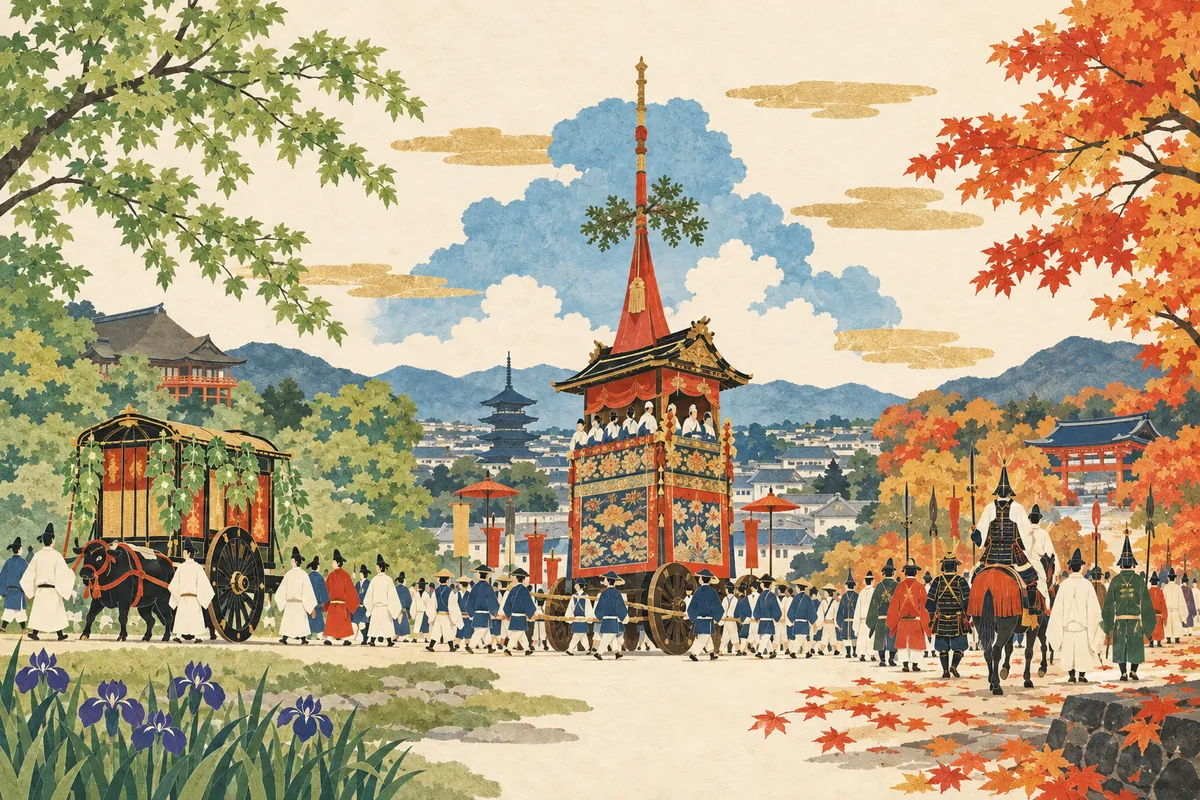
Kyoto's Three Great Festivals are the Aoi Matsuri in spring, the Gion Matsuri in summer, and the Jidai Matsuri in autumn. The Aoi Matsuri belongs to Shimogamo and Kamigamo shrines, the Gion Matsuri to Yasaka Shrine, and the Jidai Matsuri to Heian Shrine, and they differ in both the era they began and their character. The Gozan Okuribi in August is also one of Kyoto's signature events, but as a Buddhist observance for sending off ancestral spirits, it is not counted among the Three Great Festivals.Key points in 30 seconds
Aoi Matsuri: May 15, the annual festival of Shimogamo and Kamigamo shrines
Gion Matsuri: the whole month of July, the festival of Yasaka Shrine
Jidai Matsuri: October 22, the festival of Heian Shrine that began in 1895
Kyoto's eras reflected in three festivals
Kyoto's Three Great Festivals are the Aoi Matsuri, the Gion Matsuri, and the Jidai Matsuri. Add the Gozan Okuribi and they become Kyoto's Four Great Events.
Comparing the three festivals at a glance
The Three Great Festivals differ in their dates, the shrines that hold them, and the era in which they began. The differences are summarized in the table below. Dates are the usual ones, and arrangements for rain and times may change from year to year.
Comparing Kyoto's Three Great Festivals and the Gozan Okuribi (usual year)
| Event | Dates | Shrine / organizers | Origins | Highlights |
|---|---|---|---|---|
| Aoi Matsuri | May 15 | Annual festival of Shimogamo and Kamigamo shrines | Said to date to about 1,500 years ago, around the reign of Emperor Kinmei | Rotō no Gi, a procession of more than 500 people in Heian court dress |
| Gion Matsuri | July 1–31 | Festival of Yasaka Shrine | Said to begin with prayers to drive away an epidemic in 869 | Procession of 34 yamaboko floats across the Saki Matsuri and Ato Matsuri |
| Jidai Matsuri | October 22 | Grand festival of Heian Shrine | 1895 (Meiji 28) | Historical costume procession of about 2,000 people stretching about 2 km |
| (For reference) Gozan Okuribi | August 16 | Local people and temples at the foot of each mountain | A Buddhist observance sending off ancestral spirits at Obon | Fires in the shape of characters and figures are lit on five mountains |
Festivals of three eras: ancient, medieval, and modern
The Aoi Matsuri (also called the Kamo Matsuri) is said to have begun in 544, when poor harvests and epidemics were blamed on a curse of the Kamo deities and a festival with galloping horses was held. It is a chokusai, a festival attended by an imperial envoy, and in the Heian period it is said that the word "matsuri" alone referred to the Kamo Matsuri.
The yamaboko floats of the Gion Matsuri are said to have begun in 869, when 66 halberds were set up in prayer for an epidemic to end, and by the Muromachi period the floats had become the center of the festival. The events are run by neighborhood organizations called chōjū. The Jidai Matsuri, on the other hand, began in 1895 to celebrate the 1,100th anniversary of the move of the capital to Heian-kyō and the founding of Heian Shrine, and the procession is carried out by the Heian Kōsha, a citizens' organization.
A festival of the imperial court, a festival supported by townspeople, and a festival born from Meiji-era Kyoto's efforts to revitalize the city: lining up the three reveals the many layers of Kyoto's history.
Why isn't the Gozan Okuribi included?
The Gozan Okuribi is a traditional Buddhist observance that sends off ancestral spirits at Obon. Because its origins differ from those of the Three Great Festivals, which are shrine festivals, it is not counted among them; instead, the Three Great Festivals plus the Okuribi are sometimes called Kyoto's Four Great Events. All five Okuribi fires are Registered Intangible Folk Cultural Properties of Kyoto City.
The Gion Matsuri is also counted as one of Japan's Three Great Festivals, in addition to being one of Kyoto's Three Great Festivals. "Kyoto's Three Great Festivals" and "Japan's Three Great Festivals" are different groupings, so be careful not to confuse them.
If you go: rain and viewing seats
All three festivals center on outdoor processions, so checking the weather and where to watch is essential. Here are points to note before you go (as of October 2026).
- Aoi Matsuri: Postponed if it rains. The decision is made around 18:00 the day before. Paid viewing seats are available in two places: Kyoto Gyoen (the Imperial Palace grounds) and the approach to Shimogamo Shrine
- Gion Matsuri: The procession starts at Shijō Karasuma for the Saki Matsuri (17th) and at Karasuma Oike for the Ato Matsuri (24th). There are paid, all-reserved viewing seats on Oike-dōri
- Jidai Matsuri: Postponed if it rains. The decision is made early that morning. Watching the whole procession takes about two hours, and paid viewing seats are also available
Mini quiz for this entry
Check what you've read with 1 multiple-choice questions.
Which one is not one of Kyoto's Three Great Festivals?
Sources and verification
Content checked: October 11, 2026
Updated: October 11, 2026
References are in Japanese.