
Japanese葵祭の装束・道順・名前の由来
Aoi Matsuri: Costumes, Route, and the Origin of Its Name
Other spellings and namesAoi Festival / Kamo Festival (賀茂祭) / Roto no Gi procession
In short
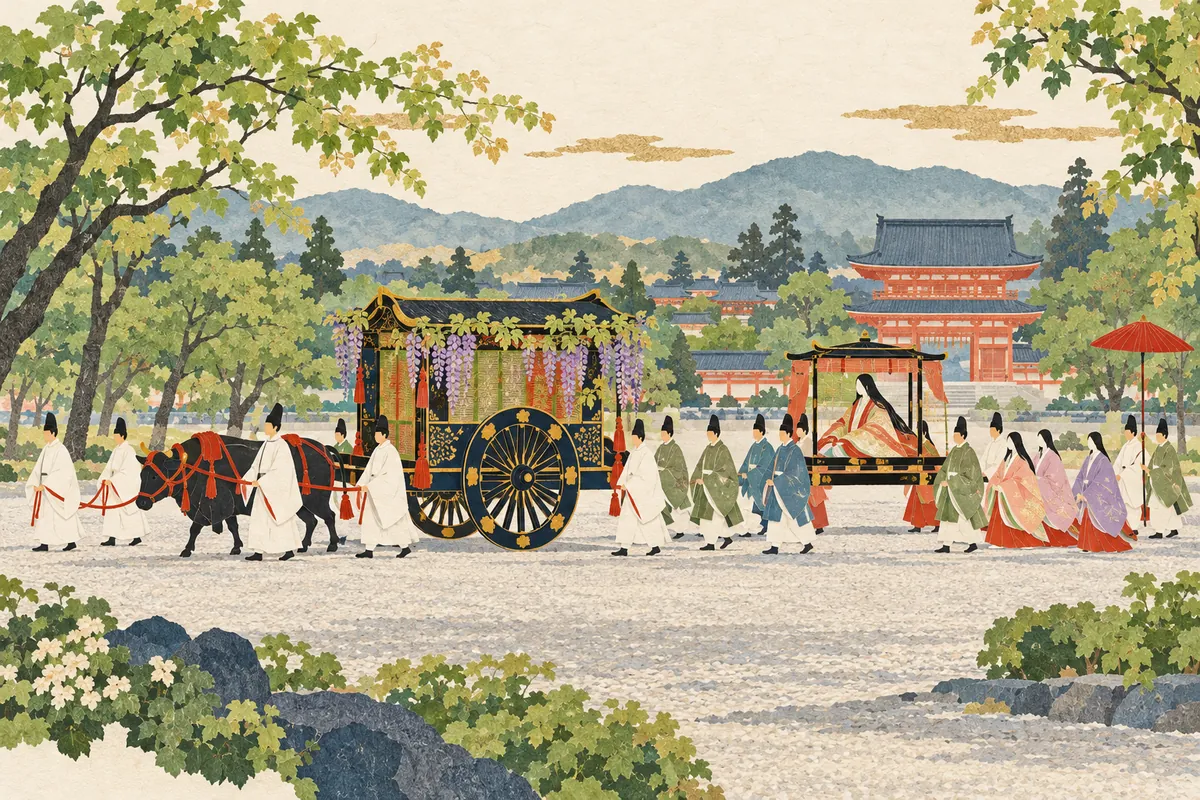
The Aoi Matsuri (Aoi Festival), held every year on May 15, is one of Kyoto's three great festivals and was originally called the Kamo Matsuri (Kamo Festival). Its name is said to come from decorating the bamboo blinds (misu), ox carriages, and more with futaba-aoi (two-leaved wild ginger), and the Rotō no Gi procession in Heian-period costume leaves the Kyoto Imperial Palace and travels about 8 kilometers via Shimogamo Shrine to Kamigamo Shrine.Key points in 30 seconds
The Rotō no Gi procession takes place every year on May 15
Originally called the Kamo Matsuri; the name is said to come from the futaba-aoi leaf decorations
About 8 km from the Kyoto Imperial Palace via Shimogamo Shrine to Kamigamo Shrine
A May 15 procession that heralds spring
The Rotō no Gi procession of the Aoi Matsuri takes place every year on May 15. It is known for its elegant procession in Heian-period costume.
The Aoi Matsuri is a major spring festival in Kyoto, held every year on May 15.
Aoi leaves and Heian costume
At the Aoi Matsuri you can see elegant costumes that look like something out of a Heian-period court picture scroll.
The name comes from decorating the bamboo blinds (misu), ox carriages, and the court dress of the procession with futaba-aoi.
The procession leaves the Kyoto Imperial Palace and heads for Kamigamo Shrine by way of Shimogamo Shrine.
It was originally called the Kamo Matsuri and is said to have come to be called the Aoi Matsuri in the Edo period.
In 819 the Aoi Matsuri became a state event ranked with the important regular rites of the ritsuryō legal system.
Famous in the mid-Heian period, the Aoi Matsuri appears in both The Tale of Genji and The Pillow Book.
The origins of the Aoi Matsuri are said to go back to the time of Emperor Kinmei, in the mid-6th century, about 1,500 years ago.
Where does the procession pass, and when?
The scheduled times for the Rotō no Gi are the times when the head of the procession passes. In the morning it leaves the Kyoto Imperial Palace and goes via Marutamachi-dōri and Kawaramachi-dōri to Shimogamo Shrine. After the ceremony at the shrine (Shatō no Gi), in the afternoon it passes along Shimogamo-hondōri and Kitaōji-dōri, then goes north along the Kamo River embankment to Kamigamo Shrine.
In case of rain the Aoi Matsuri is postponed, and whether it will go ahead is decided at around 18:00 the day before. Paid viewing seats are set up in two places: Kyoto Gyoen and the approach to Shimogamo Shrine. Times and seating arrangements may change from year to year, so check the information for the year you plan to go.
Scheduled times for the Rotō no Gi (when the head of the procession is expected to pass)
| Point | Scheduled time |
|---|---|
| Departure from the Kyoto Imperial Palace | 10:30 |
| Arrival at Shimogamo Shrine (shrine ceremony) | 11:40 |
| Departure from Shimogamo Shrine | 14:20 |
| In front of Rakuhoku High School | 14:40 |
| Kitaōji Bridge | 14:55 |
| Arrival at Kamigamo Shrine (shrine ceremony) | 15:30 |
Why is she called the Saiō-dai ("acting" Saiō)?
The figure who stands out most in the procession is the Saiō-dai. In the Heian period the Saiō (shrine priestess) was an imperial princess, but today she is chosen from among unmarried women of the city, so she is called the Saiō-dai, with dai meaning "acting" or "stand-in." Having completed her purification rite (misogi), the Saiō-dai rides in a palanquin (oyoyo) carried by attendants, dressed in formal itsutsuginu-mo-karaginu (jūnihitoe, the twelve-layered robe).
The procession of women centered on the Saiō-dai was revived in 1956 (Shōwa 31). Court ladies such as myōbu, nyoju, munanori-onna, and uneme follow one after another, forming the Saiō-dai procession, separate from the main procession centered on the imperial envoy.
There are events before May 15, too
The Aoi Matsuri does not end with the May 15 procession alone. Preliminary rites include the Kurabeuma Ashizoroe-shiki (horse-race trials) on May 1, the Yabusame Shinji (horseback archery) on May 3, and the Saiō-dai Nyonin-retsu Misogi Shinji (purification of the Saiō-dai and her ladies) on May 4. In the Yabusame Shinji, archers in hunting dress gallop along a riding ground of about 300 meters in Tadasu no Mori and shoot at three targets; it is regarded as a purification rite to pray for the safety of the procession.
Kamigamo Shrine and Shimogamo Shrine take turns, year by year, hosting the Saiō-dai's purification, and in 2026 (Reiwa 8) it was held at the Mitarashi Pond of Shimogamo Shrine. On May 12, the Mikage Matsuri is also held, when Shimogamo Shrine welcomes the divine spirit from Mikage Shrine at the foot of Mount Hiei. The Aoi Matsuri is a chokusai, a festival at which an imperial envoy (chokushi) serves on behalf of the emperor.
The Rotō no Gi procession numbers more than 500 people, 36 horses, and 4 oxen. The main procession includes the kebiishi (police officials), the kuranotsukai (envoy of the treasury), the yamashironotsukai (envoy of Yamashiro Province), the ox carriage (gosho-guruma), decorated parasols (furyū-gasa), and the Konoe-zukai-dai, who plays the role of the imperial envoy. If you attend the preliminary rites as well as watching the procession, you will see clearly that the Aoi Matsuri is the annual festival of both Shimogamo and Kamigamo shrines.
Mini quiz for this entry
Check what you've read with 3 multiple-choice questions.
On what date is the Aoi Matsuri procession held each year?
Which decoration gave Aoi Matsuri its present name?
Where does the Aoi Matsuri procession stop between Kyoto Imperial Palace and Kamigamo Shrine?
Sources and verification
Content checked: October 11, 2026
Updated: October 11, 2026
References are in Japanese.