
Japanese祇園祭の一か月と山鉾
The Gion Festival's Month and Its Yamahoko Floats
Other spellings and namesGion Matsuri / Gion Goryōe (祇園御霊会) / Yamahoko Junkō (float procession) / Yasaka Shrine
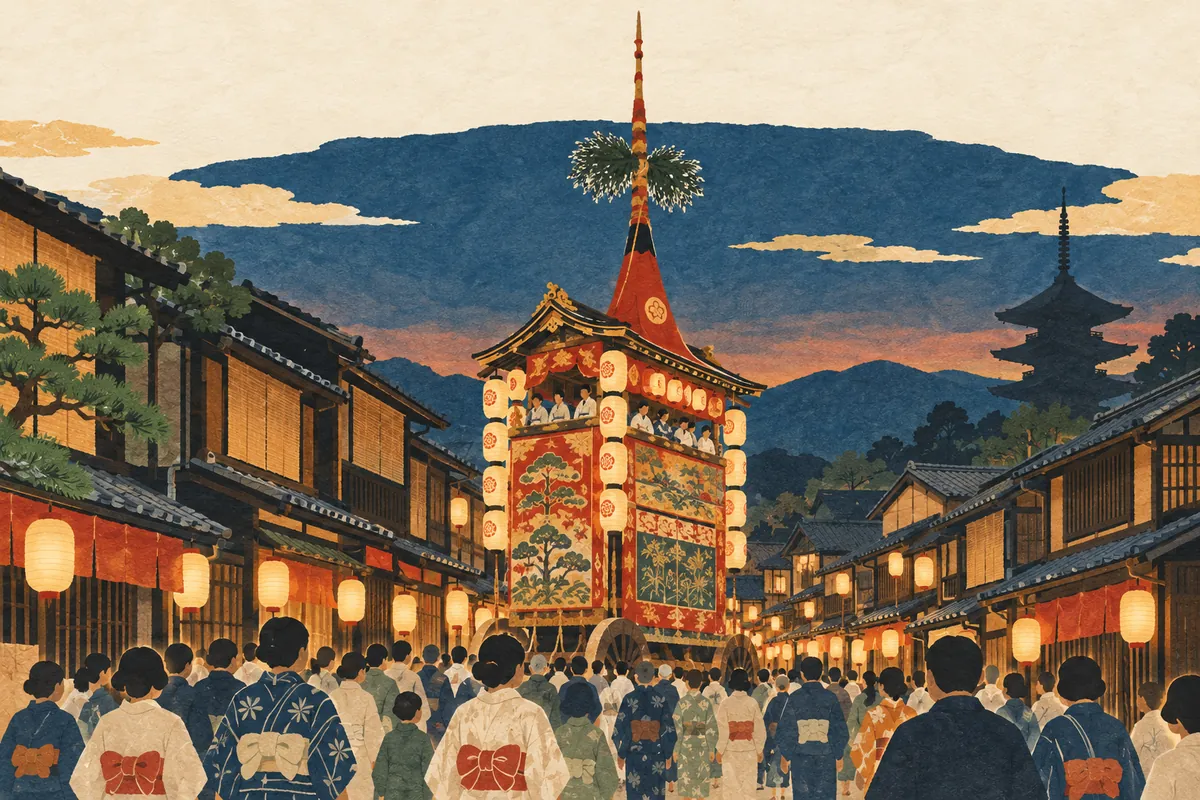
In short
The Gion Festival (Gion Matsuri) is the festival of Yasaka Shrine, with a wide variety of events continuing throughout the month of July. It began with prayers to drive away epidemics, and 34 yamahoko floats appear in the Yamahoko Junkō procession.Key points in 30 seconds
Festival events run from July 1 to 31
The festival of Yasaka Shrine
34 floats take part in the Yamahoko Junkō procession
A festival that lasts through a whole summer month
The Gion Festival runs from July 1 to 31, about a month in all.
The Gion Festival is the festival of Yasaka Shrine, with a wide variety of events throughout the month of July.
The Gion Festival, held in July, is the festival that represents summer in Kyoto.
The Gion Festival has its origins in a goryōe, a rite to pacify the epidemics that swept the capital.
The Gion Festival continues from the Kippu-iri on July 1 to the Ekijinja Nagoshi-sai on July 31.
The yamahoko are the town's art museums
Counting the Saki Matsuri (first procession) and Ato Matsuri (second procession) together, 34 gorgeous yamahoko floats parade through the city.
The yamahoko began with 66 halberds
The yamahoko are said to have begun in 869, when 66 halberds (hoko) about two jō (about 6 meters) long were set up to pray for the end of an epidemic then spreading. A little over 100 years later, tsukuriyama (decorated artificial mountains), said to be the origin of today's yama floats, are said to have joined the procession.
The yamahoko took on their present form around the Nanboku-chō period, and in the Muromachi period they became the center of the festival. At their peak the yamahoko numbered 58, and the largest hoko weighs about 12 tons. The yamahoko events are an Important Intangible Folk Cultural Property of Japan and are also inscribed on UNESCO's Intangible Cultural Heritage list.
The yamahoko events are supported by the "chō"
The "Yamahoko Events of the Kyoto Gion Festival" were designated an Important Intangible Folk Cultural Property of Japan on February 3, 1979 (Shōwa 54). They were inscribed on UNESCO's Intangible Cultural Heritage list in 2009, and since 2016 they have been listed as one of the "Yama, Hoko, Yatai, float festivals" of Japan.
From around the end of the 16th century, the yamahoko came to be lavishly decorated with woven hangings, ornamental metal fittings (kazari kanagu), carvings, and more. The events—from the lottery that decides the order of the procession, through the assembly of the yama and hoko and the Yoiyama, to the procession itself—are run by neighborhood organizations called chōjū (町中). The preservation body is the Gion Matsuri Yamahoko Rengōkai (Gion Festival Yamahoko Association), a public interest incorporated foundation.
Main events in July
The Gion Festival continues from the Kippu-iri on July 1 to the Ekijinja Nagoshi-sai on July 31. The table summarizes the usual schedule. The sequence from assembling the yamahoko through the Yoiyama to the procession is repeated twice, for the Saki Matsuri and the Ato Matsuri, and on the procession days Yasaka Shrine also holds the Shinkōsai (17th) and Kankōsai (24th), when the deities travel out and return. Times and viewing conditions for each event change from year to year, so check the official information for the year you go.
Main events of the Gion Festival (usual schedule)
| Date | Event |
|---|---|
| July 1 | Kippu-iri (start of the festival) |
| July 10–14 | Assembly of the yama and hoko for the Saki Matsuri, and hikizome (trial pulling) |
| July 14–16 | Saki Matsuri Yoiyama (folding-screen displays and more) |
| July 17 | Saki Matsuri yamahoko procession; Shinkōsai |
| July 18–21 | Assembly of the yama and hoko for the Ato Matsuri, and hikizome |
| July 21–23 | Ato Matsuri Yoiyama |
| July 24 | Ato Matsuri yamahoko procession; Kankōsai |
| July 31 | Ekijinja Nagoshi-sai (close of the festival) |
The difference between the Saki Matsuri and Ato Matsuri
The yamahoko procession is divided into two: the Saki Matsuri on the 17th and the Ato Matsuri on the 24th. In 1966 the two were combined into a single procession on the 17th, but the Ato Matsuri on the 24th was revived in 2014. The procession starts at Shijō-Karasuma for the Saki Matsuri and at Karasuma-Oike for the Ato Matsuri.
Highlights of the procession are the kuji-aratame (checking of the lottery order) and the tsuji-mawashi (turning the floats at intersections). Paid viewing seats, all reserved, are set up along Oike-dōri. There are 34 yamahoko in total for the Saki Matsuri and Ato Matsuri combined (as of October 2026). Note that some sources give the number as 33.
Mini quiz for this entry
Check what you've read with 3 multiple-choice questions.
During which month do the many events of Gion Matsuri take place?
Gion Matsuri is the festival of which shrine?
How many yama and hoko floats appear across Gion Matsuri's processions?
Sources and verification
Content checked: October 11, 2026
Updated: October 11, 2026
References are in Japanese.