
Japanese五山送り火の夜
The Night of the Gozan no Okuribi
Other spellings and namesDaimonji Okuribi (大文字送り火) / Kyoto Gozan Okuribi / Daimonji bonfire, August 16
In short
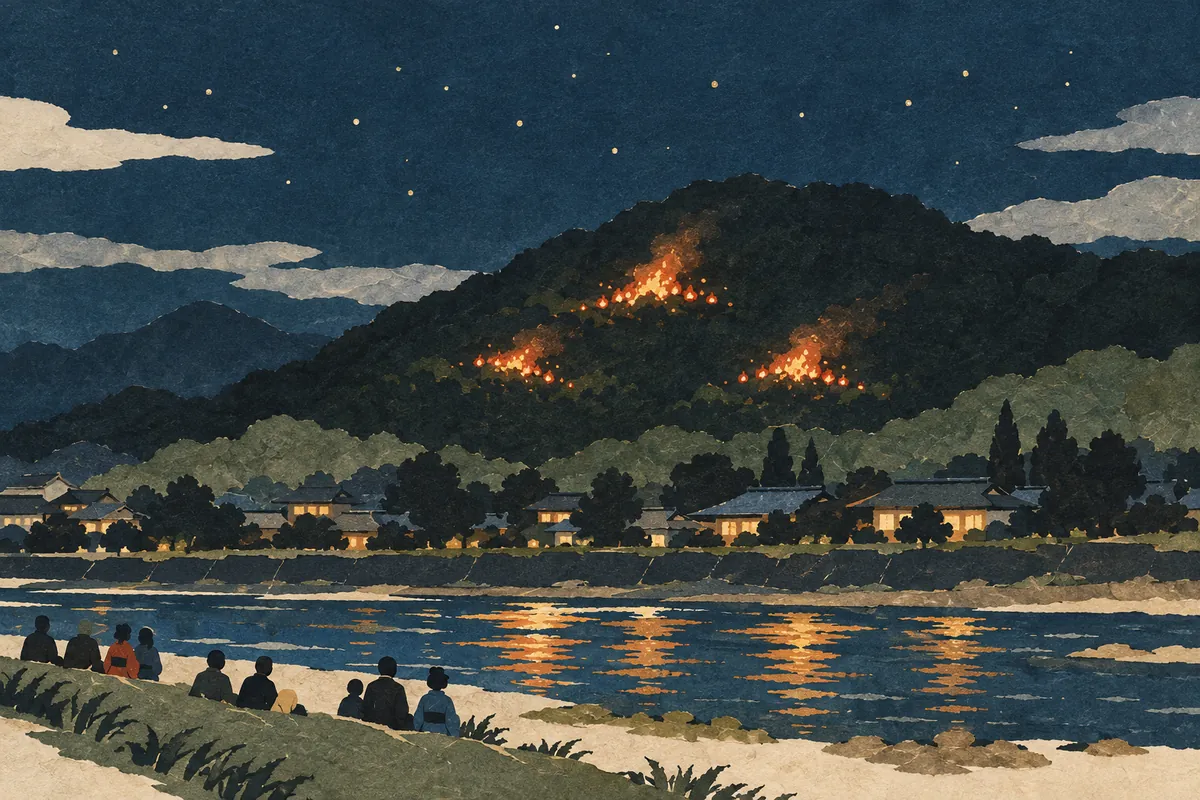
The Gozan no Okuribi (Five Mountain Send-off Fires) is an event on the night of August 16 in which five characters and shapes are lit in fire on the mountains surrounding Kyoto. It is handed down as a summer milestone in Kyoto, sending off the ancestral spirits (shōryō) welcomed home during Obon.Key points in 30 seconds
Held every year on August 16
Five characters and shapes are drawn in fire
A separate event from Kyoto's three great festivals
Lighting fires on the mountains to send off the spirits
On the night of August 16, fires in the form of characters such as 大 (dai, "great") and other shapes are lit on the mountains surrounding Kyoto.
The Gozan no Okuribi is held every year on August 16.
The Gozan no Okuribi is held every year on August 16. It is a Buddhist event to send off the spirits of the dead.
Five fires are lit: the Daimonji, Hidari Daimonji, Myōhō, Funagata, and Toriigata.
Which mountain, and what time?
The okuribi begin with the Daimonji at 8:00 p.m., followed at five-minute intervals by the Myōhō, Funagata, Hidari Daimonji, and Toriigata, in that order. Each fire burns for about 30 minutes. The fires link up as if tracing the mountains surrounding the Kyoto Basin counterclockwise, from the Higashiyama (eastern) mountains to the Kitayama (northern) and Nishiyama (western) mountains.
All five okuribi are Registered Intangible Folk Cultural Properties of Kyoto City, preserved and handed down by the people and temples of the communities at their foot. For example, at the Daimonji, the head priest of Daimonji-dera (Jōdo-in) and members of the preservation society chant the Heart Sutra; at the Hidari Daimonji, the fire from a lighting ceremony at Hōon-ji is carried up to the fire beds on the mountaintop; and at the Funagata, Rokusai Nenbutsu (a Buddhist chanting and dance performance) is held at Saihō-ji after the fire.
At the Daimonji there is also a belief that if you write your name and illness on a gomagi (prayer stick) and have it burned, the illness will be healed. Gomagi are accepted in the grounds of Hachi Shrine, beyond Ginkaku-ji, in front of the preservation society's meeting hall.
Locations and lighting order of the Gozan no Okuribi
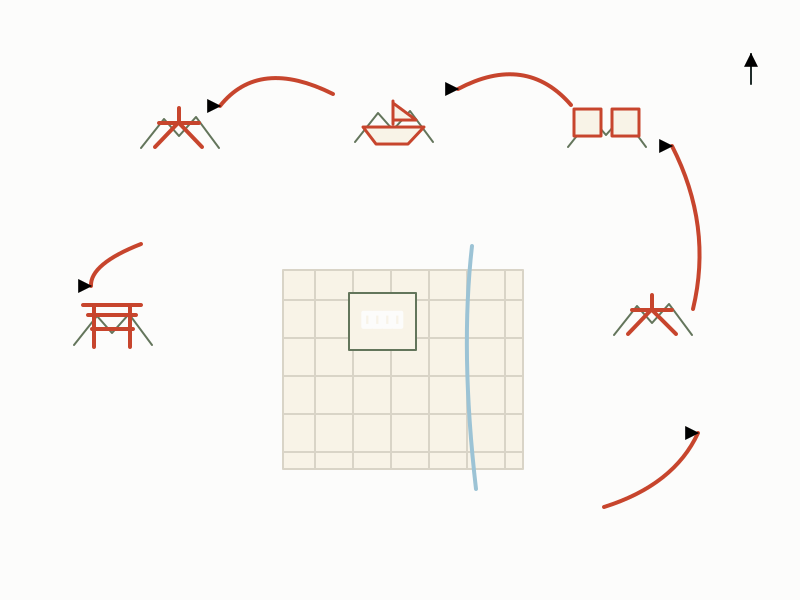
Lighting times and locations of the Gozan no Okuribi (every year on August 16)
| Okuribi | Lighting time | Mountain / location |
|---|---|---|
| Daimonji (大文字) | 20:00 | Higashiyama: Nyoigatake (Mount Daimonji) |
| Myōhō (妙法) | 20:05 | Matsugasaki: Nishiyama (Mantōrōyama) and Higashiyama (Daikokutenyama) |
| Funagata (船形, "boat shape") | 20:10 | Nishigamo: Funayama |
| Hidari Daimonji (左大文字, "left Daimonji") | 20:15 | Ōkitayama: Mount Daimonji |
| Toriigata (鳥居形, "torii shape") | 20:20 | Saga-Toriimoto: Mandarayama |
Once there were more than five
It is said that until the early Meiji period, okuribi were lit not just on five mountains but on about ten. They can no longer be seen, but there were reportedly also okuribi in the shapes of 一 ("one"), い (the kana i), a bell at the tip of a bamboo pole, a snake, and a naginata (halberd).
Calling the Gozan no Okuribi "Daimonji-yaki" ("Daimonji burning") is a serious mistake. The okuribi are a traditional event for sending off the spirits of Obon, so it is important to call them by a name that fits the event's meaning. As for which direction the Daimonji faces, there are said to be various theories, such as that the Ashikaga family chose a position with a good view, and some things about its origins remain unknown.
Things to keep in mind if you go to see them
Well-known viewing spots include: for the Daimonji, along the Kamo River from Marutamachi Bridge to around Misono Bridge, and Kyoto Gyoen; for the 妙 (Myō), around Kyoto Notre Dame University on Kitayama-dōri; for the 法 (Hō), along the Takano River upstream of Demachiyanagi; for the Funagata, along the Kamo River from Kitayama Ōhashi Bridge to around Nishigamo Bridge; for the Hidari Daimonji, along Nishiōji-dōri between Enmachi and Kinkaku-ji; and for the Toriigata, around Togetsukyō and Hirosawa Pond. It is difficult to see all of them from one place, so you choose your spot according to which okuribi you want to see.
Climbing the mountains is prohibited on the day. In Kyoto City (except Yamashina and Fushimi wards), people are asked to cooperate by temporarily turning off neon signs and outdoor lights from 19:50 to 20:50. Riverbanks are dark underfoot at night, and access may be restricted if the water rises, so take particular care if you watch from beside the river.
Mini quiz for this entry
Check what you've read with 3 multiple-choice questions.
What is lit on the mountains during Gozan Okuribi?
In which month is Gozan Okuribi held?
When is Kyoto's Gozan Okuribi held?
Sources and verification
Content checked: October 11, 2026
Updated: October 11, 2026
References are in Japanese.