
Japanese地蔵盆(じぞうぼん)
Jizo-bon
Other spellings and namesJizō-bon / Jizobon / Kyoto Jizō-bon / Jizō-e / 地蔵盆
In short
Jizō-bon is a neighborhood event that honors the local Jizō statue and prays for children's healthy growth and the safety of the neighborhood. In Kyoto it has been handed down as a summer event organized by each neighborhood, mainly on the weekend closest to August 24, the holy day (ennichi) of the bodhisattva Jizō.Key points in 30 seconds
Many neighborhoods hold it on the weekend near August 24, Jizō's holy day
Prays for neighborhood safety and children's healthy growth
Activities and how to take part differ from neighborhood to neighborhood
Selected by Kyoto City as one of its "Intangible Cultural Heritage Connecting Kyoto" (Kyōto o Tsunagu Mukei Bunka Isan)
Children's end of summer, gathered around the Jizō
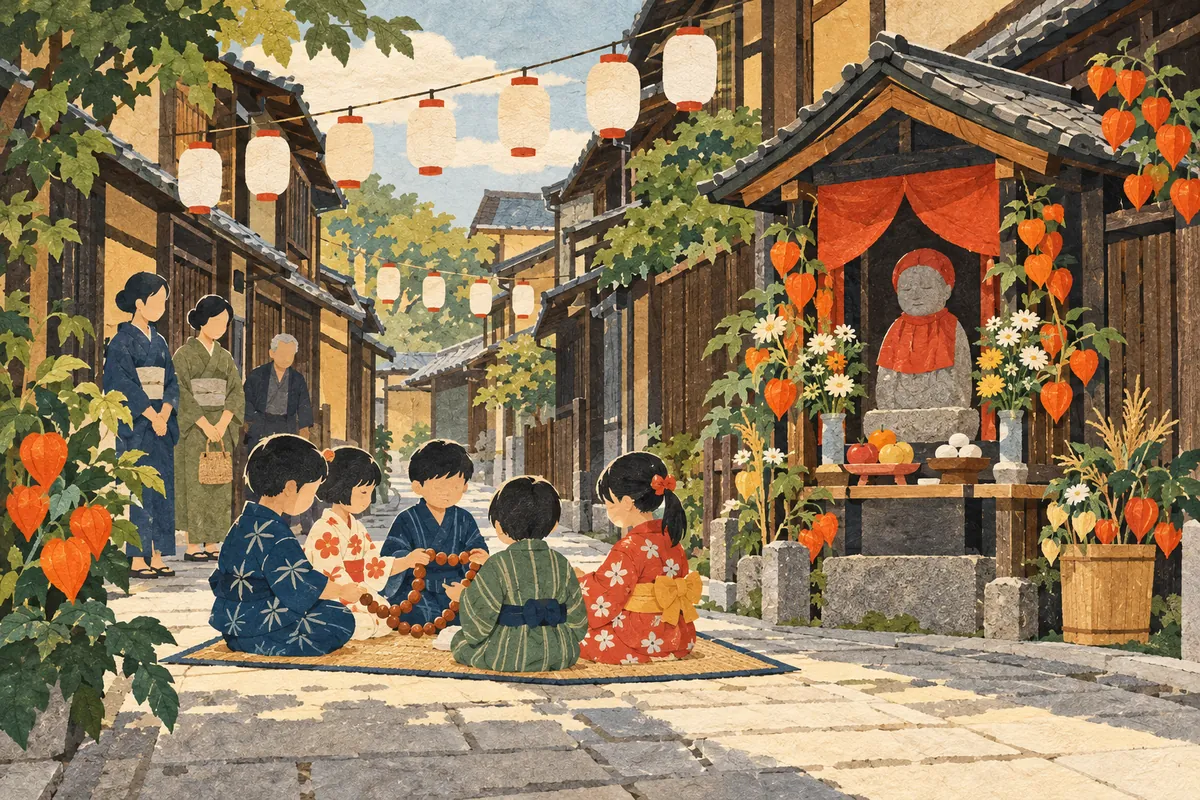
Neighbors decorate their local Jizō statue beautifully and hold activities such as juzu-mawashi (passing around a giant rosary), sutra chanting, games, and handing out sweets. Though it has a religious background, today it also plays a large role as an occasion for children and local residents to meet face to face.
Kyoto City has selected "Kyoto's Jizō-bon: A Traditional Community Event Connecting Neighborhoods and Generations" as one of its "Intangible Cultural Heritage Connecting Kyoto." For children, Jizō-bon has become the event that closes their summer vacation, and because adults also help prepare and run it, it has become a place for people of many generations to interact.
The activities, dates, and who can take part vary by neighborhood. If you would like to join, check the information from your neighborhood association or on its notice board.
Why around August 24?
Jizō-bon is held mainly on the day before Jizō's holy day (the 24th day of the 7th month in the old lunar calendar, or August 24 in the modern calendar), but these days many neighborhoods hold it on the nearest weekend to suit participants' schedules. In neighborhoods that enshrine Tendō Dainichi Nyorai, some hold Dainichi-bon centered on that deity's holy day, August 28.
In the past some neighborhoods spent two days or more on it, but because there are fewer children and it is harder for adults to find time, most are now said to finish in a single day. In a 2023 survey, about 90% of responding neighborhoods held it on the weekend closest to August 24 (August 19–20).
Why is it so popular in Kyoto?
In Kyoto, self-government by neighborhood, such as ryōgawa-chō neighborhoods formed by houses facing each other across a street, has continued for a long time. It is thought that, together with the wish to protect the neighborhood from fire and disaster, the familiar Jizō statue became something the community relied on.
Two reasons are given for why each neighborhood enshrines a Jizō: in fire-prone Kyoto, fire-warding Jizō statues were placed at crossroads, and Jizō statues were enshrined beside the wooden neighborhood gates that were closed at night, to keep evil from entering. The availability of granite suited for stone statues in the upper reaches of the Shirakawa is also thought to have helped.
As the city spread in the Edo period and self-government by neighborhood took root, Jizō festivals known as Jizō-matsuri or Jizō-e became major neighborhood events. The name Jizō-bon is said to have come into use after the Meiji era began. During the anti-Buddhist movement (haibutsu kishaku) of the early Meiji era, many roadside Jizō statues were removed, but from the mid-Meiji era onward they were dug up from the ground and elsewhere, and Jizō-bon was revived.
What happens at Jizō-bon?
As Jizō-bon approaches, neighborhood residents take the Jizō out of its small shrine, give it a fresh coat of paint known as okeshō ("putting on makeup"), and dress it in a new bib. The altar is decorated with flowers and offerings, often including hōzuki (Chinese lantern plants). Neighborhoods without their own Jizō often borrow one from a temple or use a Buddhist painting instead.
Around the venue, there may be lanterns made with a child's name written on them when the child is born. The event begins with a priest chanting sutras, and in some neighborhoods children sit in a circle and pass around a huge rosary 2 to 3 m in diameter, which is called juzu-mawashi.
- Okeshō (repainting) and decorating the Jizō
- Sutra chanting and juzu-mawashi
- Handing out sweets, sharing home cooking, game contests, and suika-wari (watermelon splitting)
- A prize lottery (some neighborhoods do fugo-oroshi (畚おろし), lowering prizes in a basket from a second-floor window)
Jizō-bon today, and how to take part
In a fiscal 2013 (Heisei 25) survey, about 80% of all responding neighborhoods held Jizō-bon (including Dainichi-bon and similar events) that year. At the same time, a growing number of neighborhoods are simplifying or discontinuing the event because of fewer children and changing lifestyles.
During the COVID-19 pandemic, many neighborhoods canceled it. In surveys of neighborhoods, the share answering "we will hold it" went from 51% in 2020 to 44% in 2021 and 68% in 2022, and in 2023 91% answered "we will hold it / held it." However, the survey targets differed from year to year, so the figures cannot be compared directly.
Even in neighborhoods with few children, there are examples of reviving Jizō-bon by reaching out to nearby apartment buildings, and of holding it at a school-district community hall to welcome children from areas where Jizō-bon cannot be held. People who have just moved in should start by checking the information from the neighborhood association or on its notice board.
Share of neighborhoods answering that they would hold Jizō-bon
- 2020
- 2021
- 2022
- 2023
Mini quiz for this entry
Check what you've read with 3 multiple-choice questions.
What do Kyoto neighborhoods traditionally pray for at Jizō-bon?
What is it called when, as Jizō-bon approaches, neighborhood residents give their Jizō statue a fresh coat of paint?
Around which date is Jizō-bon especially common in Kyoto?
Sources and verification
Content checked: October 11, 2026
Updated: October 11, 2026
References are in Japanese.