
Japanese火迺要慎(ひのようじん)のお札
Hi-no-yojin Fire-Prevention Charm (火迺要慎)
Other spellings and namesHi-no-yōjin / Hinoyōjin talisman / Atago-san charm / Atago Shrine charm / Sennichi-mairi / 火迺要慎 / 火廼要慎
In short
Hi-no-yōjin (火迺要慎) is a charm against fire, issued by Atago Shrine on the summit of Mount Atago, the highest peak in Kyoto City. In Kyoto it is customary to post it in the kitchen or near the cooking stove (okudo-san) to ward off fire, and visiting during Sennichi-mairi, from the night of July 31 to the early morning of August 1 each year, is said to bring a thousand days' worth of blessings.Key points in 30 seconds
Atago Shrine's charm against fire, regarded as the very symbol of Atago-san
Posted in the kitchen or near the okudo-san stove to ward off fire
Sennichi-mairi runs from the night of July 31 to early August 1; in 2026 the festival period began on July 23
Tradition says a child who visits by age three will be spared from fire for life
What kind of charm is Hi-no-yōjin?
Hi-no-yōjin (火迺要慎, read hi-no-yōjin) is Atago Shrine's charm, said to be highly effective against fire and called the very symbol of Atago-san. The character 迺 is read no, and the phrase carries the meaning "fire demands caution." It is also a teaching and a warning from earlier generations, who lived without forgetting their awe of fire.
The Hi-no-yōjin charm comes in a large size (about 53 cm tall) and a small size (about 39 cm tall). Atago Shrine is the head shrine of about 900 Atago shrines across Japan, and it stands on the summit of Mount Atago, which at 924 m is the highest peak in Kyoto City.
The custom of posting it in the kitchen
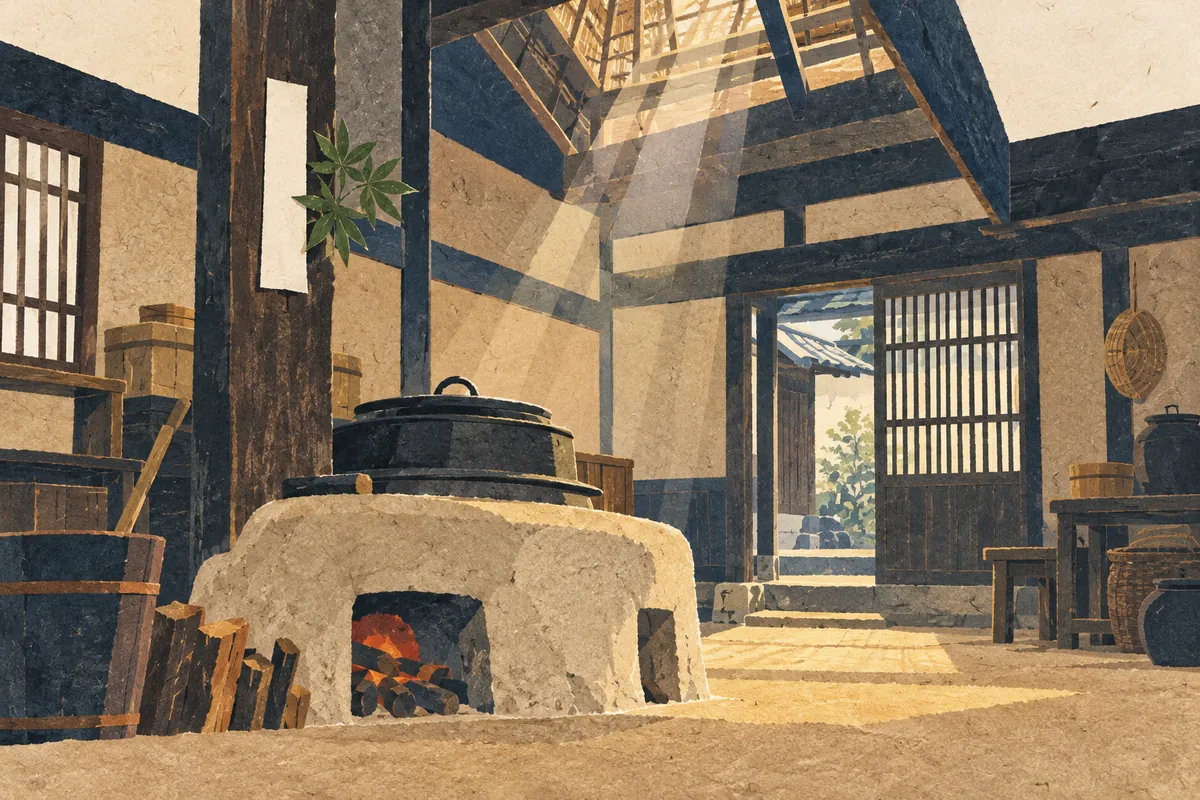
People who visit Mount Atago take the Hi-no-yōjin talisman home and post it in their kitchen to ward off fire. The custom of putting the talisman near the cooking stove (okudo-san in Kyoto dialect) has not changed from the past to the present.
There is also a custom involving shikimi (Japanese star anise). In the past, when each household lit the stove first thing in the morning, they would throw one shikimi leaf brought back from Atago-san into the fire and pray for the family's safety that day and for protection from fire. Now that kitchens have changed, people are said to enshrine shikimi together with the charm instead. Shikimi is given out in bundles of five sprigs.
Atago-san and faith in protection from fire
Shrine tradition says that in the Taihō era (701–704) En no Gyōja and Taichō built a shrine on Mount Atago with the court's permission. In the age when Shinto and Buddhism were combined, it flourished as the temple Hakuun-ji, and its main hall enshrined Shōgun Jizō. With the separation of Shinto and Buddhism in the early Meiji era, Hakuun-ji was abolished and the site became Atago Shrine.
Early modern Kyoto recorded three great fires, in the Hōei, Kyōhō, and Tenmei eras, and people earnestly prayed for protection from fire. In the early modern period, mountain ascetics (shugenja) are thought to have spread this faith from house to house, and the practice of bringing talismans and shikimi down from the mountain to every household spread. Even today, in many parts of Kyoto, volunteer fire brigades reportedly continue to hand out talismans received on the mountain to households in their district.
A thousand days of blessings: Sennichi-mairi
Sennichi-mairi, formally called Sennichi Tsuya-sai, is said to bring a thousand days' worth of blessings against fire to those who visit from the night of July 31 to the early morning of August 1. Tens of thousands of people make the pilgrimage every year, and the main approach of about 4 km, from Kiyotaki at the foot of the mountain to the summit, stays lit until the next morning.
In 2026, the festival period ran from the morning of July 23 to the early morning of August 1. Overnight visits were possible only from the evening of July 31 to the early morning of August 1; on other days, charms were not given out and the shrine did not receive visitors at night or in the early morning. Dates may change from year to year, so check the official information each year.
Sennichi-mairi schedule for 2026 (Reiwa 8)
| Date and time | Event |
|---|---|
| July 23, 9 a.m. | Opening ceremony of the ten-day Sennichi festival |
| July 23–30, 9 a.m.–4 p.m. | Charms (shinpu) given out, prayers, goshuin stamps |
| July 31, 9 p.m. | Sennichi Tsuya-sai evening offering ceremony |
| July 31, 8 a.m. until early next morning | Charms given out and more; from evening, the shrine and approach are lit and visitors can climb all night |
| August 1, 2 a.m. | Sennichi Tsuya-sai morning offering ceremony and fire-quelling rite |
If you visit by age three
Tradition says that a child who visits by the age of three will be spared from fire for life, so many visitors come to Sennichi-mairi with children.
Sennichi-mairi is also said to have begun in an era when people could not freely climb to the summit to worship. On the mountain path, people call out to each other to acknowledge the effort: "o-nobori-yasu" (おのぼりやす, "on your way up") to those climbing and "o-kudari-yasu" (おくだりやす, "on your way down") to those descending.
Getting a charm, and returning old ones
There is no road for driving up to the shrine, so visitors walk from one of the trailheads. From Kiyotaki, on the main approach, it takes about two to three hours on foot, and visitors are urged to carry a flashlight on the night of Sennichi-mairi. People who cannot safely make the climb, for physical or other reasons, can apply by phone in advance to receive charms and amulets by mail.
Old charms that have protected you for a year should be returned to the shrine with gratitude; if you cannot visit, you are advised to return them to your local guardian shrine. Replacing the charm in your kitchen every year may also serve as a yearly reminder to be careful with fire.
Mini quiz for this entry
Check what you've read with 2 multiple-choice questions.
What do volunteer fire brigades in many parts of Kyoto do with the Hi-no-yōjin (火迺要慎) fire-prevention charms from Atago Shrine?
At Atago Shrine's Sennichi-mairi, children up to what age are said to be protected from fire for life if they make the pilgrimage?
Sources and verification
Content checked: October 11, 2026
Updated: October 11, 2026
References are in Japanese.