
Japaneseおくどさん
Okudosan
Other spellings and namesOkudo (kamado stove) / Kudo / おくど(竈)
In short
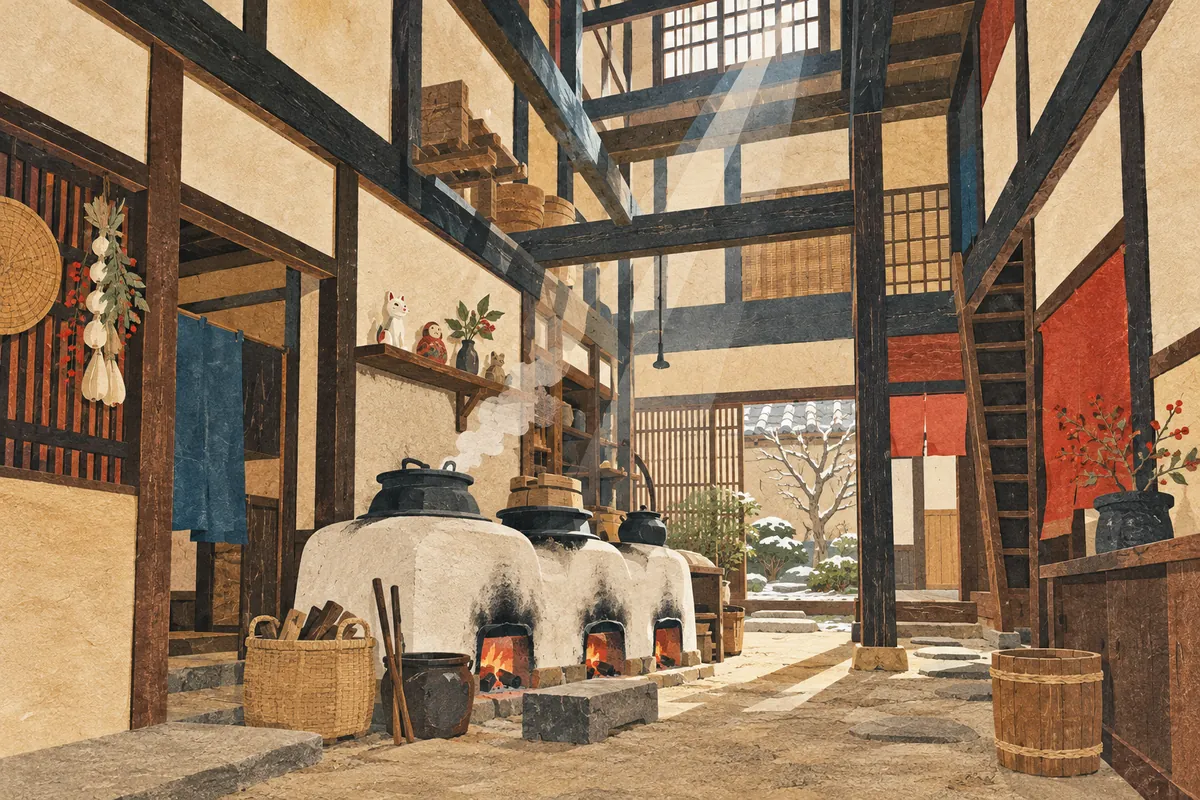
Okudosan (おくどさん) is the Kyō-kotoba (Kyoto dialect) word for a kamado, the stove used to cook rice and other dishes. In a Kyoto machiya townhouse, it stands on the earthen floor midway along or toward the back of the tōri-niwa passage, and above it is an open void called the hibukuro, for fire prevention and smoke ventilation. It has been closely tied to household customs, such as the Hotei figures on the kōjin-dana shelf above it and the kagami-mochi offered at New Year.Key points in 30 seconds
A Kyō-kotoba word for a kamado cooking stove
Set on the earthen floor of the tōri-niwa passage in a Kyoto machiya
Above it is an open void called the hibukuro
At New Year, a shimenawa rope and kagami-mochi are offered to it
A Kyō-kotoba Word for the Kamado Stove
In Kyō-kotoba, the kamado stove used to cook rice and other dishes is called okudosan. Kyō-kotoba has a way of expressing respect by adding "o-" and "-san" to a noun, as in oimosan (potatoes) and omamesan (beans).
Kudo on its own also means a kamado. A Japanese dictionary defines kudo (竈) as "kamado; hettsui (cooking stove)," and also gives the meaning found in the old dictionary Wamyōshō: a smoke hole at the back of the stove. Okudosan can be read as this kudo with "o-" and "-san" attached.
The Earthen Passage and the Hibukuro Void Above
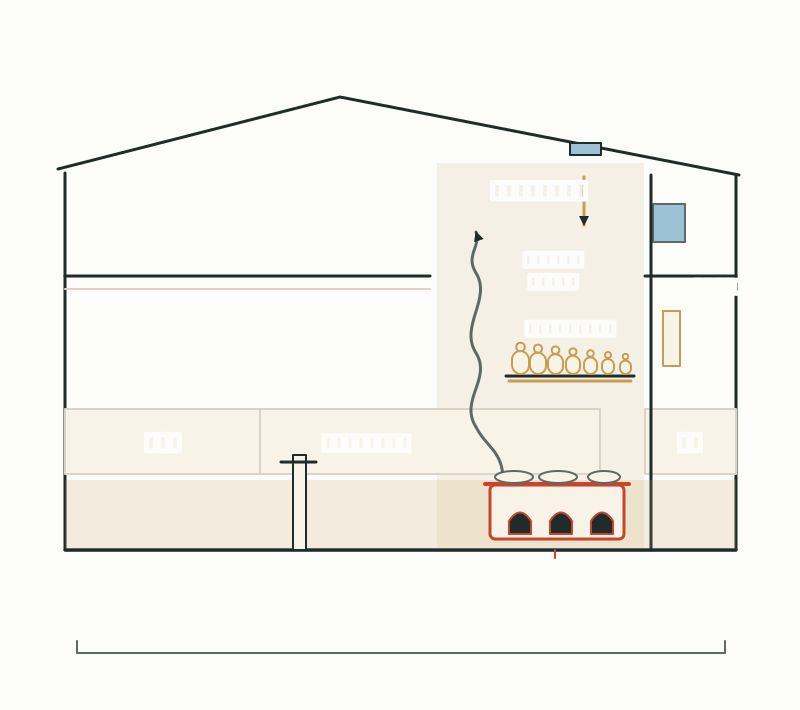
The okudosan is set on the earthen floor midway along or toward the back of the tōri-niwa in a Kyoto machiya. Tōri-niwa is the general term for the long, narrow earthen-floored passage running from the front of the house to the back; the front part, separated by a middle door (nakado), is called the mise-niwa (shop passage), and the back part the hashiri-niwa. The hashiri-niwa is where the cooking is done.
For fire prevention and smoke ventilation, the space above the okudosan is left open as a void called the hibukuro, with a high ceiling and light taken in through projecting windows. The upper part of the hashiri-niwa is open to deal with smoke and sparks from cooking, with skylights and high windows.
It is a design that makes it harder for fire to spread to other rooms should a fire break out from the stove. Looking up into the hibukuro, you can see a framework of beams and tie beams, and its craftsmanship is said to have been a place where carpenters competed in skill.
Where is the okudosan? (Schematic of a Kyoto machiya's tōri-niwa)
Names for the spaces and things around the okudosan
| Name | What kind of place or thing |
|---|---|
| Tōri-niwa (通り庭) | General term for the long, narrow earthen-floored passage running from front to back |
| Mise-niwa (店庭) | The part of the tōri-niwa in front of the middle door |
| Hashiri-niwa (走り庭) | The kitchen part of the tōri-niwa behind the middle door, where the okudosan stands |
| Hibukuro (火袋) | The open void above the hashiri-niwa; lets smoke and sparks escape and prevents fire from spreading |
| Kōjin-dana (荒神棚) | The shelf above the okudosan, where Hotei figures are lined up |
Hotei Figures and the Atago Fire Charm
There is a custom of lining up small figures of Hotei (one of the Seven Lucky Gods) on the kōjin-dana shelf above the okudosan. For each year that passes safely, one more is added, starting from the smallest, until there are seven after seven years; they are said to be lined up facing the entrance.
There is also a custom of posting near the okudosan an Atago-san talisman inscribed "火迺要慎" (Hi no yōjin, "Beware of fire"). The talisman, for fire prevention and protection from fire, is received at Atago Shrine on the summit of Mount Atago in Sagano. Note that 阿多古 is an old way of writing Atago.
The custom of enshrining a god at the stove is not unique to Kyoto. The names and ways of honoring the stove god differ from place to place; in the Kinai region (around Kyoto and Nara), pine or sakaki branches are said to be offered on top of a large pot not used in daily cooking, which is called by names such as "Okudosan."
The Okudosan at New Year
One of Kyoto's New Year decorations is okudo-kazari (stove decoration). A shimenawa (sacred straw rope) is hung on the stove, and kagami-mochi (stacked rice cakes), pine, and other decorations are placed on it in offering; kagami-mochi are displayed at the okudosan as well as in the tokonoma alcove and at the Buddhist family altar.
At the year-end mochi pounding, the steamed glutinous rice is pounded in the hashiri-niwa, while steam from the cooking rice rises from the okudosan. The finished mochi become ozōni (rice-cake soup) and kagami-mochi.
If You Want to See or Learn More
The booklet published by Kyoto City, Kyō-machiya no Iroha: Tatemono to Kurashi no Kihonchō (Kyoto Machiya Basics: A Guide to the Buildings and Life), illustrates the tōri-niwa, the hibukuro, the Hotei figures on the kōjin-dana, the Hi no yōjin talisman, and more with photographs, so you can get an overview of the area around the okudosan.
If you have a chance to visit a machiya, walk from the entrance back along the tōri-niwa and look at where on the earthen floor the stove stands and how high the void above it rises; you will get a real sense of the fire-prevention ideas introduced here. Whether a building is open to visitors, and when, varies by facility, so check each facility's information in advance.
Mini quiz for this entry
Check what you've read with 3 multiple-choice questions.
What does the Kyō-kotoba (Kyoto dialect) word okudosan refer to?
In a Kyoto machiya, what is the open void above the hashiri-niwa (earthen-floored passage) where the okudosan stands called?
Over how many years is a set of Hotei-san figures collected, one per year, and lined up on the kōjin-dana shelf above the okudosan?
Sources and verification
Content checked: October 11, 2026
Updated: October 11, 2026
References are in Japanese.