
Japanese白味噌雑煮(しろみそぞうに)
White-Miso Zoni
Other spellings and namesShiromiso zoni / Kyo-zoni (京雑煮) / Kyoto-style zoni / Kashiraimo (頭芋)
In short
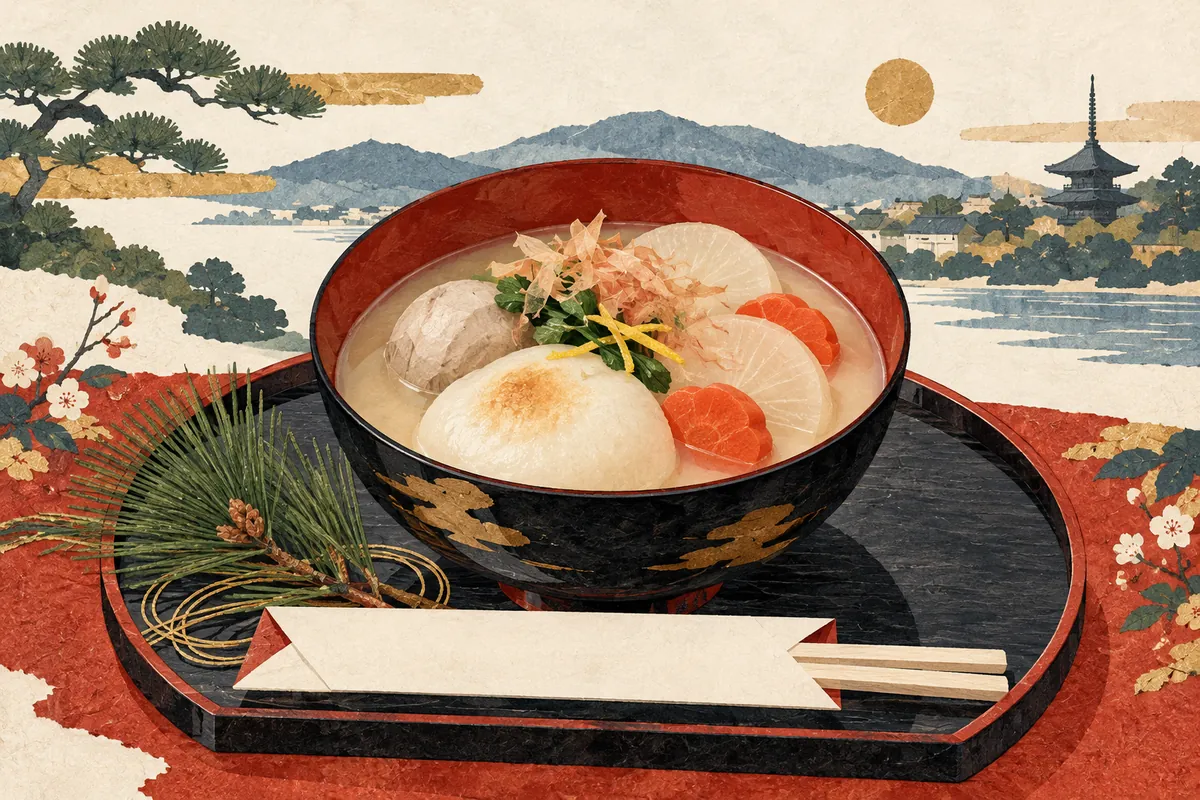
White-miso zōni is Kyoto's New Year soup: white miso dissolved in kombu stock with round mochi, kashiraimo (the mother corm of the taro), daikon, and other ingredients. Each household eats it during the first three days of the New Year, and recipes are said to be passed down from generation to generation. Each ingredient and the way it is cut carries wishes such as harmony and long life.Key points in 30 seconds
White miso is dissolved in kombu stock
The basic ingredients are round mochi, kashiraimo, and daikon
Each household eats it during the first three days of the New Year
White miso is a sweet miso made with about twice as much rice kōji as soybeans
Kombu Stock and White Miso, Round Mochi and Kashiraimo
The main ingredients of Kyoto's white-miso zōni are white miso, round mochi, kashiraimo, and daikon, and the dish is handed down throughout Kyoto Prefecture. Kashiraimo (頭芋) is the mother corm of the taro (satoimo). White-miso zōni is also called Kyō-zōni ("Kyoto zōni") and uses kombu stock rather than stock made from animal products.
In "Kyoto's food culture," which Kyoto City has selected as one of its intangible cultural heritage items under the "Kyoto o Tsunagu" program, white-miso zōni with round mochi and osechi (New Year dishes) are named as the foods eaten for the New Year. In one example of how it is made, boiled kashiraimo and daikon are cut into rounds or hexagonal "tortoise-shell" shapes and placed in a bowl with round mochi, and stock thinned with white miso is poured over them.
The Wishes Behind the Ingredients
Round mochi carries wishes for harmony and long life, and kashiraimo for prosperous descendants and success in life. Daikon cut into rounds stands for harmony and cut into tortoise-shell shapes for long life, and some families add kintoki carrots, whose vivid red is said to ward off evil. The mochi is often boiled rather than grilled so that it does not interfere with the flavor of the white miso.
In one Kyoto custom, the kashiraimo is served whole, uncut, and only the head of the household and the eldest son eat it, so that they may "stand at the head of others." There is also said to be a custom of eating one round mochi on New Year's Day, two or more on the second day, and more than the day before on the third day. How strictly these customs are kept differs from family to family.
Ingredients of white-miso zōni and the wishes they carry
| Ingredient | Wish or meaning |
|---|---|
| Round mochi | Harmony and long life (so that things settle smoothly, without sharp corners) |
| Kashiraimo (mother corm of the taro) | Prosperous descendants and success in life (to stand at the head of others) |
| Koimo (small taro) | Many children and prosperous descendants |
| Daikon | Rounds for harmony; tortoise-shell shapes for long life |
| Kintoki carrot | Its red color wards off evil (added by some families) |
White Miso and the Kyoto New Year
White miso has a high proportion of rice kōji and is known for its sweetness. It is said to have originated in Kyoto and to have been eaten since the Heian period. White-miso zōni is eaten in each household during the first three days of the New Year, and the way of making it has been passed down through the generations. Even families who do not usually eat white miso often stock up on it in preparation for the New Year.
Saikyō shiromiso (Kyoto Prefecture) is certified as one of the "100-Year Foods" by the Agency for Cultural Affairs. It is made with about twice as much rice kōji as soybeans, keeps the salt content to around 5%, and is fermented and matured in a short time. At the imperial court it was an essential seasoning for ceremonial occasions, and white-miso zōni is said to have been served at New Year. The name Saikyō ("western capital") is said to come from the fact that for a time in the Meiji era Kyoto was called Saikyō in contrast to Tokyo.
Kyoto is not the only place that uses white miso. White miso is also eaten throughout the Kansai region and in parts of Kagawa and Tokushima prefectures. In the Kantō region, zōni is typically a clear soy-sauce broth with chicken and leafy greens, and round mochi is said to be eaten mainly in western Japan and square mochi in eastern Japan.
How New Year Zōni Began, and How It Ends
The custom of eating zōni with mochi during the first three days of the New Year is said to have existed by the Heian period. In the Muromachi period, zōni with auspicious ingredients took root in many areas as a celebratory meal of the samurai class.
The celebratory zōni of the Muromachi period is said to have been dried abalone, mochi, and other ingredients simmered in a clear miso broth (sumashi miso). The custom of celebrating the New Year with zōni gradually spread to Kyoto's shrines, temples, and merchant households and then, in the mid-Edo period, to ordinary people; from around that time it is said to have become the zōni we know today, made with kombu stock and white miso.
It is also said that zōni was once made with wakamizu, the first water drawn in the year, over okera-bi, the first fire of the New Year. There is also a custom of using the okera-bi received at Yasaka Shrine's Okera Mairi to boil water on the morning of New Year's Day, then drinking ōbukucha (New Year good-luck tea) and eating zōni to pray for good health.
The way the zōni celebration ends is also distinctly Kyoto. On one account, eating grilled mochi in a clear soup with mibuna greens at kagami-biraki on January 4 marks the end of the zōni celebration; other materials give the kagami-biraki dish as kagami mochi in a clear soup with mizuna. The kind of greens and the date seem to vary from family to family.
Bonito Flakes or Not?
How bonito flakes (katsuobushi) are treated differs among sources. Some recipes top the zōni with fine threads of bonito, while other explanations say that bonito flakes and other foods of animal origin are not used because the zōni is offered to the gods and buddhas.
Another way of making it is to take the stock from kombu alone, without fish, because the dish is offered to the toshigami (the god of the New Year), and to add threads of bonito only when serving it. If bonito is not used in the stock but placed on top at the end, the two explanations are compatible. How particular each household is varies widely.
Mini quiz for this entry
Check what you've read with 3 multiple-choice questions.
Which mochi is listed as a main ingredient of Kyoto's white-miso zōni?
What is the kashiraimo (頭芋) put in Kyoto's white-miso zōni?
Roughly how many times as much rice kōji as soybeans is used to make Saikyō shiro-miso, which is also used in zōni?
Sources and verification
Content checked: October 11, 2026
Updated: October 11, 2026
References are in Japanese.