
Japanese千枚漬(せんまいづけ)
Senmaizuke
Other spellings and names千枚漬け / Senmai-zuke / Kyoto turnip pickles
In short
Senmaizuke (千枚漬) is a Kyoto pickle made by shaving Shōgoin turnip into thin slices and pickling them with kombu, vinegar, and other ingredients. It is counted among Kyoto's three great pickles, together with sugukizuke and shibazuke. It is not meant for long-term storage and is delicately pickled without lactic acid fermentation. It is made from around November, when Shōgoin turnips start to be shipped, and is loved as a taste of Kyoto's winter.Key points in 30 seconds
Made from Shōgoin turnip, a traditional Kyoto vegetable
One of Kyoto's three great pickles, with sugukizuke and shibazuke
Said to have been devised in the Edo period by a cook at the Imperial Palace
A winter pickle made from around November
A Pickle of Thinly Sliced Shōgoin Turnip
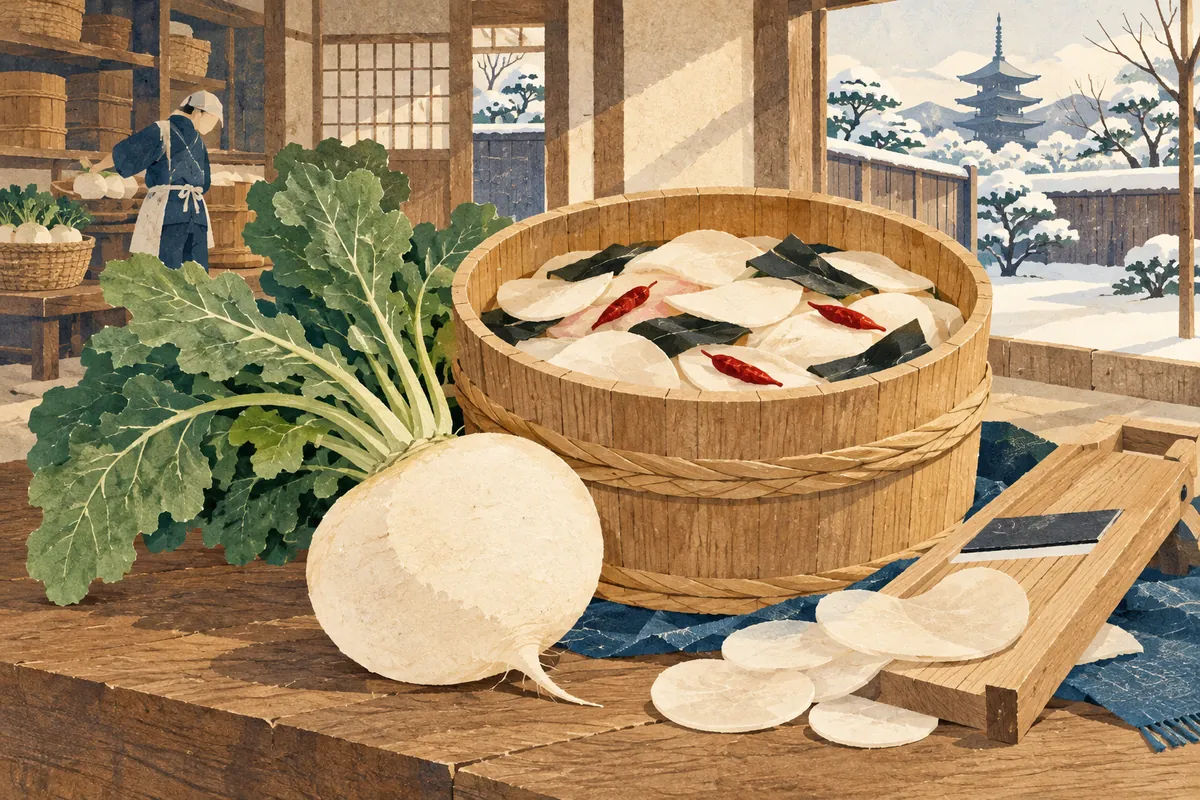
Senmaizuke is a pickle of thinly sliced, salted Shōgoin turnip and is counted among Kyoto's three great pickles, together with sugukizuke and shibazuke. The Shōgoin turnip is shaved into thin slices with a plane, given a preliminary pickling, and then given its main pickling with Hokkaido kombu, brewed vinegar, and sugar.
In one example of how it is made, the turnip is peeled thickly, shaved whole into slices about 3 mm thick, and layered in a barrel alternately with kombu seasoned with mirin, vinegar, and sugar; it is ready in about three days. It is characterized by the slipperiness of the kombu and a light, delicate flavor, and is sometimes served with mibuna greens.
Unlike conventional pickles, senmaizuke is not meant for long-term storage and is not fermented with lactic acid. It is said to have originally been a salted pickle fermented with lactic acid. Because it is now pickled in vinegar with kombu and other ingredients, it does not keep long. It is a pickle to enjoy soon after you buy it.
Why Is It Called "A Thousand Slices"?
Senmai means "a thousand sheets," and there are several explanations for the name: that the turnip is cut into rounds as thin as paper, that a single barrel held a thousand slices, or that one turnip is sliced so thin it seems to make a thousand pieces.
Most explanations relate the name to the slices being very thin and numerous, but there is also a theory that it became popular at the imperial court and was named senmaizuke there. None of these has been settled as correct, so it is safest to remember that the name is said to come from the thinness or the large number of slices.
- Because the Shōgoin turnip is sliced into paper-thin rounds before pickling
- Because a single barrel held a thousand slices
- Because one turnip is cut so thin that it seems to make a thousand slices
- Because it was added to the court menu, praised by courtiers, and named senmaizuke
Said to Have Been Devised by a Palace Cook
Senmaizuke is said to have been devised in the Edo period by Ōfuji Tōzaburō, a cook at the Imperial Palace. Tōzaburō is said to have later become a pickle merchant and sold senmaizuke, which went on to be ranked among the nation's famous local products at a national exhibition held in Kyoto in 1890 (Meiji 23).
As for when it was devised, the present form of thin round slices is said to date from around 1865 (Keiō 1) and to have been the creation of Tōzaburō, a cook in the palace's kitchen bureau (Daizen-ryō). He is sometimes introduced under the name Daikokuya Tōzaburō.
What Is the Shōgoin Turnip?
The Shōgoin turnip used for senmaizuke is the largest turnip in Japan. It is said to have originated in the Kyōhō era (1716–1736), when a farmer in Shōgoin, now in Sakyō Ward, brought back seeds of the Ōmi turnip and began growing them. Today Shino-chō in Kameoka City is the main producing area, and most of the senmaizuke made in Kyoto is said to use turnips from this area.
The Shōgoin turnip is a large, late-maturing variety with a flattened round root that grows to about 25 cm across and about 4 kg in weight. Kyoto Prefecture designates vegetables with a history of cultivation dating from before the Meiji era as "traditional Kyoto vegetables" (Kyō no dentō yasai), and it also includes the Shōgoin turnip among its "Kyoto brand products," selected for their quality.
The similarly named Shōgoin daikon is also a Kyoto brand product, but it is a radish and is not used for senmaizuke. Senmaizuke is made from the flat, round turnip.
When Can You Eat It? How It Differs From the Other Two Great Pickles
Senmaizuke is made from around November, when Shōgoin turnips start to be shipped, and long-established pickle makers preparing it in large barrels is considered a sight of winter in Kyoto. It is said to be pickled from November to around March of the following year, and its peak season is also given as from October to around March.
Kyoto Prefecture designates "Kyoto traditional foods" (Kyō-mono dentō shokuhin) made with traditional ingredients and methods, and senmaizuke, suguki, and shibazuke are designated as Kyō-tsukemono (Kyoto pickles). The three differ in ingredients, method, and season.
How Kyoto's three great pickles differ
| Pickle | Main ingredients | How it is made | Season |
|---|---|---|---|
| Senmaizuke | Shōgoin turnip, kombu | Thinly shaved and pickled in vinegar and other seasonings; no lactic acid fermentation | Winter (from around November) |
| Suguki | Suguki turnip (Kamigamo) | Pickled with salt alone and fermented with lactic acid; sour taste | Winter |
| Shibazuke | Eggplant, red shiso (Ōhara) | Pickled with salt and fermented with lactic acid | Summer |
Other Pickles With the Same Name
Japanese dictionaries give, as the first meaning of senmaizuke, the Kyoto specialty pickle made from Shōgoin turnip and treat it as a seasonal word for winter in haiku. As a second meaning, however, they list a specialty of Miyazaki Prefecture, made by layering shiso leaves and pickling them in miso or other seasonings, also called senmaizuke.
It is also said that thinly sliced turnips other than the Shōgoin turnip, or daikon, pickled in vinegar may be called senmaizuke. When looking for Kyoto's senmaizuke, whether it uses Shōgoin turnip is one useful clue.
Mini quiz for this entry
Check what you've read with 3 multiple-choice questions.
Which vegetable is used to make Kyoto's senmaizuke?
Senmaizuke is said to have been devised by someone in what role?
What is cited as a way Kyoto's senmaizuke differs from conventional pickles?
Sources and verification
Content checked: October 11, 2026
Updated: October 11, 2026
References are in Japanese.