
Japaneseおばんざいと京都のだし文化
Obanzai and Kyoto's Dashi Culture
Other spellings and namesObanzai / Kyō-ryōri (Kyoto cuisine) / Kombu dashi / Katsuo dashi / Kyoto everyday food / おばんざい
In short
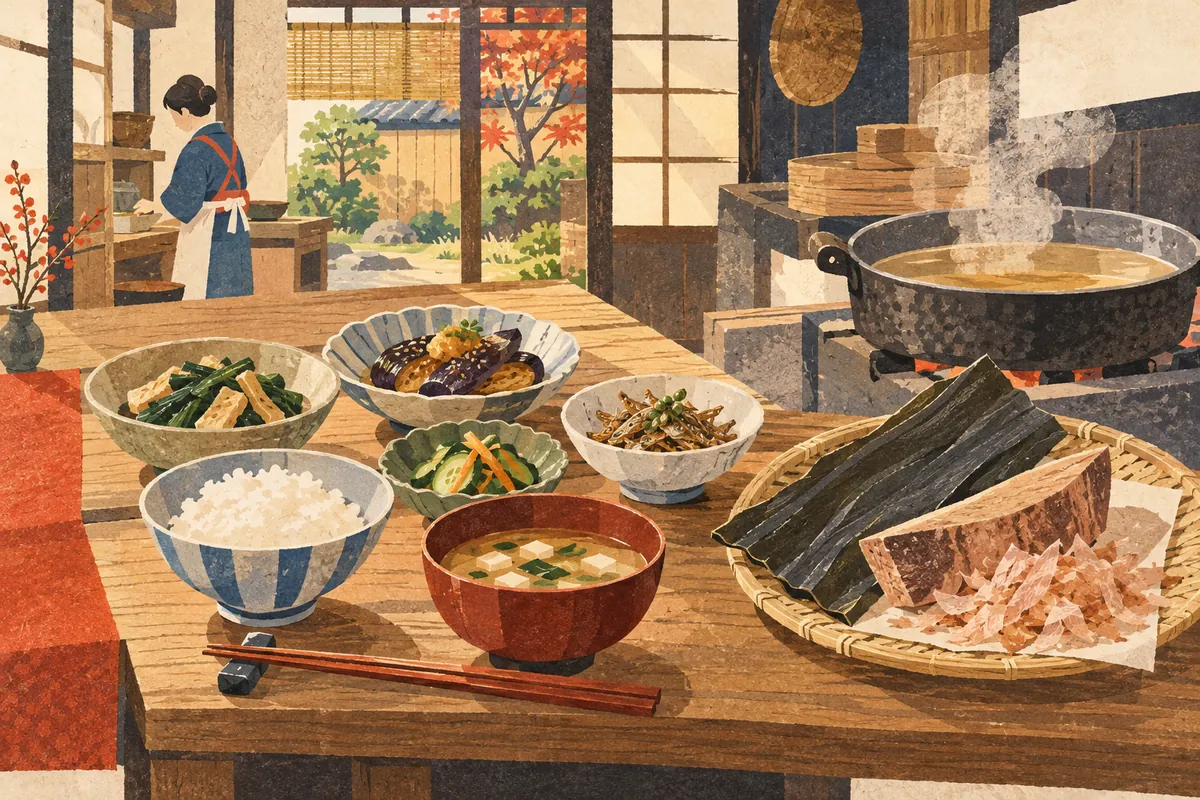
Obanzai (おばんざい) are the everyday side dishes handed down through generations in Kyoto homes. They are packed with household wisdom for making the most of seasonal ingredients, and their flavor rests on dashi (soup stock) made from kombu kelp and katsuo (bonito). Kyoto City ranks first among Japan's designated cities in household spending on both kombu and katsuobushi/shaved bonito flakes (2016–2018 average), and dashi is indispensable to Kyoto's food culture.Key points in 30 seconds
Obanzai are everyday side dishes handed down in Kyoto homes
The main ingredients of dashi are kombu and katsuo (bonito)
Kyoto City ranks first among designated cities in spending on kombu and katsuobushi (2016–2018 average)
Obanzai as Everyday Wisdom
Obanzai are Kyoto's everyday side dishes, making good use of seasonal ingredients and more. They carry on the wisdom of daily life.
Obanzai are Kyoto's everyday side dishes, filled with seasonal ingredients and the wisdom of daily life.
Kyoto Cuisine Seen Through Dashi
At Ajiwaikan, you can taste dashi made from katsuo, kombu, and more by reservation and learn about Kyoto's food culture.
Ajiwaikan introduces the "Five Great Cuisines of Kyoto," which form the basis of Kyō-ryōri (Kyoto cuisine).
At Ajiwaikan, you can taste dashi made from katsuo, kombu, and more by reservation.
Since When Has the Word "Obanzai" Been Used?
The word obanzai seems to have come into use for Kyoto's everyday side dishes after the essayist Ōmura Shige and others used it in a serialized article in 1964 (Shōwa 39). Ōmura is said to have started using the word after coming across the Edo-period cookbook Nenjū Banzai-roku (1849).
The culinary researcher Sugimoto Setsuko recalls that in her own family, raised in one of the float-owning towns of the Gion Festival, even her grandparents' generation called these dishes okazu, and obanzai was an unfamiliar word. In her view, it is a kind of "reimported" word, which came to be used in Kyoto too after spreading nationwide through television and books. What people call these dishes varies by household and generation, so it cannot be said that "everyone in Kyoto has always called them obanzai."
Okimari Ryōri: Dishes Set by the Date
"Kyoto's food culture," selected by Kyoto City as part of its "Intangible Cultural Heritage Connecting Kyoto," lists okimari ryōri (set dishes for set days) alongside household side dishes (obanzai). Deciding in advance which dish to eat on which day of each month is a piece of wisdom handed down in merchant households and elsewhere, balancing nutrition while marking rhythms in daily meals. Many of the wishes behind the dishes are expressed through wordplay.
In a 2013 public call for opinions, the top three obanzai chosen by residents were nasu no dengaku (miso-glazed eggplant), nappa to oage no taitan (leafy greens simmered with fried tofu), and chirimen sanshō (tiny dried fish with sanshō pepper).
Examples of okimari ryōri
| Day | Dish | Meaning |
|---|---|---|
| 1st | Azuki-bean rice, simmered herring and kombu, namasu (vinegared vegetables) | So the whole household can live mame (healthy and hardworking, a pun on mame, "beans"). With the astringency (shibumi) of herring and the kombu, to live shibuu, kobuu (frugally) |
| Days ending in 8 | Arame seaweed simmered with fried tofu | On days of 8, a number that widens toward the end (suehirogari) and so signifies prosperity, so that good sprouts (me, as in arame) will come up |
| 15th | Azuki-bean rice, simmered dried cod and ebi-imo taro, namasu | — |
| End of the month | Okara (soy pulp) | Since it needs no knife, it is called kirazu ("uncut"), so that bonds will not be cut and money will come in |
Kyoto, "City of Dashi," in Numbers
Comparing household spending among Japan's designated cities (2016–2018 average, households of two or more people), Kyoto City ranked first in spending on kombu, which is rich in umami, at 1,447 yen, and first in katsuobushi and shaved bonito flakes as well, at 1,231 yen. Both far exceed the average for other cities (907 yen for kombu and 837 yen for katsuobushi and bonito flakes).
Kyoto also ranks third among designated cities in spending on salted and dried seafood such as salted mackerel and chirimen-jako (tiny dried fish). It is said that in this inland city without a coastline, ways of eating fish fostered a "culture of salted and dried foods." Being far from the sea is also said to have led to innovations in processing techniques and cooking methods.
Annual spending on kombu (top three designated cities and the average of other cities)
- Kyoto
- Sakai
- Sendai
- Average of other cities
How Obanzai Differ from Kyō-ryōri
Obanzai are understood as "a food culture nurtured by daily life," while Kyō-ryōri (Kyoto cuisine) is "a food culture of hospitality." Kyō-ryōri developed from a fusion of yūsoku ryōri (court cuisine), honzen ryōri (formal banquet cuisine), shōjin ryōri (Buddhist vegetarian cuisine), kaiseki, and river-fish cuisine. It takes dashi as the basis of its flavor and ichijū sansai (one soup and three dishes) as the basis of its menus, and through the cooks' skill and aesthetic sense, it lets diners enjoy five colors, five tastes, and five cooking methods with all five senses. Kyō-ryōri became a nationally Registered Intangible Cultural Property on November 17, 2022.
Obanzai, on the other hand, are home cooking based on dashi, designed to use seasonal ingredients such as vegetables in season without waste. Both share dashi as their foundation. Another feature of Kyoto's food culture is the distinction between hare and ke (special occasions and everyday life), and both hospitality cuisine and everyday side dishes have shaped Kyoto's tables.
Mini quiz for this entry
Check what you've read with 3 multiple-choice questions.
What does the Kyoto word “obanzai” refer to?
What can visitors taste at the Kyoto Food Culture Museum Ajiwaikan?
How many foundational Kyoto cuisine styles does Ajiwaikan introduce?
Sources and verification
Content checked: October 11, 2026
Updated: October 11, 2026
References are in Japanese.