
Japaneseすぐき(酸茎)
Suguki
Other spellings and namesSugukizuke / Suguki-zuke (すぐき漬) / 酸茎 / Suguki turnip
In short
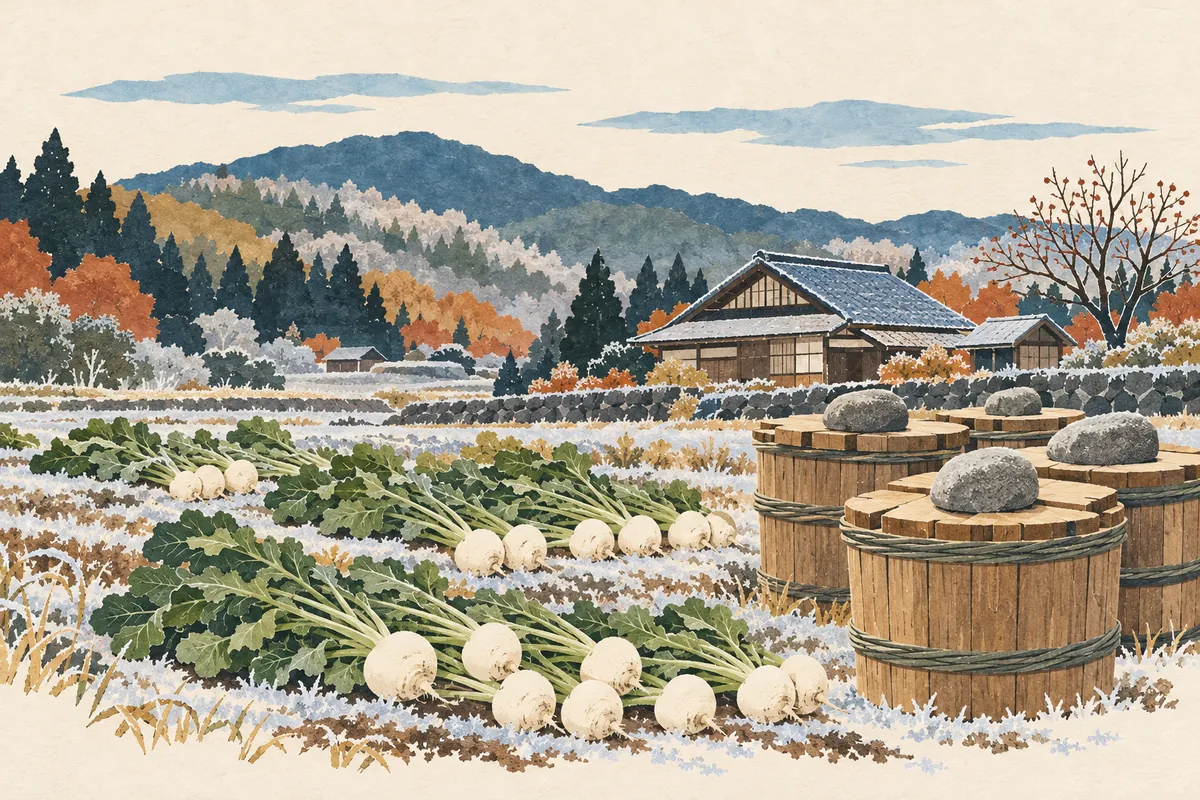
Suguki (酸茎, "sour stem") is the name of a kind of turnip grown since long ago in Kamigamo, Kyoto, and of the pickle made by pickling it with salt alone and fermenting it with lactic acid. It is known for its distinctive sourness and is counted among Kyoto's three great pickles, together with senmaizuke and shibazuke. It is harvested and pickled from mid-November to around January and is loved as one of the representative pickles of a Kyoto winter.Key points in 30 seconds
A turnip grown in Kamigamo and one of the traditional Kyoto vegetables
Pickled with salt alone and fermented with lactic acid, giving it a sour taste
Once made by the shake (shrine priest families) of Kamigamo Shrine and presented to the Imperial Palace
One of Kyoto's three great pickles, together with senmaizuke and shibazuke
Suguki Is Both a Vegetable and a Pickle
Suguki is a kind of turnip counted among the traditional Kyoto vegetables, known for its distinctive sourness. It is rarely eaten except as a pickle, and sugukizuke—suguki pickled with salt alone—is counted among Kyoto's three great pickles, together with senmaizuke and shibazuke. Also written 酸茎, it is a turnip that for a long time was grown only in Kamigamo.
Kyoto Prefecture defines "traditional Kyoto vegetables" (Kyō no dentō yasai) by criteria such as having been introduced and grown before the Meiji era, and the definition covers the whole prefecture, not just Kyoto City. Kyoto Prefecture has also designated suguki, together with senmaizuke and shibazuke, as Kyō-tsukemono (Kyoto pickles) among its "Kyoto traditional foods" (Kyō-mono dentō shokuhin).
A Pickle Guarded by Kamigamo's Shrine Families
There are several theories about how suguki began. One is that in the Azuchi-Momoyama period the shake (families who served Kamigamo Shrine) began cultivating plants that grew wild along the Kamo River; another is that the seeds were received from the Imperial Palace in Kyoto.
Sugukizuke, pickled with salt alone, is said to have begun in the early Edo period. At first only the shrine families made it, and it was a luxury pickle presented to the Imperial Palace. In the late Edo period farmers around Kamigamo Shrine also began to make it, but because taking suguki out to other villages was forbidden, production stayed limited. It is said to have spread after the Meiji Restoration and come to be sold widely in the city.
It is also said that because the shrine families used sugukizuke as gifts to the imperial court and elsewhere and kept the method a closely guarded secret, the area under cultivation was effectively kept from expanding.
Lactic Acid Fermentation With Salt and a Muro
Suguki's sourness comes from lactic acid fermentation. Sugukizuke is made in three main stages: preliminary pickling, main pickling, and muro-ire (placing it in the muro). The muro is a heated room kept at about 40°C with charcoal, electricity, or other means, and promoting lactic acid fermentation in the muro is the usual method today. With this method the pickle is ready to eat in about half a month.
In the past, instead of using a muro, the pickles were left to ferment at natural temperatures, a method called jikō-nare ("ripened by the season"). In that case they were ready in spring or summer, so in the Edo period suguki is said to have been enjoyed as a summer delicacy. There was a time, then, when it was not the winter pickle we think of today.
How sugukizuke is made (one example)
| Stage | What is done |
|---|---|
| Preliminary pickling | Salted overnight before the main pickling and washed the next day |
| Main pickling | Salted again, weighted with stones, and left for about a week |
| Muro-ire | Left for about a week in a muro heated with lit charcoal briquettes or similar, to ferment with lactic acid |
| Finishing | Cooled at natural temperatures; ready when the pickling liquid rises after 5–6 days |
When and How Is It Eaten?
As frost begins to fall, the sugar content of the suguki root rises, so it is harvested and pickled from mid-November to around January. It is also popular as a year-end and New Year gift and is, along with senmaizuke, one of the representative pickles of winter.
When serving it, the leaves and the root are usually cut separately. The leaves are finely chopped or cut into easy-to-eat lengths, and the root is often cut into half-moons or quarter-rounds. Besides going with rice, it is also eaten in ochazuke (rice with tea poured over it) and as a snack with sake. Because muro-ire requires special facilities, suguki is rarely made at home, and in winter suguki from pickle makers appears in the shops.
How It Differs From Senmaizuke and Shibazuke
Kyoto's three great pickles each differ in ingredients and methods. Suguki and shibazuke are fermented with lactic acid, while senmaizuke is pickled with kombu and vinegar, so it does not keep long and has a delicate flavor. As for season, suguki and senmaizuke are considered winter pickles, while shibazuke brightens the summer table.
Comparing Kyoto's three great pickles
| Pickle | Ingredients | Method and flavor | Associated area |
|---|---|---|---|
| Suguki | Suguki (a kind of turnip) | Pickled with salt alone and fermented with lactic acid; sour | Kamigamo |
| Senmaizuke | Shōgoin turnip | Thinly shaved and pickled with kombu, vinegar, and more; delicate flavor that does not keep long | Shōgoin |
| Shibazuke | Eggplant and red shiso | Pickled with salt and fermented with lactic acid; color and aroma of red shiso | Ōhara |
If You Walk Around Kamigamo
Kamigamo in Kita Ward has long been known as the home of suguki. Beside Mizorogaike Pond, also in Kamigamo, stands Mizorogaike Kifune Shrine, and within its grounds is Akiba Shrine, said to be the birthplace of suguki, famous as a Kyoto pickle.
Mizorogaike Kifune Shrine was established by the farmers of Mizorogaike as a branch shrine because visiting Kifune Shrine in Kurama was far and difficult. How to read the name Mizorogaike and how to walk around the pond are also covered in this dictionary's entry on Mizorogaike.
Mini quiz for this entry
Check what you've read with 2 multiple-choice questions.
Sugukizuke is made by pickling suguki, a turnip long grown in Kamigamo, using only what?
Around the Edo period, when suguki was made by jikō-nare (fermenting at natural outdoor temperatures), it was enjoyed as a delicacy of which time?
Sources and verification
Content checked: October 11, 2026
Updated: October 11, 2026
References are in Japanese.