
Japanese深泥池(みどろがいけ)
Midorogaike
Other spellings and namesMizorogaike / Midorogaike Pond / 深泥ヶ池 / Midorogaike biological community
In short
深泥池 is a pond in Kamigamo, Kita Ward, read both Midorogaike (みどろがいけ) and Mizorogaike (みぞろがいけ). The name is said to come from the several meters of mud (doro) deposited on the bottom of the pond. The surrounding town name, 上賀茂深泥池町, is read Kamigamo Midoroike-chō (かみがもみどろいけちょう), without the "ga" (が).Key points in 30 seconds
The pond has two readings, Midorogaike and Mizorogaike; in town names it is Midoroike
The name is said to come from the several meters of mud deposited on the pond bottom
Heian-period records show spellings such as 泥濘池 and 美度呂池
The Midorogaike biological community was designated a national Natural Monument in 1927
Midoro or Mizoro? A pond with two readings
深泥池 is a pond read both Midorogaike (みどろがいけ) and Mizorogaike (みぞろがいけ), located in Kamigamo, Kita Ward, Kyoto City.
The bus stop name gives the reading Midorogaike, while the guidance for the Natural Monument gives Mizorogaike in its furigana, so which reading is used differs by source. Rather than one being wrong, it seems best to think that both readings are accepted.
Town names add yet another form. As of April 1, 2025 (Reiwa 7), the Kita Ward town name 上賀茂深泥池町, which bears the pond's name, is read Kamigamo Midoroike-chō (かみがもみどろいけちょう), without the "ga" (が).
Comparing the readings of names that include 深泥池
| Name | Reading |
|---|---|
| 深泥池 (the pond) | Midorogaike (みどろがいけ) / Mizorogaike (みぞろがいけ) |
| 深泥池 (Kyoto City Bus stop) | Midorogaike (みどろがいけ) |
| 深泥池生物群集 (Natural Monument) | Mizorogaike (みぞろがいけ) |
| 上賀茂深泥池町 (town name in Kita Ward) | Kamigamo Midoroike-chō (かみがもみどろいけちょう) |
| 松ケ崎深泥池端 (town name in Sakyō Ward) | Matsugasaki Midoroikebata (まつがさきみどろいけばた) |
| 深泥池貴舩神社 | Midorogaike Kibune Jinja (みどろがいけきぶねじんじゃ) |
The name comes from the deep mud on the bottom
Midorogaike, which is also the name of a Kyoto City Bus stop, is a small pond about 1.5 km around with an area of about 9 ha. Several meters of mud are deposited on the pond bottom, and this is said to be the origin of the name—深泥 literally means "deep mud." In other words, the pond's name arose from this mud.
Old records show the name written in different ways. An entry for 829 (Tenchō 6) in the Ruijū Kokushi records the emperor visiting "泥濘池" to hunt waterfowl; an entry for 1018 (Kannin 2) in the Shōyūki mentions "美度呂池" (Midoro-ike); and volume 19 of the Konjaku Monogatarishū has a tale of a man shooting ducks at "美々度呂池." This suggests that the sound "midoro" had been in use since the Heian period.
There are also other spellings, such as 美土呂池 and 御菩薩池. It is also written 仏菩薩池, and there is a story connecting it with the monk Gyōki performing Buddhist rites here, but the explanation linking the name to mud is the more widely shared one.
The Midoroike Jizō moved to Kuramaguchi
This area along the old Kurama Kaidō was once home to the Midoroike Jizō (御菩薩池地蔵, みどろいけじぞう), one of Kyoto's Six Jizō. This Jizō has since been moved to Jōzen-ji temple at Kuramaguchi and renamed the Kuramaguchi Jizō.
Jōzen-ji's Kuramaguchi Jizō was moved from the shore of Midorogaike (near the Kurama Kaidō) during the haibutsu kishaku anti-Buddhist movement of the Meiji era. The Rokujizō Meguri, a pilgrimage to the six Jizō statues enshrined at the entrances to the capital, is held every year on August 22 and 23 (as of 2018), and Jōzen-ji is one of them. The pond's name was thus also a landmark on the highway that stretched from Kuramaguchi, the capital's northern entrance.
Where can you see the name today? Bus stops, town names, and a shrine
You are most likely to see it as a bus stop name. As of 2022, there was a Midorogaike stop on Kyoto City Bus Route 4, and the nearest stops to the pond are given as the Kyoto City Bus and Kyoto Bus Midorogaike stops and Kitayama Station on the Karasuma subway line.
As for town names, Kita Ward has, besides Kamigamo Midoroike-chō, a row of towns beginning with "Kamigamo Midoro" (上賀茂深泥), such as 上賀茂深泥御用谷町 and 上賀茂深泥西山町, all in the school district of Kamigamo Elementary School and Kamogawa Junior High School. Across the ward boundary on the Sakyō Ward side is the town name Matsugasaki Midoroikebata, which belongs to the school district of Matsugasaki Elementary School and Shimogamo Junior High School.
Near the pond is Midorogaike Kibune Jinja. Because visiting the main Kifune Shrine at Kurama was far and difficult, farmers of Midorogaike invited its deity to a branch shrine here. Within its grounds is Akiba Jinja, said to be the birthplace of suguki, a Kyoto pickle.
Visiting a pond that is a Natural Monument
Midorogaike is a very precious pond, home to plants and animals that have lived there since the Ice Age. On June 14, 1927 (Shōwa 2), it was designated a national Natural Monument to protect its aquatic plant communities, and since 1988 (Shōwa 63) the designation has covered its entire biological community.
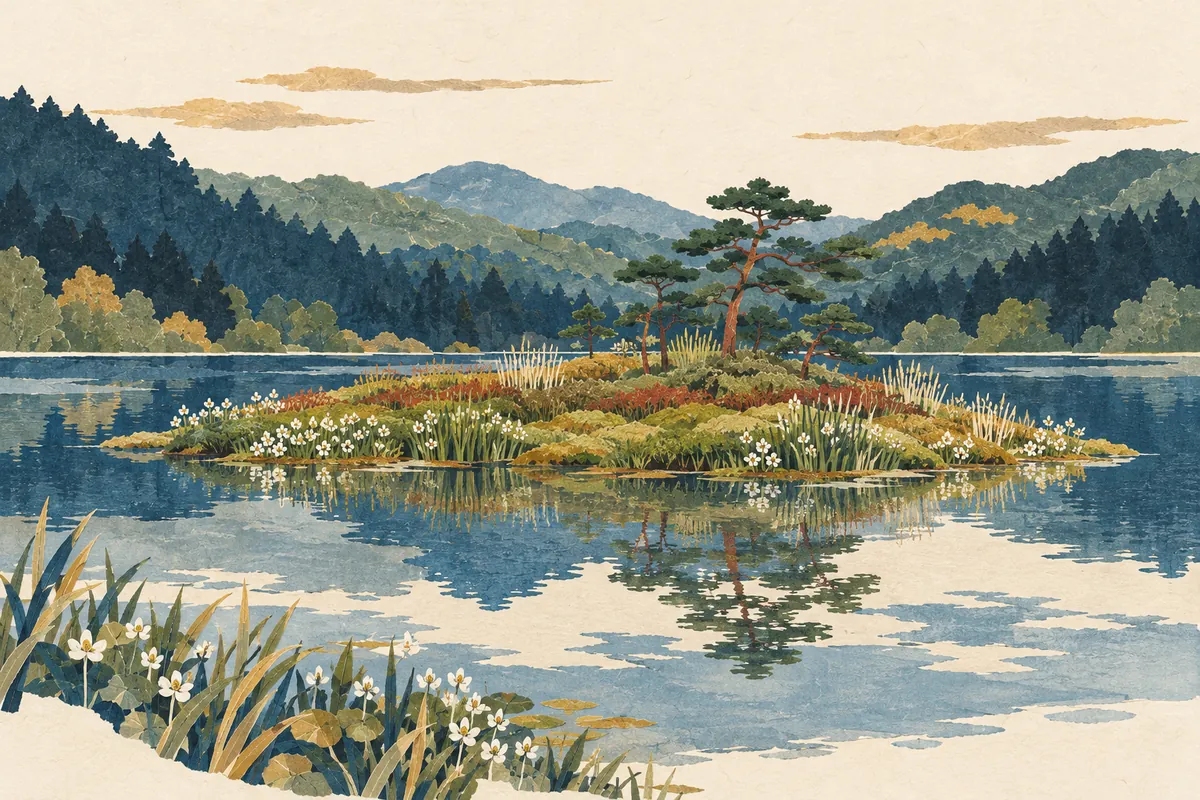
The highlight is the floating island that spreads across the center of the pond. It covers about a third of the pond and was formed by plant remains piling up without decomposing; in summer it rises, and in winter it sinks and is submerged. The pond itself formed when the mouth of a valley was dammed by sediment from the Kamo River's alluvial fan, and water is thought to have begun accumulating in earnest only within the last 10,000 years or so.
As a seasonal guide, there are the white flowers of bogbean (mitsugashiwa) in April–May, rabbit-ear iris (kakitsubata) and tokisō orchids in May, and sawagikyō lobelia in September. On the other hand, eutrophication, the invasion of non-native fish, and increased traffic on the road on the west side of the pond are seen as conservation problems. Take nothing, release nothing, and watch quietly from the outside: that is how to enjoy this pond.
Mini quiz for this entry
Check what you've read with 2 multiple-choice questions.
Which is a correct reading of 深泥池, a pond in Kamigamo, Kita Ward?
What is said to be the origin of the name Midorogaike (深泥池, "deep-mud pond")?
Sources and verification
Content checked: October 11, 2026
Updated: October 11, 2026
References are in Japanese.