
Japaneseをけら詣り(おけらまいり)
Okera-mairi
Other spellings and namesOkera Mairi / Okera-bi (okera fire) / Okera-sai / Kitchō-nawa / Hinawa (fire rope) / をけら詣り / おけら参り
In short
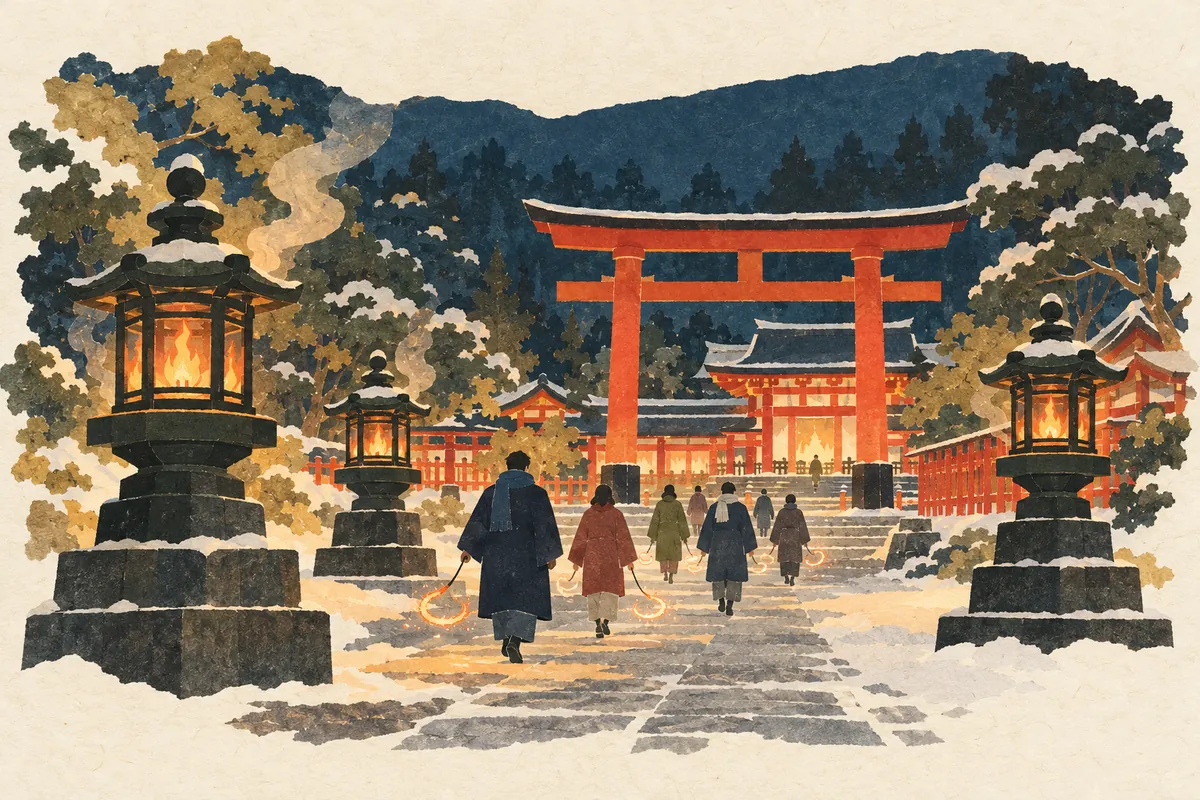
Okera-mairi (をけら詣り) is a year-end event held at Yasaka Shrine from the night of New Year's Eve into the early morning of New Year's Day. Worshippers transfer the okera-bi (okera fire), burned together with the medicinal herb okera (白朮), onto a fire rope also called a kitchō-nawa, and pray for good health throughout the year. It usually runs from around 7:30 p.m. on December 31 until around 5:00 a.m. on New Year's Day; in 2026 it takes place on Thursday, December 31.Key points in 30 seconds
At Yasaka Shrine, from around 7:30 p.m. on New Year's Eve until early on New Year's morning (usual schedule)
Okera (白朮) is a medicinal herb of the aster family that gives off a strong smell when burned
The fire carried home on the rope was once used to light the stove for cooking zōni and the lamp on the household altar
Today, the extinguished fire rope can be hung in the kitchen as a charm against fire
Receiving Fire at Yasaka Shrine on New Year's Eve
Okera-mairi is an event held at Yasaka Shrine in Higashiyama Ward from New Year's Eve into New Year's Day. A seasonal tradition of the end of the year in Kyoto, it is held from around 7:30 p.m. on December 31 until around 5:00 a.m. on New Year's Day. In 2026, the Ōharae purification rite (from 15:00) and the Joya-sai New Year's Eve ceremony (from 19:00) are scheduled for Thursday, December 31.
First, at 7:00 p.m., the Joya-sai ceremony closing the year is held in the main hall. After that, priests light sacred fire in turn in the lanterns set up in the grounds, and burn pieces of okera (白朮) together with okera-gi, wooden sticks on which parishioners and worshippers have written wishes for good health in the coming year. The fire burns through the night until early New Year's morning, and on New Year's Day the Okera-sai (白朮祭) ceremony is held.
What Kind of Plant Is Okera?
Okera, written 白朮 in kanji, is a plant of the aster family. Its dried roots give off a very strong smell when burned, and so it has long been believed to drive away evil. Until the Edo period, burning okera is said to have been a year-end custom in ordinary households as well.
Okera is also used in traditional Chinese medicine and is said to be good for the stomach and intestines. As of 2012, the shrine also offered a rare otoso (New Year's spiced sake) made with okera, called okera-zake, in the grounds until dawn. Whether it is offered may vary from year to year, so check the shrine's information for that year.
Carrying the Fire Home on a Rope (Kitchō-nawa)
Worshippers transferred this okera-bi onto a fire rope and carried it home without letting it go out. In the past, the fire was reportedly used to kindle the pot for cooking the New Year's zōni (rice-cake soup) and to light the lamp on the kamidana (household altar), with prayers for good health throughout the year. It was a custom of the days when cooking was done on a kamado stove, which in Kyoto is called okudosan.
There is also a custom of using that fire on New Year's morning to boil water for ōbukucha (a good-luck New Year's tea) and to eat zōni, praying for good health in the year ahead.
This fire rope is also called kitchō-nawa ("lucky rope"), and it is a New Year custom to carry it home while twirling it round and round so the fire won't go out. The rope is made from bamboo fibers so that the fire is less likely to die.
Today, the extinguished fire rope can be hung in the kitchen as a charm against fire. A kake-hinawa (hanging fire rope; offering of 1,000 yen) is available only during Okera-mairi; it has received the okera fire as a prayer for protection from misfortune and fire for the year, and is hung in the kitchen.
Where Does the Fire Come From? Is It Done at Other Shrines?
The sacred fire that becomes the okera-bi is not suddenly lit on New Year's Eve. It is kindled at the Kiribi-shiki fire-making ceremony at 4:00 a.m. on December 28, using a traditional fire drill board and drill. After the Joya-sai on New Year's Eve, this fire is lit in the lanterns and burned along with the okera-gi.
Yasaka Shrine is not the only place where people receive fire on a rope. At Kitano Tenmangū in Kamigyō Ward, a Kiribi-sai fire-making festival is held at its auxiliary shrine Hinomiko-sha (火之御子社); the kindled fire is moved to an iron brazier, and fire ropes are handed out. Check Kitano Tenmangū's information for dates and times.
Main year-end and New Year rituals at Yasaka Shrine
| Date and time | Ritual | Details |
|---|---|---|
| December 28, 4:00 a.m. | Kiribi-shiki | Sacred fire is kindled with a fire drill board and drill |
| December 31, 7:00 p.m. | Joya-sai | A ceremony in the main hall closing the year |
| December 31, around 7:30 p.m. to around 5:00 a.m. on New Year's Day | Okera-mairi | Okera and okera-gi are burned with the sacred fire in the lanterns, and worshippers transfer the fire to fire ropes |
| January 1 | Okera-sai (白朮祭) | New Year's Day ceremony |
| January 3 | Hatsu-nō Hōnō and Karuta Hajime-shiki | Offering of the Okina Noh dance on the Noh stage, and a match of Hyakunin Isshu poetry cards |
Things to Keep in Mind When Visiting
Yasaka Shrine is located at 625 Gion-machi Kitagawa, Higashiyama Ward, Kyoto City. It is about a 5-minute walk east of Gion-Shijō Station, but you cannot bring okera-bi onto trains. If you carry home a burning rope, be sure to put the fire out before boarding any transportation.
In Kyoto, a series of events leads up to Okera-mairi at the end of the year. In early December, daikon-daki (simmered daikon radish events) are held at Senbon Shaka-dō and Ryōtoku-ji, and it is a Kyoto custom to begin New Year preparations on Kotohajime, December 13. Then, on the night of New Year's Eve, people receive the okera fire at Yasaka Shrine and welcome the new year praying for good health.
The Gion kagai (geisha districts) also have year-end customs connected with the okera fire. In Gion Kōbu, Miyagawachō, and Gion Higashi, on New Year's Eve, geiko and maiko make the rounds of the ochaya (teahouses) with the year-end greeting "Okotōsan dosu," and at night they visit Yasaka Shrine to receive the okera fire.
Mini quiz for this entry
Check what you've read with 2 multiple-choice questions.
At Okera-mairi, what do people light with the okera-bi (okera fire) and carry home, twirling it so the fire doesn't go out?
The unburned remains of the fire rope brought home from Okera-mairi are enshrined in the kitchen as a charm for what?
Sources and verification
Content checked: October 11, 2026
Updated: October 11, 2026
References are in Japanese.