
Japanese大根焚き(だいこだき)
Daiko-daki
Other spellings and names大根だき / 大根炊き / Daikon-daki / Daikodaki / Jōdō-e (成道会) / Hōonkō (報恩講)
In short
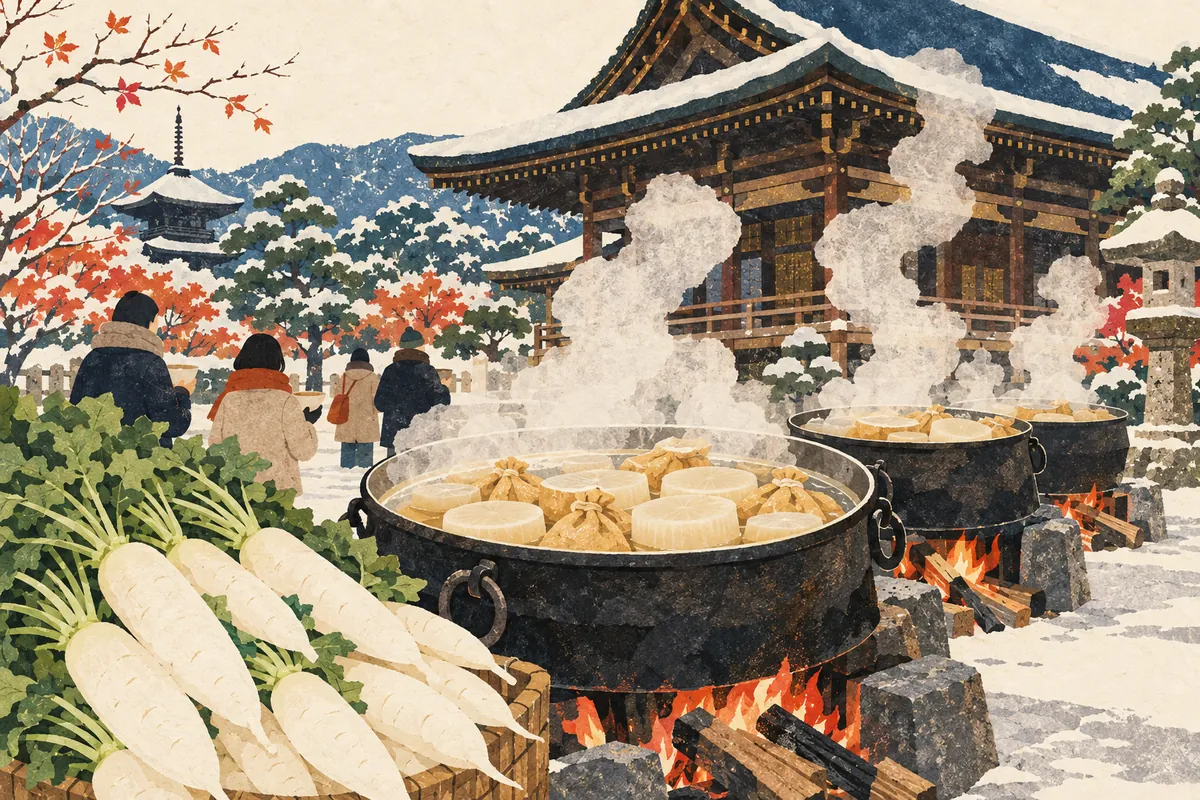
Daiko-daki (大根焚き) is an event held at Kyoto temples, mainly in December, in which daikon radishes that have been blessed with prayers are simmered in huge pots and served to worshippers. It is said that eating them protects you from chūbu (stroke). At Senbon Shaka-dō (Daihōon-ji) it is held every year on December 7 and 8 to coincide with the Jōdō-e, and in 2026 it is scheduled for Monday, December 7, and Tuesday, December 8.Key points in 30 seconds
In Kyoto it is called daiko-daki, not daikon-daki
At Senbon Shaka-dō, held every December 7–8 to coincide with the Jōdō-e, the celebration of the Buddha's enlightenment
At Ryōtoku-ji it is the popular name for the Hōonkō, tied to a story about Shinran Shōnin (canceled for the 2025 season)
Eating the daikon is said to protect you from chūbu (stroke)
What is daiko-daki?
Daiko-daki is an event in which temples in winter Kyoto offer daikon simmered in huge pots before the Buddha and also serve it to worshippers. In Kyoto, 大根焚き is read daiko-daki rather than daikon-daki, and event notices add the reading as 大根(だいこ)焚き.
Daiko-daki was originally an event to rejoice in and give thanks for the Buddha's attainment of enlightenment, and its meaning and methods have changed in various ways from temple to temple. It is said that eating the daikon protects you from chūbu (stroke), and on the day the temples are crowded with people praying for good health.
Daiko-daki is also an event to drive away illness and pray for better health, and its origins vary from temple to temple. Besides daikon simmered after a Sanskrit character (bonji) has been written on it, there are versions simmered with deep-fried tofu (aburaage) and salt-seasoned versions, so the flavor differs from temple to temple.
Senbon Shaka-dō's "Jōdō-e and Daiko-daki"
The daiko-daki at Senbon Shaka-dō (Daihōon-ji) in Kamigyō Ward is said to have been started in the Kamakura period by Jizen Shōnin, the temple's third head priest. Inspired by the Buddha's attaining enlightenment at dawn on December 8 just as the morning star appeared, Jizen wrote the seed syllable (Sanskrit character) of Shaka on daikon during a memorial service and offered them as a charm against evil. This daikon was simmered together with other daikon and served to worshippers, and that is said to have been the beginning. The Sanskrit character is baku, the seed syllable representing Shaka Nyorai (Shakyamuni Buddha).
The event continued until around the end of the Edo period and was later revived through the faith of the temple's followers. Today the temple holds a prayer service for "protection from stroke and all illnesses and for better health," and the simmered daikon is given to worshippers on both December 7 and 8. Daikon inscribed with the Sanskrit character are blessed with prayers, cut into rounds, and simmered with deep-fried tofu before being served.
In 2026 it is scheduled for Monday, December 7, and Tuesday, December 8, from 10:00 to 16:00, and the daiko-daki costs 1,000 yen. During the event, the temple's hidden principal image is also shown to the public.
Ryōtoku-ji's "Daiko-daki" comes from a story about Shinran Shōnin
According to the story handed down at Ryōtoku-ji (Shinshū Ōtani school) in Narutaki, Ukyō Ward, in 1252 (Kenchō 4), Shinran Shōnin stopped there on his way back from visiting the remains of his teacher Hōnen Shōnin at Tsukinowa-dera in the Atago mountains, and preached to the villagers. The villagers, moved by his teaching, served him daikon simmered in salt, and he is said to have left them the ten-character myōgō (sacred name) "Kimyō jin jippō muge kō nyorai," written with soot left on the pot, using a bundle of susuki (Japanese pampas grass) plumes as a brush. "Daiko-daki" is the popular name for the Hōonkō service associated with this story.
At the Hōonkō, held every year on December 9 and 10, about 3,000 aokubi daikon grown in Shino-chō, Kameoka City, Kyoto Prefecture, are simmered. The daikon, dug up early in the morning of the day before, are laid out across the whole temple grounds, cut up by the temple's followers, and simmered in huge pots day and night. However, Ryōtoku-ji canceled its December 2025 Daiko-daki for various reasons, and the 2026 season is also canceled, as there is no prospect of holding it (as of October 2026).
Is it held at other temples too?
Daiko-daki is not limited to Senbon Shaka-dō and Ryōtoku-ji. The daiko-daki at Hōjū-ji, Sanbō-ji, and Kegon-ji (Suzumushi-dera) are also well known (as of 2018). Dates and fees change from year to year, so check each temple's information before you go.
Kyoto's main daiko-daki and their origins
| Temple | School | Origin and features |
|---|---|---|
| Senbon Shaka-dō (Daihōon-ji) | Shingon school, Chisan branch | Daikon inscribed with a Sanskrit character are simmered for the Jōdō-e. Every year on December 7–8 |
| Ryōtoku-ji | Shinshū Ōtani school | A Hōonkō tied to the story of villagers serving Shinran Shōnin daikon simmered in salt. Every year on December 9–10 (canceled for the 2025 and 2026 seasons) |
| Hōjū-ji | Tendai school | Daiko-daki with prayers offered to the principal image, the Migawari (substitute) Fudō Myōō |
| Sanbō-ji | Nichiren school | Held with a prayer service and the Oeshiki. Yuzu rice is also served, from the story that Nichiren Daishōnin prized yuzu as a good medicine for warming the body |
| Kegon-ji (Suzumushi-dera) | Rinzai school | Prayers for good health in the coming year on the last festival day of the year for Kōfuku Jizō Bosatsu |
Why daikon in winter?
As for the belief that it protects against stroke, one view is that because people tended to lack nutrition in winter, when no crops could be harvested, it seems to have been a way of staying healthy through the winter by eating root vegetables and other foods that keep well. However, this is only one view, and some temples, such as Senbon Shaka-dō, hand down a religious origin linked to a memorial service celebrating the day of the Buddha's enlightenment.
The end of the year in Kyoto proceeds like this: after daiko-daki in early December, preparations for the New Year begin with Koto-hajime on December 13, and on New Year's Eve people welcome the new year with Okera-mairi at Yasaka Shrine. Daiko-daki can be called the event that opens this calendar of year-end events.
Visiting Senbon Shaka-dō
The formal name of Senbon Shaka-dō is Daihōon-ji, and its address is Mizomae-chō, Itsutsuji-dōri Rokkenchō nishi-iru, Kamigyō Ward. It was founded by Gikū in 1220 (Jōkyū 2), and its main hall, which escaped war and disaster, is cherished as the oldest main hall in central Kyoto (Rakuchū). The main hall was built in 1227 and is designated a National Treasure.
Entry to the temple grounds is free, while the main hall and the treasure hall charge admission. In the grounds is a memorial mound to Okame, who is said to have cleverly helped her husband, the master carpenter, during construction of the main hall. The nearest stop is the Kamishichiken city bus stop.
Mini quiz for this entry
Check what you've read with 2 multiple-choice questions.
In a story handed down at Ryōtoku-ji temple in Narutaki, what did Shinran Shōnin use in place of a brush to write the myōgō (the sacred name of Amida Buddha) after being served daikon simmered in salt in Kenchō 4?
The Daiko-daki at Senbon Shaka-dō is said to have begun in the Kamakura period when who wrote a Sanskrit character on daikon as a charm against evil?
Sources and verification
Content checked: October 11, 2026
Updated: October 11, 2026
References are in Japanese.