
Japanese六道まいり(ろくどうまいり)
Rokudo Mairi
Other spellings and namesRokudō Mairi / Shōrai-mukae (welcoming the ancestral spirits) / Oshōrai-mukae / Mukae-gane (welcoming bell) / Rokudō-san / 六道まいり
In short
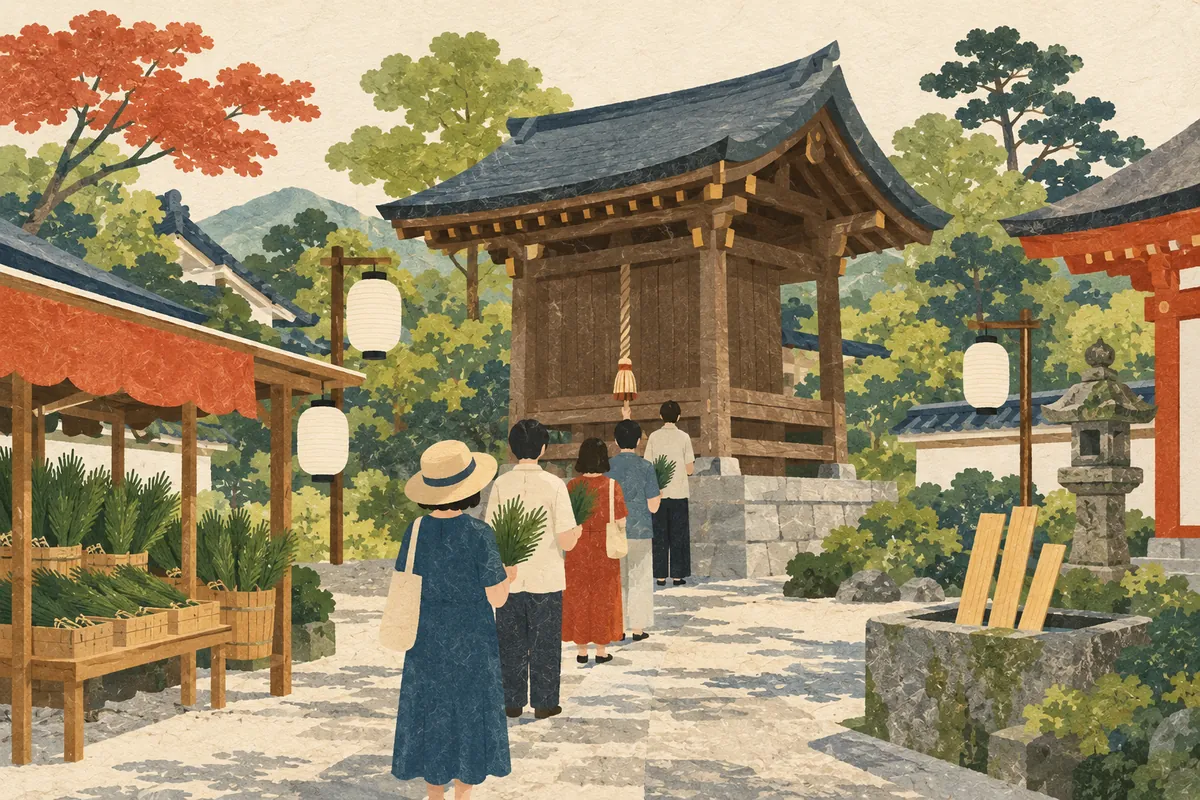
Rokudō Mairi (六道まいり) is a Kyoto event held before Obon, in which people visit Rokudō Chinnō-ji (六道珍皇寺) in Higashiyama Ward and ring the Mukae-gane (welcoming bell) to welcome the spirits of their ancestors, the oshōrai-san (お精霊さん); it is also called Shōrai-mukae. It usually runs for four days, August 7–10; in 2026 it was held from Friday, August 7, to Monday, August 10, from 6:00 a.m. to 10:00 p.m.Key points in 30 seconds
Held every year from August 7 to 10 at Rokudō Chinnō-ji in Higashiyama Ward
People ring the Mukae-gane and welcome the oshōrai-san with kōyamaki (Japanese umbrella pine) and mizu-tōba (wooden memorial tablets)
The area in front of the temple gate has long been regarded as the Rokudō no Tsuji, the border between this world and the next
Households observing their first Obon after a death are said by custom to always come to welcome the spirit
What Is Rokudō Mairi?
Rokudō Mairi is an event in which people visit Rokudō Chinnō-ji in Higashiyama Ward to welcome back the spirits of their ancestors, who return home for Obon. In Kyoto, there is a custom of visiting the temple on August 7–10, before Urabon (Obon), to welcome the spirits (mitama), and it is also called Shōrai-mukae ("welcoming the spirits").
In Kyoto, the ancestral spirits welcomed at Obon are affectionately called oshōrai-san (お精霊さん). The event is said to be rooted in customs of inviting and honoring ancestral spirits that existed even before Buddhism arrived, and to have continued for 600 years as an important Obon tradition in Kyoto.
The dates are announced by the temple each year. In 2026, it was held for four days, from Friday, August 7, to Monday, August 10, from 6:00 a.m. to 10:00 p.m. each day.
In What Order Do You Pay Your Respects?
Worshippers have a posthumous Buddhist name written on a mizu-tōba (wooden memorial tablet) in the main hall, then ring the Mukae-gane to welcome the oshōrai-san into this world. Next, they purify the mizu-tōba in incense smoke and, at the spot in front of the Jizō hall called Sai no Kawara, offer water to the mizu-tōba with kōyamaki leaves. This is called mizu-ekō (water offering).
Kōyamaki is usually bought at the flower stalls set up along the approach. The kōyamaki and mizu-tōba offered before the Mukae-gane are believed to hold the spirits of the ancestors and the newly deceased. For those who cannot come, there is also proxy memorial service in which the kōyamaki is delivered to their homes by August 13, when Obon begins—showing that the kōyamaki serves as a guide for welcoming the oshōrai-san home.
The order of steps in Rokudō Mairi
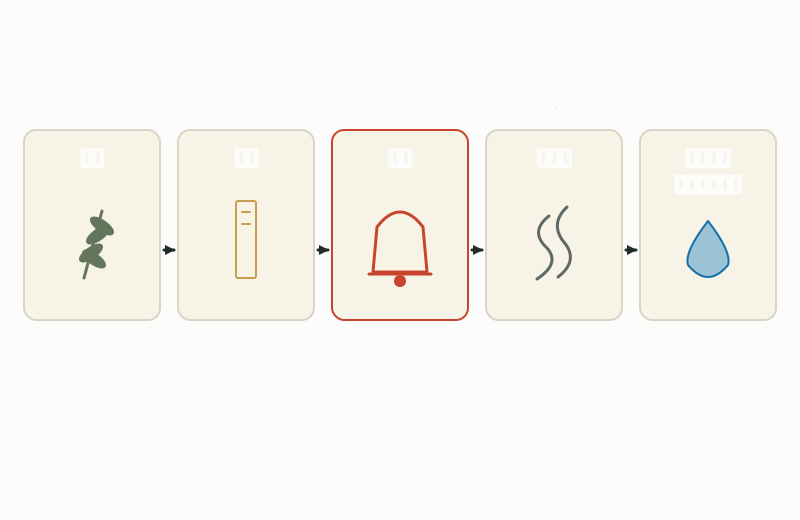
The route for paying respects at Rokudō Chinnō-ji
| Step | Place or item | What to do |
|---|---|---|
| 1 | Main gate and approach | Buy kōyamaki at the flower stalls along the approach |
| 2 | Main hall | Have a posthumous Buddhist name (or secular name, or "spirits of the ancestors of the __ family") written on a mizu-tōba |
| 3 | Bell tower | Ring the Mukae-gane and welcome the oshōrai-san |
| 4 | Incense stand | Purify the mizu-tōba in incense smoke |
| 5 | In front of the Jizō hall (Sai no Kawara) | Offer water to the mizu-tōba with kōyamaki leaves (mizu-ekō) |
Why Is This the "Entrance to the Other World"?
"Rokudō" refers to the six realms of Buddhism: hell, hungry ghosts, animals, asura (fighting demons), humans, and heaven. The crossroads where these paths part—the border between this world and the next—has long been said to lie around the grounds of Rokudō Chinnō-ji, and it was believed to be the entrance to the underworld. A stone monument reading "Rokudō no Tsuji" (the Crossroads of the Six Realms) stands in front of the gate.
The reasons given are that it lay on the route to Toribeno, the eastern burial ground of Heian-kyō, where funeral processions took place, and the legend that Ono no Takamura, an official of the early Heian period, traveled to the underworld through a well behind the main hall. The name "Rokudō no Tsuji" also appears in the tale collection Kojidan, suggesting it was known as a "passage to the underworld" from medieval times.
Ono no Takamura is said to have served the imperial court by day and worked at the court of Enma, king of the underworld, by night. This legend of him as an underworld official also appears in works such as the Gōdanshō and the Konjaku Monogatarishū, and was more or less established by the Muromachi period. In the grounds is the "Well for Commuting to the Underworld," and in recent years the "Well of Return from the Underworld," said to have been used to come back, was also found on the temple's former grounds.
How Far Does the Mukae-gane Reach?
This bell is called the Mukae-gane ("welcoming bell") because it is rung at Urabon to welcome the spirits, and it has been believed that its sound reaches all the way to the underworld, and that the dead are called back to this world in response to its toll.
There is a legend about the bell recorded in the Kojidan. Before the temple's founder, Keishun Sōzu, left for Tang China, he ordered that the bell be buried in the ground for three years, but a temple monk could not wait and dug it up after about a year and a half and rang it—and its sound is said to have reached the priest all the way in Tang China. A bell that could be heard in China, people believed, would surely reach the underworld too, and so it is said to have become the Mukae-gane.
First-Obon Households, and Spirit Welcoming at Other Temples
In Kyoto, it has long been said to be the custom that a household observing its first Obon after a death must come to Rokudō Chinnō-ji, the "Rokudō no Tsuji," to welcome the niibotoke (the newly deceased), who returns to the family home for the first time, so that the spirit does not lose its way. Households marking the first or third anniversary of a death are also accustomed to visiting with particular care.
Spirit welcoming called "Rokudō Mairi" is not unique to Rokudō Chinnō-ji. At Senbon Shaka-dō (Daihōon-ji) in Kamigyō Ward, because a complete set of statues of the Six Kannon, based on the belief in the six realms, is enshrined there, the temple holds "Rokudō Mairi Shōrai Mukae," welcoming the spirits on August 8–12 and sending them off on August 16.
The oshōrai-san welcomed at Obon are sent off when Obon ends. Summer events in 2026 also included the Kyoto Gozan Okuribi (Five Mountain Send-off Fires) on August 16 and the "Okuri-gane" (send-off bell) at Yata-dera. At Rokudō Chinnō-ji, a great segaki memorial service is usually held on August 17, the day after the Okuribi, after which the mizu-tōba are ritually burned to close the Obon observances.
Visiting, or If You Cannot Go
Rokudō Chinnō-ji is located at 595 Komatsu-chō, Yamatoōji-dōri Shijō-sagaru 4-chōme, Higashiyama Ward, Kyoto City. At ordinary times, the grounds are open for free worship. Because Rokudō Mairi is a midsummer event, visitors tend to crowd in the morning, and people are asked to spread out their visits to the cooler hours around midday or in the evening after sunset.
For those unable to visit, for example because they live far away, the temple again in 2026, as in the previous year, accepted requests for proxy memorial services online and by mail and delivered kōyamaki. Applications for 2026 closed on July 31; temple monks rang the Mukae-gane and performed mizu-ekō on behalf of the applicants. Application periods and methods are announced each year, so it is best to check the temple's official website.
Mini quiz for this entry
Check what you've read with 2 multiple-choice questions.
During Rokudō Mairi, what leaves are used to offer water to the mizu-tōba (wooden memorial tablets) at the spot called Sai no Kawara?
In the legend of Rokudō Chinnō-ji's Mukae-gane (welcoming bell), a bell that was ordered to stay buried for three years was dug up and rung after about a year and a half. How far did its sound reach?
Sources and verification
Content checked: October 11, 2026
Updated: October 11, 2026
References are in Japanese.