
Japanese平氏の六波羅と鎌倉幕府の探題
Rokuhara: From Taira Stronghold to Kamakura Shogunate Tandai
Other spellings and namesRokuhara / Rokuhara Tandai / Taira no Kiyomori / Jōkyū War
In short
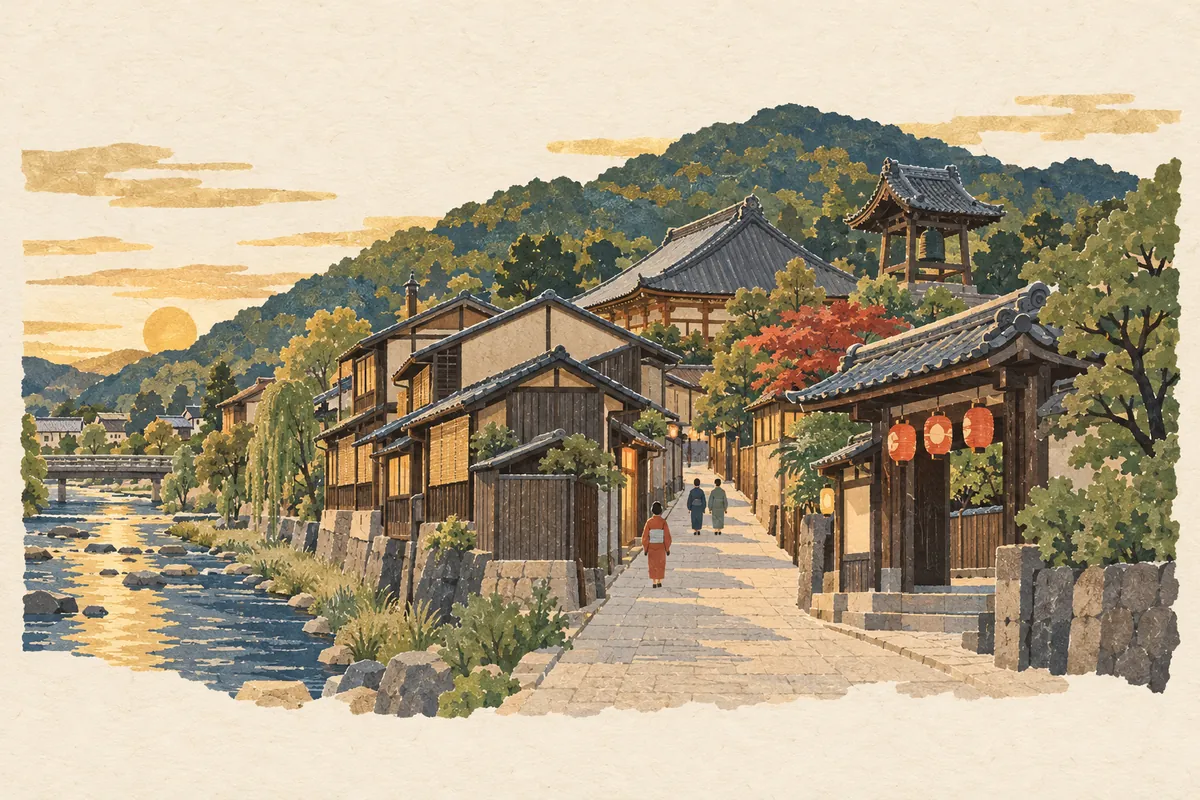
Rokuhara is a place name that referred to the area east of the Kamo River, from today's Matsubara-dōri to around Shichijō. In the late Heian period, the mansions of the Taira clan gathered here, and after the Jōkyū War the Kamakura shogunate's Rokuhara Tandai was established here as a base for watching over the imperial court and governing western Japan. Traces of the Taira mansions survive today in town names such as Tamon-chō, Kadowaki-chō, and Ikedono-chō.Key points in 30 seconds
A place name for the area on the east bank of the Kamo River from Matsubara-dōri to around Shichijō
The Taira clan's base in Kyoto; town names preserve traces of their mansions
The Rokuhara Tandai was established here after the Jōkyū War
It fell in 1333 to an attack by Ashikaga Takauji and others
The Taira clan rose to power in Taira no Kiyomori's time
In the late Heian period, the Taira clan expanded its power and reached its peak under Taira no Kiyomori.
The rise and fall of the Rokuhara Tandai
In Taira no Kiyomori's time, the mansions of the Taira clan lined Rokuhara.
After the Jōkyū War of 1221, Hōjō Yasutoki and Hōjō Tokifusa stayed at Rokuhara to deal with its aftermath; this was the origin of the Rokuhara Tandai.
In 1333, the Rokuhara Tandai was attacked by Ashikaga Takauji and others and fell.
The Rokuhara Tandai had one official each for the North (Kitakata) and the South (Minamikata), chosen from the Hōjō clan.
Where is Rokuhara? The origin of the name
In the past, Rokuhara referred to the area on the east bank of the Kamo River from Gojō Ōji (today's Matsubara-dōri) to Shichijō Ōji, and today it is used as the name of the area around the Rokuhara school district in Higashiyama Ward. It is also written 六原, and is said by some to derive from the old place name Rokurogahara (轆轤原), while others think it is probably named after Rokuharamitsu-ji temple.
This area was the gateway to Toribeno, a place for funerals and burials, and was regarded as the border between this world and the next. Saikō-ji (later Rokuharamitsu-ji), founded by Kūya in 963, and Chinkō-ji, with its legend that Ono no Takamura traveled to the afterlife from there, were built here, and the area in front of Chinkō-ji's gate is called Rokudō no Tsuji (the Crossroads of the Six Realms). Every year from August 7 to 10, it is crowded with people making Rokudō Mairi pilgrimages to welcome the spirits of their ancestors.
Rokuhara was also on the pilgrimage route to Kiyomizu-dera. The Ryōjin Hishō, a late Heian-period collection of songs, sings of how the Rokuhara-dō temple hall stood right after you crossed the Gojō stone bridge over the Kamo River. Note that Gojō-dōri at that time is today's Matsubara-dōri—the street in front of Chinkō-ji—and is in a different place from today's Gojō-dōri.
Taira mansions survive in town names
The Taira clan's link with Rokuhara began in the early 12th century, when Kiyomori's grandfather Taira no Masamori built a mansion and a Buddhist hall near Chinkō-ji. In Kiyomori's generation, the clan's mansions stood side by side, and traces of them remain in the town names of the area. Rokuhara lay on the route via Yamashina to the eastern provinces and to Ise and Iga, the Taira clan's home base, making it a key transport point.
In 1183 (Juei 2), however, when the Taira clan fled the capital with Emperor Antoku and the imperial regalia, they set fire to their own mansions at Rokuhara. The land was then given to Minamoto no Yoritomo, and after Hōjō Tokimasa came to Kyoto in 1185, the office of the Kyoto Shugo (Kyoto military governor) was set up here, leading in time to the Rokuhara Tandai.
Town names connected with Taira mansions
| Town name | Said to come from |
|---|---|
| 多門町 (Tamon-chō) | The main gate (sōmon) opened on the east side of the Rokuhara residence |
| 門脇町 (Kadowaki-chō) | Kadowaki-dono, the mansion of Taira no Norimori, which stood beside (waki) the gate (kado) |
| 三盛町 (Mitsumori-chō; formerly 泉殿町, Izumidono-chō) | Kiyomori's Izumidono mansion, which contained Jōkō-in and a guardian shrine |
| 池殿町 (Ikedono-chō) | The mansion of Kiyomori's stepmother, Ike no Zenni; Kiyomori's daughter Tokuko gave birth to Emperor Antoku here |
Walking the site of the Tandai
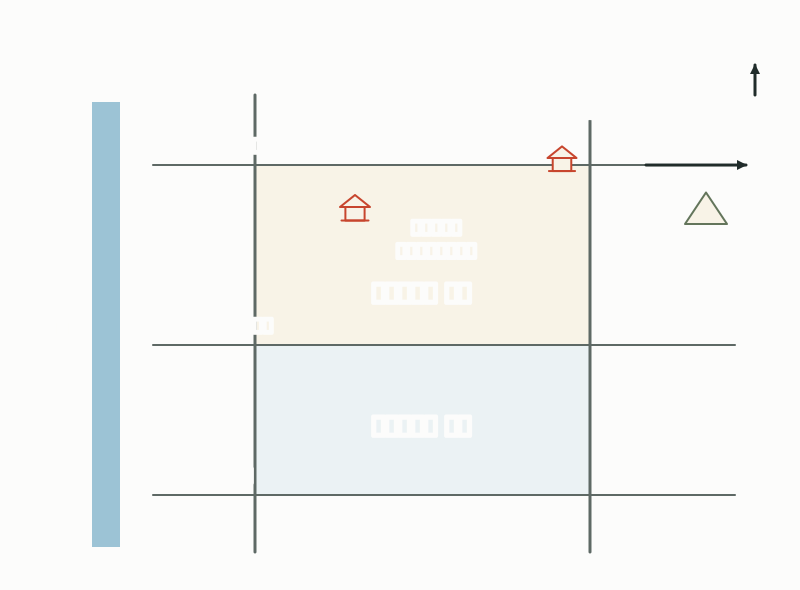
The North office of the Rokuhara Tandai stood from the end of Gojō (today's Matsubara-dōri) to the end of Rokujō-bōmon (today's Gojō-dōri), and the South office from the end of Rokujō-bōmon to the end of Rokujō (today's Shōmen-dōri). In the grounds of Rokuharamitsu-ji stands a stone marker reading "Site of the Taira Rokuhara Residence and the Kamakura Shogunate's Rokuhara Tandai." From the Muromachi period on, after the Tandai fell, Rokuhara turned into a place of faith and amusement, bustling with performing arts and ippuku issen tea sellers (who sold a cup of tea for one coin).
The main hall of Rokuharamitsu-ji was built in 1363 (Jōji 2) and is an Important Cultural Property. The standing statue of Kūya Shōnin, with six small Buddhas emerging from his mouth, is attributed to Kōshō, son of Unkei, and a sculpture said to depict Taira no Kiyomori also survives. Walking east along Matsubara-dōri, you follow the old pilgrimage route past Rokudō no Tsuji at Chinkō-ji toward Kiyomizu-dera.
The North and South offices of the Rokuhara Tandai
Mini quiz for this entry
Check what you've read with 3 multiple-choice questions.
Which warrior clan reached the height of its power under Taira no Kiyomori in the late Heian period?
Which warrior clan made Rokuhara a district of family residences in the late Heian period?
How were the heads of the Rokuhara Tandai organized?
Sources and verification
Content checked: October 11, 2026
Updated: October 11, 2026
References are in Japanese.