
Japanese化野(あだしの)
Adashino
Other spellings and namesあだし野 / Saga-Toriimoto-Adashino-chō / Adashino Nenbutsu-ji
In short
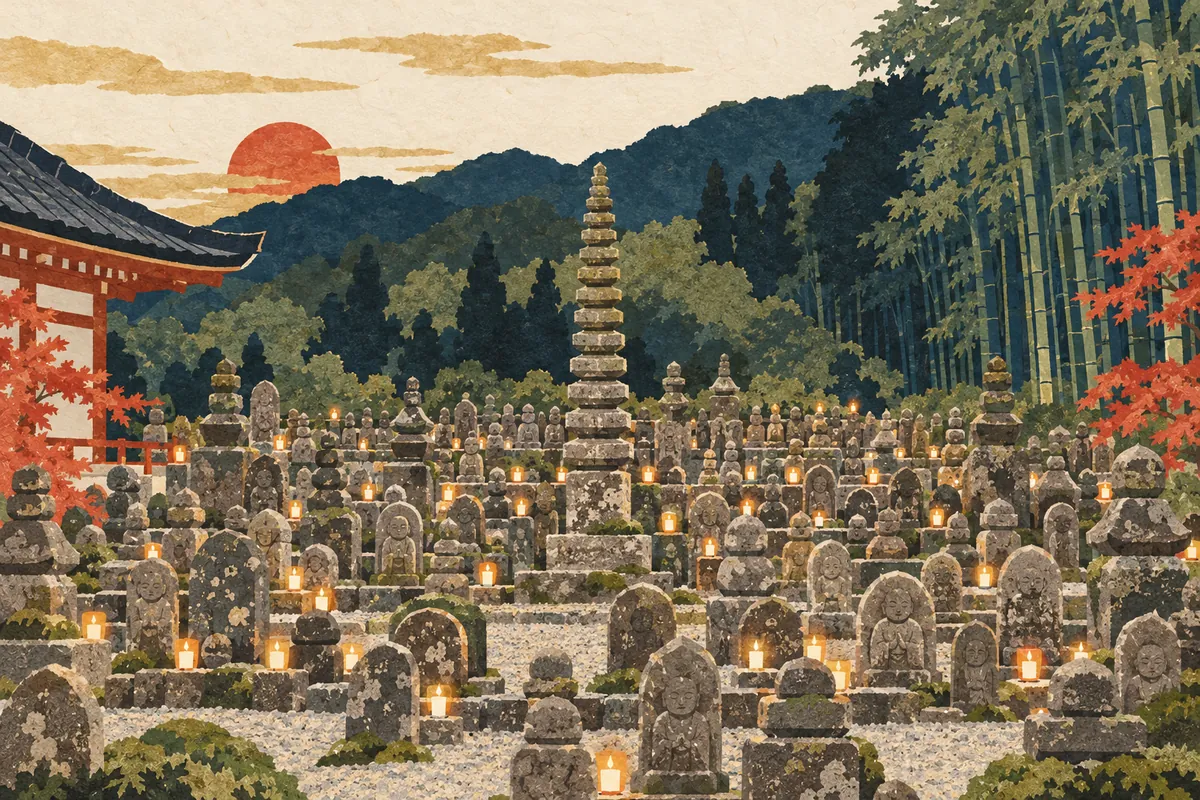
化野 is read Adashino and is a place name in Saga-Toriimoto, Ukyō Ward. Since ancient times it has been known, along with Toribeno and Rendaino, as a burial ground, and in waka poetry the phrase "the dew of Adashino" has been used to express the impermanence of life. At Adashino Nenbutsu-ji Temple there is the "Sai no Kawara," where stone Buddhas and stone pagodas once buried in the surrounding hills and fields have been gathered.Key points in 30 seconds
Read Adashino (あだしの). The town name is Saga-Toriimoto-Adashino-chō (さがとりいもとあだしのちょう)
A burial ground ranked alongside Toribeno and Rendaino
Adashi is said to mean fleeting or empty
The Sentō Kuyō, in which candles are lit for the stone Buddhas and pagodas, is held every August
Not "Bakeno" but "Adashino"
化野 is read Adashino. It is a place name in Saga-Toriimoto, Ukyō Ward, known for Adashino Nenbutsu-ji Temple. It still survives in addresses as the town name Saga-Toriimoto-Adashino-chō, Ukyō Ward.
The town name is read さがとりいもとあだしのちょう (Saga-Toriimoto-Adashino-chō). Reading the kanji 化 as adashi is hard to guess from its usual readings. Kyoto has many town names that are difficult to read or unusual, so learning them together with their origins makes them easier to remember.
A burial ground ranked with Toribeno and Rendaino
Since ancient times, Adashino has been known as a burial ground along with Toribeno and Rendaino, and in waka poetry "the dew of Adashino" (化野の露) has been used as an expression for the impermanence of life. Adashino Nenbutsu-ji hands down that this area has been a place for laying the dead to rest since the Heian period, first by exposure to the elements and later by burial in the ground.
Looking at today's town names, the name Rendaino survives in Murasakino-Nishi-Rendaino-chō and Murasakino-Higashi-Rendaino-chō in Kita Ward, and the name Toribe survives in Imagumano-Toribeyama-chō (いまぐまのとりべやまちょう) in Higashiyama Ward. In places as far apart as Saga, Murasakino, and Higashiyama, place names tied to funerals and burial are still handed down today.
Places spoken of together as burial grounds, and town names that preserve them
| Place name | Reading | Example of a town name that preserves it (ward) |
|---|---|---|
| 化野 | Adashino (あだしの) | Saga-Toriimoto-Adashino-chō (Ukyō Ward) |
| 蓮台野 | Rendaino (れんだいの) | Murasakino-Nishi-Rendaino-chō and Murasakino-Higashi-Rendaino-chō (Kita Ward) |
| 鳥辺野 | Toribeno (とりべの) | Imagumano-Toribeyama-chō (Higashiyama Ward) |
The meaning of adashi and the temple's stone Buddhas
Adashi is said to mean fleeting or empty. The character 化 ("to change") is said to express life (生) changing into death (死), as well as the wish to be reborn into this world or to be born in the Pure Land of Paradise. The stone Buddhas and stone pagodas lined up in the grounds of Adashino Nenbutsu-ji were once scattered and buried in the hills and fields of Adashino, and they were gathered by local people in the mid-Meiji period.
The gathered stone Buddhas and pagodas are enshrined in an area called the Sai no Kawara (西院の河原, "riverbed of Sai"), with a thirteen-story pagoda and a seated statue of Amida Nyorai at the center. The name is said to come from Sai no Kawara (賽の河原), the riverbank of the underworld, and to evoke the story of children told in the Jizō hymn (Jizō wasan) attributed to the priest Kūya.
The temple's history and the Sentō Kuyō
The formal name of Adashino Nenbutsu-ji is Kasaizan Tōzen-in Nenbutsu-ji, and it now belongs to the Jōdo (Pure Land) school. According to temple tradition, it was founded about 1,200 years ago by Kōbō Daishi Kūkai to honor the people buried here.
Temple tradition further says that during the Kōnin era (810–824), Kūkai buried a thousand stone Buddhas, set up stone statues of the Five Wisdom Buddhas (Gochi Nyorai) on the riverbank, built a hall, and called it Gochi Nyorai-ji. It was originally a Shingon temple, but in the early Kamakura period it became a hall for Hōnen's continuous nenbutsu practice, was converted to the Jōdo school, and came to be called Nenbutsu-ji. The present main hall is said to have been rebuilt in 1712.
The Sentō Kuyō ("thousand-lantern memorial service"), in which candles are lit for the stone Buddhas and pagodas of the Sai no Kawara, is known as a summer evening event. As of October 2026 it is said to be held on the last Saturday and Sunday of August, but some sources give August 23 and 24, so the dates should be checked each year.
Visiting: deep in Saga, at Toriimoto
Adashino Nenbutsu-ji stands at the foot of the mountains in Oku-Saga, beyond Arashiyama. At the back of the grounds stretches a grove of mōsō bamboo, and the scenery changes with each flight of steps you climb. Visiting hours start at 9:00 (last admission 16:30; 15:30 in January, February, and December), but they may change because of events or weather, so check the temple's official website before you go.
If you walk through the Sai no Kawara, with its countless stone Buddhas, knowing the area's history as a burial ground, the sense of impermanence in the phrase "the dew of Adashino" comes through with real feeling. The stone Buddhas are objects of worship, so please visit quietly.
Mini quiz for this entry
Check what you've read with 2 multiple-choice questions.
How is 化野, a place name in Saga-Toriimoto, Ukyō Ward, read?
Along with Toribeno and Rendaino, Adashino has long been known as what kind of place?
Sources and verification
Content checked: October 11, 2026
Updated: October 11, 2026
References are in Japanese.