
Japanese番組小学校(ばんぐみしょうがっこう)
Bangumi Elementary Schools
Other spellings and namesBangumi schools (番組学校) / Kyoto's community-district elementary schools
In short
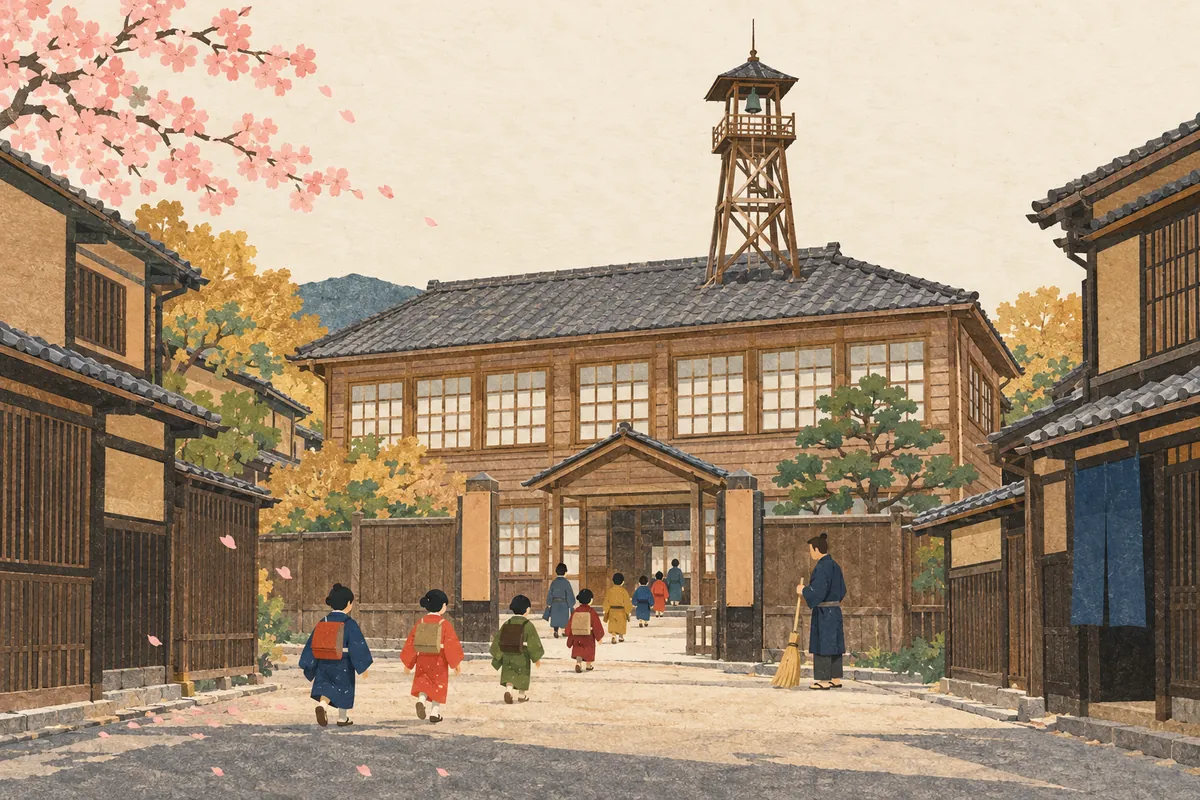
The bangumi elementary schools were 64 schools opened in 1869 (Meiji 2), one for each bangumi—a reorganized unit of Kyoto's chōgumi (neighborhood federations). They opened three years before Japan's national school system, residents bore the costs through kamadokin and other contributions, and the schools became community hubs that also housed a town office, a police box, and a fire lookout tower.Key points in 30 seconds
The first two schools opened on May 21, 1869 (Meiji 2)
64 schools for 65 chōgumi (because in one case two groups shared a school)
Supported by kamadokin, contributed by every household with a kamado (cooking stove)
The bangumi areas carry on in today's motogakku (former school districts)
Kyoto's elementary schools came before the national school system
In 1869 (Meiji 2), elementary schools opened in Kyoto in each bangumi, the units formed by reorganizing the chōgumi of Kamigyō and Shimogyō. This was before the national school system (Gakusei) was proclaimed in 1872 (Meiji 5). For the 65 bangumi of Kamigyō and Shimogyō combined, 64 schools opened.
Once the new chōgumi were established by the second chōgumi reform at the end of January 1869, school building moved forward rapidly. On May 21, opening ceremonies were held at the Kamigyō 27th Bangumi (Ryūchi) Elementary School and the Shimogyō 14th Bangumi (Shūtoku) Elementary School, and all the schools opened within that year.
The last to open, on December 21, was the elementary school of Kamigyō's 28th and 29th bangumi (Kyōgoku). Because these two groups jointly built one school, there were 64 schools for 65 chōgumi. The bangumi elementary schools are also called "Japan's first community-district elementary schools."
Number of chōgumi and bangumi elementary schools in Kamigyō and Shimogyō
- Kamigyō
- Shimogyō
- First chōgumi reform (1868)
- Second chōgumi reform (1869)
- Bangumi elementary schools (end of 1869)
Supported by townspeople through "kamadokin"
Local residents were deeply involved in founding and running the schools. In Kyoto, whose population had fallen sharply from the end of the Edo period into the Meiji era, the townspeople (machishū) are said to have believed that "building a town starts with building people." Every household with a kamado (cooking stove), whether or not it had children, contributed kamadokin (竈金, "stove money") to found and run the 64 elementary schools.
Many school buildings were provided through donations from local volunteers or on part of the grounds of temples and shrines; they had no playgrounds and were not much larger than ordinary houses. Under the prefecture's own rules, lessons centered on three subjects: calligraphy (hitsudō), arithmetic, and reading.
How were they different from terakoya?
Since the Edo period, Kyoto had a tradition of private academies teaching Chinese learning, National Learning, Western learning, and Shingaku, as well as terakoya (small private schools for commoners). In 1867 (Keiō 3), Nishitani Kisui, who ran a terakoya, petitioned for the establishment of a teaching institution, and Makimura Masanao, who later became governor of the prefecture, strongly pushed a plan to build one elementary school for each group as a place to practice reading, calligraphy, and arithmetic.
The big difference is that whereas terakoya were schools run by individuals, the bangumi elementary schools were set up for each chōgumi, a community unit, and that chōgumi paid the costs. This is why the bangumi schools are described as "community-district" elementary schools.
Both a school and the town's all-purpose office
Kyoto Prefecture planned for each chōgumi to have an elementary school together with a chōgumi meeting hall, so the bangumi schools were both town offices and local branches of the prefecture. The schools housed police and police boxes (kōban) and fire lookout towers (bōkarō), and they also handled health-center-like work such as garbage disposal and vaccinations. The chōgumi paid all of these costs.
Under the revised Elementary School Order of 1890 (Meiji 23), control of the schools passed to Kyoto City, but residents kept a deep-rooted sense that the schools were "their own" and symbols of their school district. This led to activities organized by school district, such as federations of neighborhood associations, sports promotion associations, and local fire brigade units.
Memories that live on as motogakku
Even after schools were merged and closed, the school districts based on the bangumi schools remained as units of local community. The motogakku (former school district) names still in use today, and the facilities reused after schools closed, carry the history of communities that built and supported their schools.
Comparing the bangumi of 1869 with today's motogakku, for example, Kamigyō's 27th Bangumi corresponds to Ryūchi, and Shimogyō's 11th Bangumi to Kaichi. The same motogakku name appears for two bangumi in some cases because school districts were merged in 1892 (Meiji 25).
Where can you see them today?
To learn about the history of the bangumi elementary schools in one place, visit the Kyoto Municipal Museum of School History on Gokōmachi-dōri south of Bukkōji (Gokōmachi-dōri Bukkōji sagaru), Shimogyō Ward. Housed in the former Kaichi Elementary School building, it presents the history of education in Kyoto, centering on the 64 bangumi schools, through school cultural properties and historical materials. Check the official information for opening days and fees before you visit.
Some buildings of closed bangumi schools are now used as other facilities. At the Kyoto Art Center (former Meirin Elementary School) and the Kyoto International Manga Museum (former Tatsuike Elementary School), the main gates and walls are Registered Tangible Cultural Properties of Japan.
- Kyoto Municipal Museum of School History (Gokōmachi-dōri Bukkōji sagaru, Shimogyō Ward; former Kaichi Elementary School)
- Stone marker "Ryūchi School, Japan's First Elementary School" (north side of Oike-dōri east of Yanagi-no-banba, Nakagyō Ward)
- Kyoto Art Center (former Meirin Elementary School) and Kyoto International Manga Museum (former Tatsuike Elementary School)
Mini quiz for this entry
Check what you've read with 3 multiple-choice questions.
How many bangumi elementary schools opened in Kyoto in 1869?
What was the money called that every household with a kamado (cooking stove), whether or not it had children, contributed to build and run the bangumi elementary schools?
Which of these events happened in 1869?
Sources and verification
Content checked: October 11, 2026
Updated: October 11, 2026
References are in Japanese.