
Japanese町組(ちょうぐみ)
Chōgumi
Other spellings and namesChōgumi of Kamigyō and Shimogyō / Sōchō (惣町) / Chōgumi reforms (町組改正)
In short
A chōgumi (町組) was a self-governing organization in which several of Kyoto's chō—neighborhoods formed on both sides of a street—joined together as a regional federation. Chōgumi took shape around the 16th century and were reorganized into 65 groups in two chōgumi reforms in the early Meiji period. These groups became the units for the bangumi elementary schools and carry on in today's motogakku (former school districts).Key points in 30 seconds
A self-governing federation of several chō (neighborhoods)
Formed in Kamigyō and Shimogyō around the 16th century
Reorganized in the chōgumi reforms of 1868 and 1869 (Meiji 1 and 2)
The 65 chōgumi of 1869 are the prototype of today's motogakku
Layers: chō, chōgumi, and sōchō
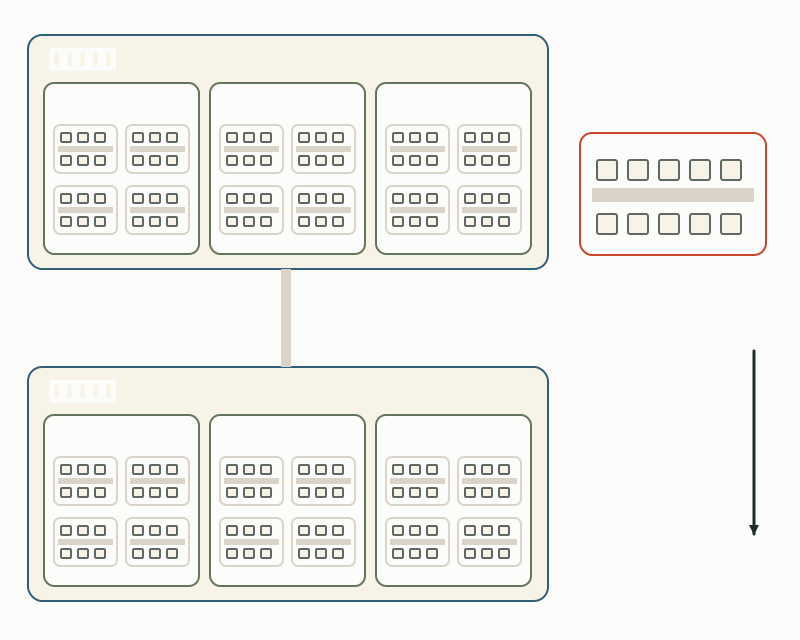
A chō (町) in Kyoto is a community made up of houses facing each other across a street. By the mid-16th century, several chō in each of Kamigyō and Shimogyō are said to have joined together to form chōgumi, and above those, the sōchō (惣町) organizations of Kamigyō and Shimogyō were established.
A chōgumi is a self-governing organization in which chō formed on both sides of a street joined together as a regional federation. Its prototype, formed around the early 16th century, is said to have expanded and developed and continued until 1868 (Meiji 1). The starting point for understanding chōgumi is that each chō is a ryōgawachō ("both-sides town"), formed on both sides of a single street.
Layers of chō, chōgumi, and sōchō
What the chōgumi did in an age of war
Triggered by the Ōnin War, the residents of Kyoto developed self-governing organizations to protect their own lives. It is said that in the mid-16th century the chō around the Dairi (Imperial Palace) came together to form the Rokuchō ("Six Towns"), and chōgumi were later formed in Shimogyō and Kamigyō as well.
Based on their chō, the people of Kamigyō and Shimogyō carried out self-governing activities: seeking exemption from duties such as labor service, and maintaining the safety of daily life and their festivals. In time, the chō and chōgumi also came to systematically build and maintain kamae, defensive enclosures that protected their living space. The sōchō of Shimogyō revived the Gion Festival, which had been interrupted by the Ōnin War.
The townspeople (machishū) gathered at a shared hall (sōdō) to discuss the various problems of their town. In the Sengoku period, regulations (hatto) were set for each chō, and town rules called chōshikimoku are also said to have spread. The chō and chōgumi became the foundation of the lives of Kyoto's common people.
Reborn in the Meiji chōgumi reforms
After continuing until 1868 (Meiji 1), the chōgumi were reorganized by Kyoto Prefecture. In the first chōgumi reform of November 1868, the distinctions between oyamachi (parent towns), edamachi (branch towns), and shinmachi (new towns) were abolished, and the city was divided at Nijō-dōri into 45 groups in Kamigyō and 41 in Shimogyō. Kamigyō and Shimogyō were made the Upper and Lower Great Groups (kami-ōgumi and shimo-ōgumi), with ōdoshiyori (chief elders) appointed by the governor. Each group had nakadoshiyori and soedoshiyori (assistant elders), publicly chosen from within the group for one-year terms, who also took turns working at the prefectural office.
Because the number of chō per group had not been evened out enough, the second chōgumi reform of 1869 (Meiji 2) set the boundary at Sanjō-dōri and created 65 chōgumi in all: 33 in Kamigyō and 32 in Shimogyō. Each group is said to have had an average of 26 to 27 chō, and once the new chōgumi were in place at the end of January 1869, the building of elementary schools moved forward rapidly.
The boundary between Kamigyō and Shimogyō in the chōgumi reforms
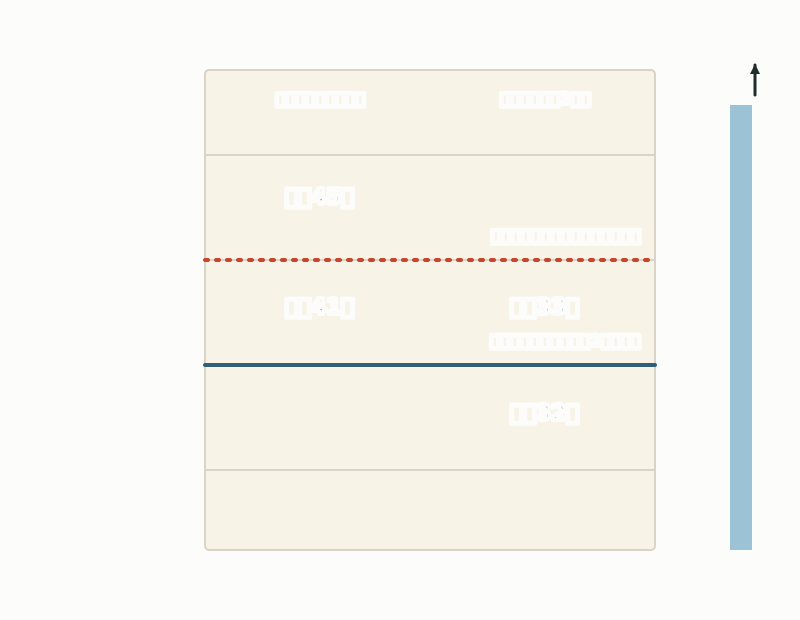
Comparing the two chōgumi reforms
| First chōgumi reform | Second chōgumi reform | |
|---|---|---|
| Date | November 1868 (Meiji 1) | 1869 (Meiji 2) |
| Boundary between Kamigyō and Shimogyō | Nijō-dōri | Sanjō-dōri |
| Number of groups | Kamigyō 45, Shimogyō 41 | Kamigyō 33, Shimogyō 32 (65 in total) |
| Size of one group | Based on units of 20 chō | An average of 26 to 27 chō |
| Main changes | Abolished the distinctions between parent, branch, and new towns; placed nakadoshiyori and soedoshiyori in each group | Evened out the uneven numbers of chō and made the groups the basis of the new administration |
On to the bangumi schools and motogakku
The chōgumi created by the second chōgumi reform were called "Kamigyō No. X Bangumi" or "Shimogyō No. X Bangumi," and an elementary school was built for each bangumi. These are the bangumi elementary schools. Because Kamigyō's 28th and 29th bangumi jointly built one school, there were 64 elementary schools for 65 chōgumi.
Shimogyō's 33rd Bangumi (Yasaka) was a group split off from Shimogyō's 24th Bangumi just after the second chōgumi reform. Later, the system in which a chōgumi equaled an elementary school district continued under the national school system as well, and while changing names—ku, kumi, gakku—it became the prototype of today's motogakku.
Sorting out similar terms, and how to look things up
The words for Kyoto's community units overlap from era to era. Roughly speaking, the chō is the smallest unit; a group of chō is a chōgumi; the chōgumi after the Meiji reforms are the bangumi; the later elementary school districts are gakku; and those that remained as community units even after schools were merged or closed are motogakku.
If you want to know which bangumi your area corresponds to, the "Table Comparing the Bangumi of 1869 with Present Motogakku" published by Kyoto City is a good clue. Once you know the motogakku name, you can trace which numbered bangumi of Kamigyō or Shimogyō it was.
- Chō (町): a community of houses on both sides of a street
- Chōgumi (町組): a self-governing federation of several chō (16th century to 1868)
- Sōchō (惣町): the organization uniting the chōgumi of Kamigyō or of Shimogyō
- Bangumi (番組): the 65 chōgumi after the second chōgumi reform of 1869
- Motogakku (元学区): a unit inherited from the bangumi and school districts, still used for community activities
Mini quiz for this entry
Check what you've read with 2 multiple-choice questions.
Kyoto's chōgumi (町組) were federations formed by grouping what?
In the second chōgumi reform of 1869 (Meiji 2), which street became the boundary between the chōgumi of Kamigyō and Shimogyō?
Sources and verification
Content checked: October 11, 2026
Updated: October 11, 2026
References are in Japanese.