
Japanese北野天満宮と天神さんの25日
Kitano Tenmangu and Tenjin-san on the 25th
Other spellings and namesKitano Tenmangū / Tenjin-san / Sugawara no Michizane / Tenjin Market / Gongen-zukuri / Toyotomi Hideyori / 北野天満宮
In short
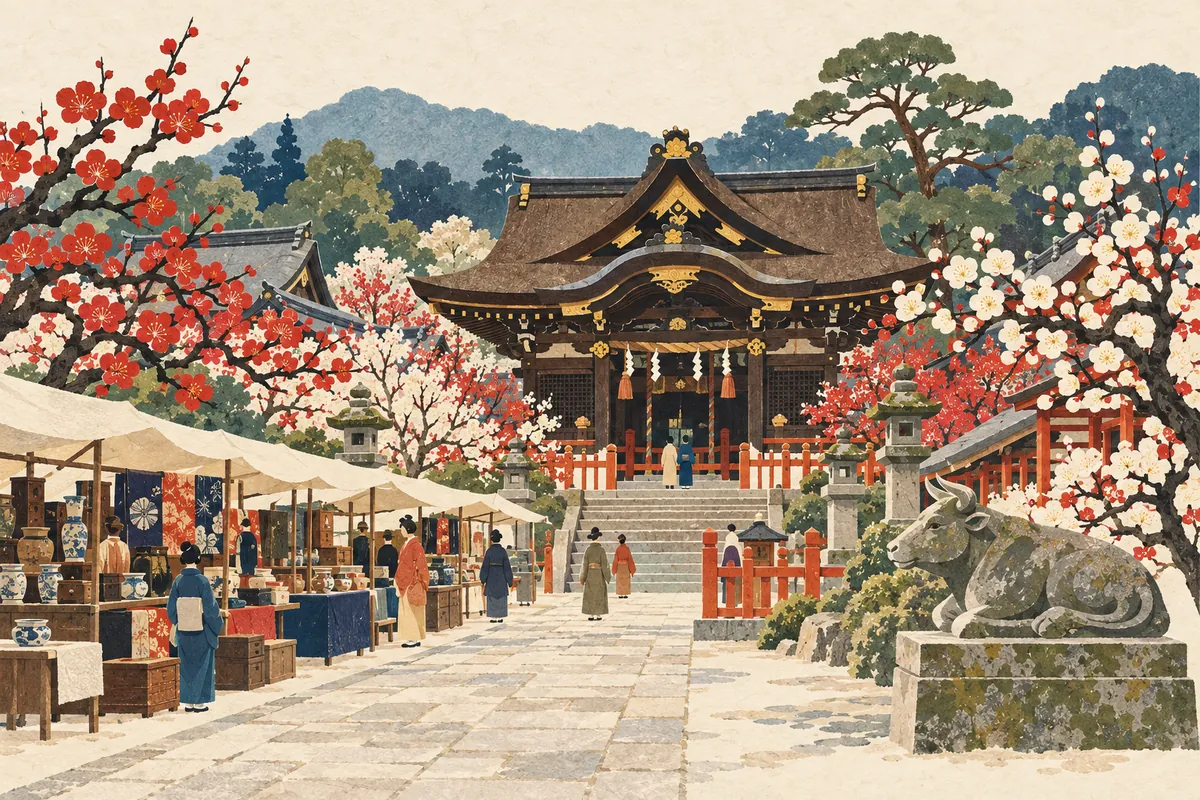
Kitano Tenmangū enshrines Sugawara no Michizane and is the head shrine of about 12,000 Tenmangū and Tenjin shrines across Japan. It is said to have been founded in 947 at Kitano, northwest of Heian-kyō. The Tenjin Market on the 25th of every month reflects the dates of Michizane's birth and death, and the current main hall was built by Toyotomi Hideyori.Key points in 30 seconds
Head shrine of the Tenmangū and Tenjin shrines that enshrine Sugawara no Michizane
Said to have been founded in 947
The Tenjin Market is held on the 25th of every month; January's is Hatsu-Tenjin and December's is Shimai-Tenjin
The grounds have about 1,500 plum trees of about 50 varieties, and remains of the Odoi historic site
Sugawara no Michizane, the deity of learning
Kitano Tenmangū enshrines Sugawara no Michizane, who is cherished as the deity of learning.
Kitano Tenmangū is said to have been founded in 947. It is the head shrine of the Tenmangū shrines that enshrine Sugawara no Michizane.
The current main hall, a National Treasure, was built by Toyotomi Hideyori in 1607.
The main hall of Kitano Tenmangū is known as a representative surviving example of the Gongen-zukuri style.
The Tenjin Market on the 25th of every month
The Tenjin Market is held on the 25th of every month. This reflects the fact that both Sugawara no Michizane's birth date and death date fell on the 25th.
Why was Michizane enshrined at Kitano?
Sugawara no Michizane became Minister of the Right in 899 (Shōtai 2) and governed alongside the Minister of the Left, Fujiwara no Tokihira. In 901 (Shōtai 4), however, he was demoted and sent to Kyushu as Provisional Governor-General of Dazaifu, and two years later, on the 25th day of the 2nd month of 903 (Engi 3), he died at Dazaifu.
The Tenmangū is said to have been founded in 947 (Tenryaku 1), following a divine oracle, at Kitano, to the northwest of Heian-kyō, the direction known as the "Gate of Heaven" (tenmon). Later, Emperor Ichijō sent an imperial envoy in 987, and in 1004 he visited in person. Within only about half a century of its founding, it had become a shrine that emperors visited.
Main events in the history of Sugawara no Michizane and Kitano Tenmangū
| Year | Event |
|---|---|
| 899 (Shōtai 2) | Michizane is appointed Minister of the Right |
| 901 (Shōtai 4) | Demoted and sent to Kyushu as Provisional Governor-General of Dazaifu |
| 903 (Engi 3) | Dies at Dazaifu on the 25th day of the 2nd month |
| 947 (Tenryaku 1) | The shrine is said to have been founded at Kitano |
| 987 (Eien 1) | Emperor Ichijō sends an imperial envoy |
| 1004 (Kankō 1) | Emperor Ichijō visits the shrine |
| 1591 (Tenshō 19) | Toyotomi Hideyoshi builds the Odoi earthworks (still remaining in the grounds) |
| 1607 (Keichō 12) | Toyotomi Hideyori builds the main hall (National Treasure) |
Tenjin-san means plum blossoms
Kitano Tenmangū's plum garden, Hana no Niwa, is planted with about 1,500 plum trees of about 50 varieties, associated with Michizane. There is also the legend of the Tobiume ("flying plum"): before leaving for Dazaifu, Michizane composed a poem as if speaking to his beloved plum tree, and in 907 (Engi 7) the tree is said to have flown to Anraku-ji temple in Dazaifu to be with him.
On February 25, the anniversary of Michizane's death, the Baikasai (Plum Blossom Festival) is held, and offerings decorated with sprigs from 42 white plum and 33 red plum trees carry the meaning of warding off the major unlucky ages of men and women. The plum garden is usually open from early February to late March, but in 2026 it was open from February 1 to May 24. Early-blooming plums start to flower right after the New Year.
On the day of the Baikasai, an outdoor tea ceremony called the Baikasai Nodate Ōchanoyu is also held, drawing many plum-blossom viewers. The middle gate in front of the main hall is called Sankō-mon, and it bears an imperial plaque reading "Tenmangū," written by Emperor Gosai. If you visit in plum season, look up at the plaque on the gate too.
If you visit the Tenjin Market, see the Odoi in the grounds too
At the Tenjin Market on the 25th of every month, stalls selling antiques, secondhand goods, used clothing, and more line the grounds, and it is considered one of Kyoto's two great temple-and-shrine fairs, along with the Kōbō Market at Tō-ji. Hatsu-Tenjin in January and Shimai-Tenjin in December are especially lively. It runs roughly from 7 a.m. to around sunset, and since arrangements may change, it is safest to check the official website in advance.
In the grounds, the Odoi earthworks that Toyotomi Hideyoshi built in 1591 remain as the Odoi Historic Site Momiji-en (maple garden), with about 350 maple trees, including the Mitsumata no Momiji (three-forked maple), said to be more than 400 years old. The vermilion Uguisu Bridge spans the Kamiya River. The 2026 autumn opening runs from October 31 to December 6. The main hall is called Yatsumune-zukuri and is a representative surviving example of Momoyama architecture that became the prototype of the Gongen-zukuri style.
Mini quiz for this entry
Check what you've read with 3 multiple-choice questions.
Who is enshrined at Kitano Tenmangu Shrine?
Which of these events happened in 947?
Who had Kitano Tenmangu's main sanctuary rebuilt in 1607?
Sources and verification
Content checked: October 11, 2026
Updated: October 11, 2026
References are in Japanese.