
Japanese東寺金堂・三宝院唐門・南禅寺方丈(とうじこんどう・さんぼういんからもん・なんぜんじほうじょう)
Tō-ji Kondō, Sanbō-in Karamon, and Nanzen-ji Hōjō
Other spellings and namesToji Kondo (東寺金堂) / Sanboin Karamon gate (三宝院唐門) / Nanzenji Ohojo (南禅寺大方丈) / Kyoto National Treasure architecture
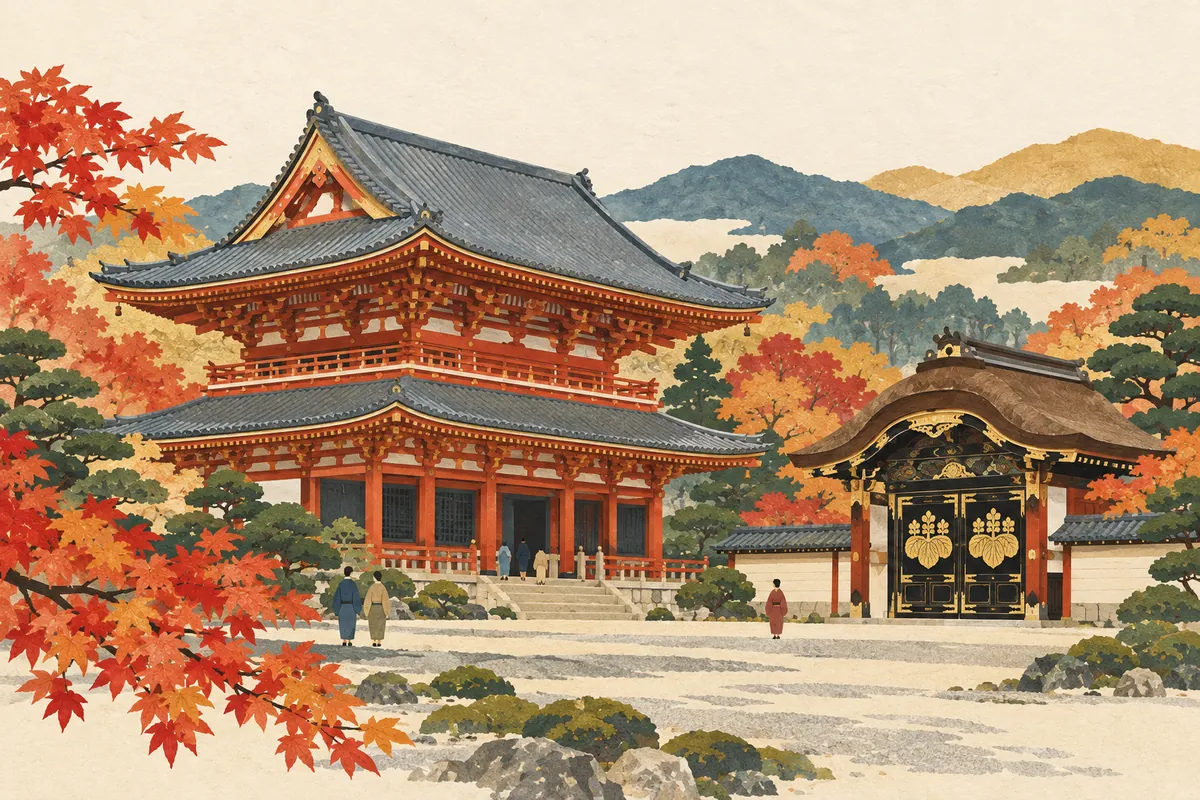
In short
Kyoto's National Treasure buildings are distinctive not only in appearance but also in how they blend several styles, in their roofing materials, and in their histories of relocation. The Kondō of Tō-ji, the Karamon gate of Daigo-ji's Sanbō-in, and the Hōjō of Nanzen-ji all date from around the Momoyama period, and comparing their histories of rebuilding, relocation, and reuse reveals the time each building has lived through.Key points in 30 seconds
Tō-ji's Kondō mixes the wayō (Japanese), zenshūyō (Zen), and daibutsuyō (Great Buddha) styles and was rebuilt in 1603
Sanbō-in's Karamon is a hira-karamon gate roofed with cypress bark; its lacquer and gold leaf were restored in a 2010 repair
Nanzen-ji's Ōhōjō is a former Imperial Palace building moved here in 1610
All three buildings are designated National Treasures
Tō-ji's Kondō, Where Three Styles Overlap
The Kondō (main hall) of Kyōōgokoku-ji (Tō-ji) is designated a National Treasure.
Tō-ji's Kondō burned down in 1485 and was rebuilt in 1603 (Keichō 8).
Tō-ji's Kondō is a Momoyama-period building that harmonizes three styles: wayō, zenshūyō, and daibutsuyō.
Sanbō-in's Karamon, Moved More Than Once
Sanbō-in's Karamon is built with a karahafu (cusped) gable, and its roof is thatched with cypress bark (hiwadabuki).
Sanbō-in's Karamon was built in 1599 (Keichō 4) as a heichūmon, a gate set in a wall.
Sanbō-in's Karamon was moved twice, in 1615 and around the An'ei era, before settling in its present location.
Nanzen-ji's Hōjō, a Former Imperial Palace Building
Nanzen-ji's Ōhōjō (Great Abbot's Quarters) is an old palace building that was granted to the temple and moved here when the Imperial Palace was rebuilt in 1610.
In 1610 (Keichō 15), on the occasion of the rebuilding of the Imperial Palace, an old palace building was granted to the temple and moved here; that is today's Ōhōjō.
Comparing the Three National Treasures
Put the three side by side and you can see that all were completed between the end of the Warring States period and the beginning of the Edo period, and that each has a different roofing material. Comparing tile, hiwada (cypress bark), and kokera (thin wooden shingles) shows how different buildings that are all "National Treasure architecture" can look.
Comparing Tō-ji's Kondō, Sanbō-in's Karamon, and Nanzen-ji's Hōjō
| Building | Location | Date of the present building | Form and roof | National Treasure designation |
|---|---|---|---|---|
| Kondō of Kyōōgokoku-ji (Tō-ji) | Kujō-chō, Minami Ward | Rebuilt in 1603 | Irimoya (hip-and-gable) roof with hon-kawara tiles; with a mokoshi (pent roof) | 1953 |
| Karamon of Daigo-ji Sanbō-in | Daigo Higashiōji-chō, Fushimi Ward | Built in 1599 | Three-bay, single-entrance hira-karamon gate; cypress-bark roof | 1954 |
| Hōjō of Nanzen-ji (Ōhōjō and Shōhōjō) | Nanzenji Fukuchi-chō, Sakyō Ward | Moved here in 1610 (Ōhōjō) | Ōhōjō: irimoya roof with kokera shingles | 1953 |
Tō-ji's Kondō Keeps Its Heian-Period Location and Size
Tō-ji's Kondō was first built in 796 (Enryaku 15), soon after Heian-kyō was founded. The present building was rebuilt in 1603 (Keichō 8) after the hall burned in 1485, but during dismantling and repair in 1940 (Shōwa 15), foundation stones, paving stones, and part of the altar platform from the original building were found, confirming that the location and scale are almost exactly as they were.
The building is a single-story hip-and-gable structure whose core measures five bays across the front and three bays deep, with a mokoshi (pent roof) around the first story. When you look at it, focusing on the bracketing under the eaves and on the mokoshi at the front makes the mix of the three styles easy to see. It is distinguished by its three-stepped bracketing in the daibutsuyō style and by the raised center of the mokoshi. It is regarded as a masterpiece of Momoyama-period Buddhist architecture because it blends different styles while bringing them together into a single unified form.
The Karamon and the Hōjō Are Buildings That "Moved In"
Sanbō-in's Karamon was built in 1599 as a heichūmon (a gate set in a wall) and settled in its present location after being moved twice. In a partial dismantling and repair in 2010, its lacquer coating and gold leaf were restored, and it was also found that parts from other gates had been reused in it. The large relief carvings of the paulownia crest (go-shichi no kiri) on its doors express the spirit of the Momoyama period, and it is considered one of the finest surviving hira-karamon gates.
Nanzen-ji was originally a detached palace built by the Retired Emperor Kameyama in the Kōan era (1278–1288) and later converted into a Zen temple. In other words, buildings from the Imperial Palace were later moved to a temple that already had ties to an imperial residence.
Nanzen-ji lost its halls to fire during the fighting of 1467 (Ōnin 1), and today's Ōhōjō is an old Imperial Palace building that was granted to the temple and moved here in 1610. The original palace building has not been identified; one theory says it was the Seiryōden and another the palace of an empress dowager (nyoin gosho). Many points in its transom carvings, ceilings, and wooden paneled doors are said to match the style of the Seiryōden, and it is valued as a building that preserves the appearance of palace architecture well. The Shōhōjō (Small Abbot's Quarters) attached to the Ōhōjō is sometimes said to have been added around the Kan'ei era (1624–1644), but this is not certain.
Mini quiz for this entry
Check what you've read with 3 multiple-choice questions.
How is To-ji's Kondo classified on Cultural Heritage Online?
Which of these events happened in 1603?
Which three architectural styles are combined in To-ji's present Kondo?
Sources and verification
Content checked: October 11, 2026
Updated: October 11, 2026
References are in Japanese.