
Japanese平等院鳳凰堂と極楽浄土の表現
Byōdō-in's Phoenix Hall and Its Vision of the Pure Land
Other spellings and namesPhoenix Hall (Hōōdō) / Fujiwara no Yorimichi / Jōchō / Unchū Kuyō Bosatsu (Bodhisattvas on Clouds)
In short
Byōdō-in's Phoenix Hall (Hōōdō) in Uji is an Amida hall completed in 1053 by Fujiwara no Yorimichi. In 1052, the year said to mark the start of mappō (the age of the decline of the Buddhist Law), he turned his villa into a temple and built the hall so that the Pure Land of Paradise would seem to lie to the west, across the pond. The seated Amida Nyorai by Jōchō and the statues of the Unchū Kuyō Bosatsu express the longing for rebirth in the Pure Land.Key points in 30 seconds
Founded in 1052; the Amida Hall (Phoenix Hall) was completed in 1053
The hall faces east, showing that the Pure Land lies to the west across the pond
The name Hōōdō (Phoenix Hall) dates from around the beginning of the Edo period
The phoenixes on the roof were replaced with second-generation ones in 1968
From an Uji villa to a temple
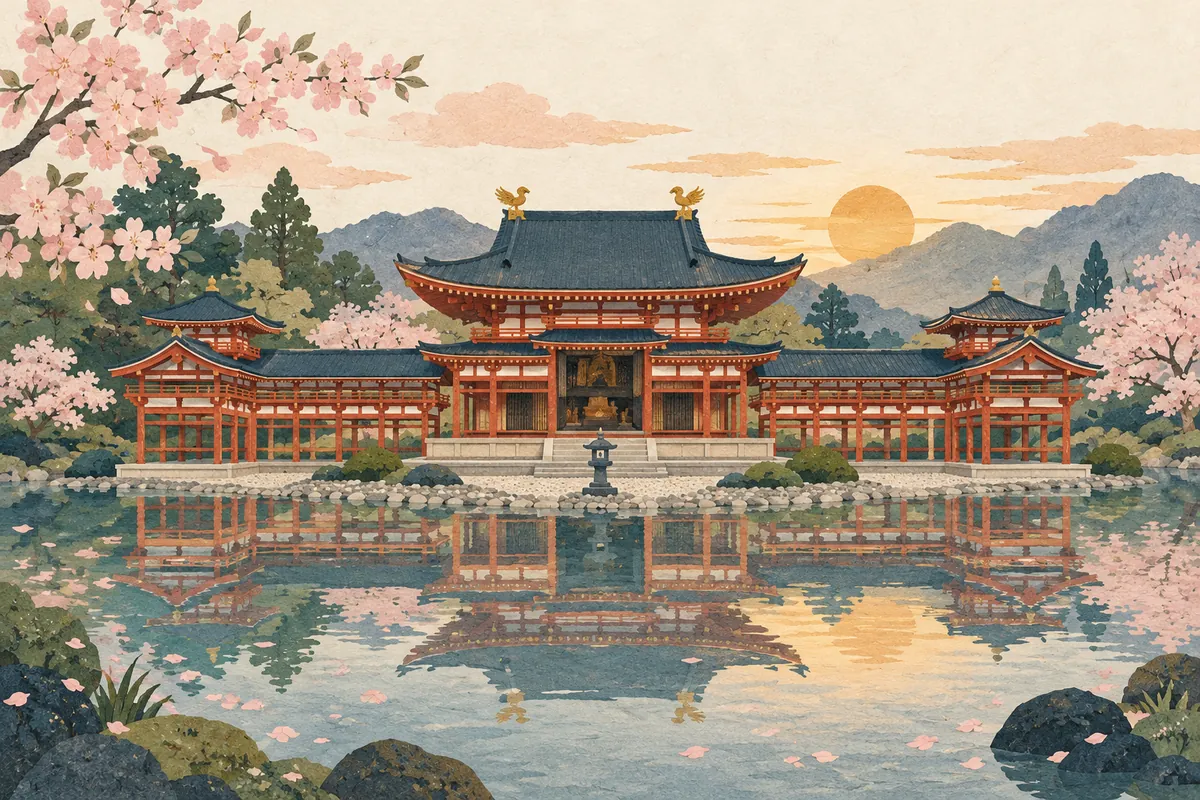
The Amida Hall of Byōdō-in is called the Phoenix Hall (Hōōdō). Phoenixes also adorn its roof.
Byōdō-in is in Uji City. The Phoenix Hall is one of the cultural properties that represent Uji.
Fujiwara no Yorimichi, son of Fujiwara no Michinaga, turned his villa into a temple in 1052 and named it Byōdō-in.
The Phoenix Hall enshrines a seated statue of Amida Nyorai made by the Buddhist sculptor Jōchō.
In 1053, the year after Byōdō-in was founded, the Amida Hall was completed; today it is called the Phoenix Hall.
The seated Amida Nyorai of the Phoenix Hall is the work of Jōchō, the leading Buddhist sculptor of the Heian period.
Byōdō-in preserves 52 wooden statues of the Unchū Kuyō Bosatsu (Bodhisattvas on Clouds), designated National Treasures.
The Amida Nyorai created by Jōchō
Byōdō-in's Phoenix Hall enshrines a wooden seated Amida Nyorai made by the Buddhist sculptor Jōchō.
The wooden seated Amida Nyorai of the Phoenix Hall is a work by Jōchō, a Buddhist sculptor of the Heian period.
Why was it built across the pond?
The year 1052 (Eishō 7), when Fujiwara no Yorimichi turned the villa he had inherited from his father Michinaga into a temple, was regarded as the first year of mappō, the age when the Buddha's teachings decline, and Pure Land belief, which longs for rebirth in Paradise, was spreading. The following year, 1053 (Tengi 1), the Amida Hall was completed, and a large jōroku-size seated Amida Nyorai attributed to Jōchō was enshrined in it.
The Phoenix Hall stands on an island in the pond, facing east. This layout shows that the Pure Land of Paradise lies to the west, across Aji-ike Pond. The garden, in which the hall, Aji-ike Pond, the Uji River, and the mountains on the opposite bank form a single whole, is in the style of the Pure Land gardens that represent the Heian period, and as the oldest Pure Land garden it is designated a Historic Site and Place of Scenic Beauty.
Since when has it been called the Phoenix Hall?
When it was built, it was called the Amida Hall. Because seen from the front it looks like a bird with its wings spread, and because a pair of phoenixes is set on the roof, it came to be called the Hōōdō (Phoenix Hall) from around the beginning of the Edo period. The name is said to have been in use from around the time of the major repairs in 1670 (Kanbun 10).
The phoenixes now on the roof are the second generation; they replaced the original ones, now National Treasures, in 1968 (Shōwa 43). Scientific research showed that when it was first built, the hall was painted with nitsuchi, a reddish pigment made by firing yellow ocher, and in the Heisei-era major repairs completed in 2014 it was returned to colors close to those of the original. The rohan hōju (finial) on the roof has also been restored to its original gold.
The way the temple was supported also changed over time. In the Meiō era (1492–1501), Jōdo-in, a temple of the Jōdo school, was founded to restore Byōdō-in, and from 1670, Jōdo-in and Saishō-in of the Tendai school worked together to maintain Byōdō-in. The roof is thought to have been fully tiled during the major repairs of 1101 (Kōwa 3), and the tiles were fired at the Mukaiyama kilns in Kawachi.
A thousand years through war and repair
Byōdō-in has faced crisis many times. In 1180 (Jishō 4), Minamoto no Yorimasa was defeated in the Battle of Uji and took his own life at Byōdō-in, and in 1336 (Kenmu 3), Kusunoki Masashige set fire to the surrounding area, burning many of the temple buildings except for a few. Even so, the Phoenix Hall survived, and it is regarded as the only remaining structure through which one can recall the age of Fujiwara regency rule.
The garden, too, has been restored on the basis of excavations. Surveys from 1990 onward showed that in the Heian period the pond's shore was a gently sloping pebble beach (suhama) paved with fist-sized stones, and the present shore has been returned to that appearance. The flat bridge (hirabashi) and arched bridge (sorihashi), which cross via a small island to the north to the hall's north wing corridor, were also restored in their Heian-period form in 2000.
Main events in the history of Byōdō-in
| Year | Event |
|---|---|
| 1052 (Eishō 7) | Fujiwara no Yorimichi turns his villa into a temple and founds Byōdō-in (the first year of mappō) |
| 1053 (Tengi 1) | The Amida Hall (Phoenix Hall) is completed |
| 1180 (Jishō 4) | Minamoto no Yorimasa is defeated at Uji and takes his own life at Byōdō-in |
| 1336 (Kenmu 3) | Many temple buildings are lost to fire set by Kusunoki Masashige |
| 1670 (Kanbun 10) | Major repairs to the Amida Hall; around this time it comes to be called the Phoenix Hall |
| 1950–1957 | Shōwa-era major repairs of the Phoenix Hall |
| 1951 | The Phoenix Hall and the seated Amida Nyorai are designated National Treasures |
| 1968 | The phoenixes on the roof are replaced with second-generation ones |
| 1994 | Inscribed as part of the World Cultural Heritage Site "Historic Monuments of Ancient Kyoto" |
| 2001 | The Museum Hōshōkan opens |
| 2012–2014 | Heisei-era major repairs of the Phoenix Hall |
Mini quiz for this entry
Check what you've read with 3 multiple-choice questions.
Which famous hall at Byodo-in is named after a bird?
Who converted Fujiwara no Michinaga's villa into Byodo-in?
Which of these events happened in 1053?
Sources and verification
Content checked: October 11, 2026
Updated: October 11, 2026
References are in Japanese.