
Japanese東寺百合文書と風神雷神図屏風
The Tōji Hyakugō Documents and the Wind God and Thunder God Screens
Other spellings and namesToji Hyakugo Monjo / Fujin Raijin-zu Byobu / Wind God and Thunder God screens / Tawaraya Sotatsu / Ogata Korin
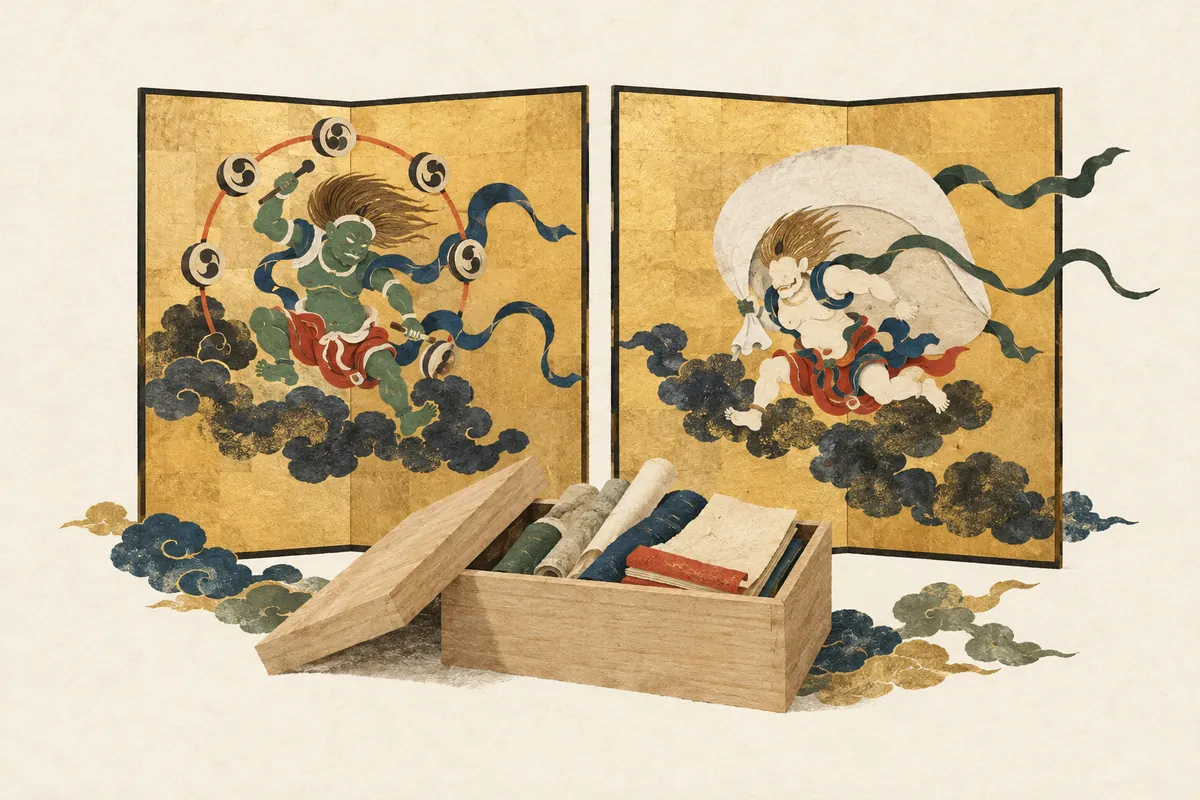
In short
Kyoto's cultural properties are not only buildings. The Tōji Hyakugō Documents (Tōji Hyakugō Monjo) preserve more than 20,000 medieval records and were inscribed on UNESCO's Memory of the World Register in 2015. The Wind God and Thunder God screens were passed down from Tawaraya Sōtatsu's National Treasure to Ogata Kōrin's copy, and comparing them reveals differences in composition.Key points in 30 seconds
The Tōji Hyakugō Documents number 24,067; 94 paulownia boxes survive
"Hyakugō" (百合, a hundred boxes) comes from counting paulownia boxes as ichigō, nigō (one gō, two gō)
The Tōji Hyakugō Documents were inscribed on UNESCO's Memory of the World Register in 2015
Sōtatsu's original, owned by Kennin-ji, is a National Treasure; Kōrin's copy, owned by the Tokyo National Museum, is an Important Cultural Property
Tōji's records, protected box by box
The Tōji Hyakugō Documents are held by the Kyoto Institute, Library and Archives (Kyoto Prefectural Kyōtogaku Rekisaikan).
The Tōji Hyakugō Documents are a body of historical materials totaling 24,067 documents, dating from the Nara period to the early Edo period.
Ninety-four boxes survive: 46 labeled with katakana and 48 labeled with hiragana.
A composition passed from Sōtatsu to Kōrin
Kōrin's screens are a copy of Tawaraya Sōtatsu's National Treasure, handed down at Kennin-ji in Kyoto.
Kōrin's Wind God and Thunder God screens are a pair of two-panel folding screens painted in color on gold-leafed paper.
Why is 百合 read hyakugō?
The name comes from the hundred paulownia boxes donated to hold the documents by Maeda Tsunanori, the fifth lord of the Kaga domain, in the Edo period. Because boxes are counted ichigō, nigō ("one box, two boxes," using the counter 合, gō), the collection came to be called the "Hyakugō Monjo" ("hundred-box documents"). Tsunanori had the documents surveyed and copied, and donated the boxes in 1685 (Jōkyō 2) when the work was finished.
The contents center on temple documents left by Tōji's organization of monks, and also include records of negotiations with the imperial court and warrior houses, documents related to the Kamakura and Muromachi shogunates, and documents about the shōen estates Tōji held. They are regarded as Japan's largest body of historical documents and as indispensable for research on Buddhist history and medieval society.
Main milestones of the Tōji Hyakugō Documents
| Year | Event |
|---|---|
| 1685 (Jōkyō 2) | Maeda Tsunanori donates a hundred paulownia boxes to hold the documents |
| 1967 | Transferred to Kyoto Prefecture; full-scale research and organization begins at the Kyoto Prefectural Library and Archives |
| 1980 | Opened to the public in full in response to requests from residents and scholars |
| 1997 | Designated a National Treasure (53 newly found documents also added) |
| October 10, 2015 | Inscribed on UNESCO's Memory of the World Register |
How do Sōtatsu's and Kōrin's Wind God and Thunder God screens differ?
Tawaraya Sōtatsu's Wind God and Thunder God screens are a National Treasure owned by Kennin-ji. They bear neither signature nor seal, yet it is said that no one doubts they are Sōtatsu's work. The gold-leaf ground is said to be not mere decoration but a space of infinite depth.
In the 18th century, Ogata Kōrin faithfully copied these screens. The gaze of the Thunder God, which looks down on the world below in Sōtatsu's version, was changed in Kōrin's version so that he looks toward the Wind God; this sense of unity, as if the two gods were dancing in step, is said to be the hallmark of Kōrin's version. Sakai Hōitsu later painted Summer and Autumn Grasses on the back of Kōrin's screens, but for preservation the front and back have been separated into two sets of screens.
In Kōrin's version, the gods' robes flutter in the wind as if a strong wind were blowing through from left to right, and rain clouds of blurred ink create depth. Comparing Sōtatsu's original with Kōrin's copy shows how each painter thought differently about the same subject.
Sōtatsu's and Kōrin's Wind God and Thunder God screens
| Item | By Tawaraya Sōtatsu | By Ogata Kōrin |
|---|---|---|
| Period | Edo period, 17th century | Edo period, 18th century |
| Format | Pair of two-panel screens; color on gold-leafed paper | Pair of two-panel screens; color on gold-leafed paper |
| Owner | Kennin-ji (on deposit at the Kyoto National Museum) | Tokyo National Museum |
| Designation | National Treasure | Important Cultural Property |
| Thunder God's gaze | Looks down on the world below | Looks toward the Wind God |
| Signature and seal | None | — |
Where can you see the originals or the data?
Sōtatsu's original is on deposit at the Kyoto National Museum, and at Kennin-ji you can see a high-resolution reproduction of the screens. Because the original is shown only according to the museum's exhibition schedule, it is safest to check the exhibition information before you go.
The Tōji Hyakugō Documents are held by the Kyoto Institute, Library and Archives in Shimogamo, Sakyō Ward. On "Tōji Hyakugō Monjo WEB," run by Kyoto Prefecture, images of about 20,000 items (30,000 documents) are published online, so you can see what medieval documents look like even from home.
Mini quiz for this entry
Check what you've read with 3 multiple-choice questions.
Which institution holds the National Treasure To-ji Hyakugo Documents?
Whose original Wind and Thunder Gods screen did Ogata Korin copy?
What is the format of Ogata Korin's Wind and Thunder Gods screens?
Sources and verification
Content checked: October 11, 2026
Updated: October 11, 2026
References are in Japanese.