
Japanese時代祭の行列は動く歴史絵巻
The Jidai Matsuri Procession: A Moving Picture Scroll of History
Other spellings and namesJidai Matsuri / Festival of the Ages / Jidai Fūzoku Gyōretsu (historical costume procession) / Heian Shrine / 時代祭
In short
Jidai Matsuri is a procession held on October 22 in which about 2,000 people in the costumes of each era walk a line about 2 km long. Setting out from the Kyoto Imperial Palace and heading for Heian Shrine, it is known as a "moving picture scroll of history."Key points in 30 seconds
Held on October 22
The procession has about 2,000 people and stretches about 2 km
It ends at Heian Shrine
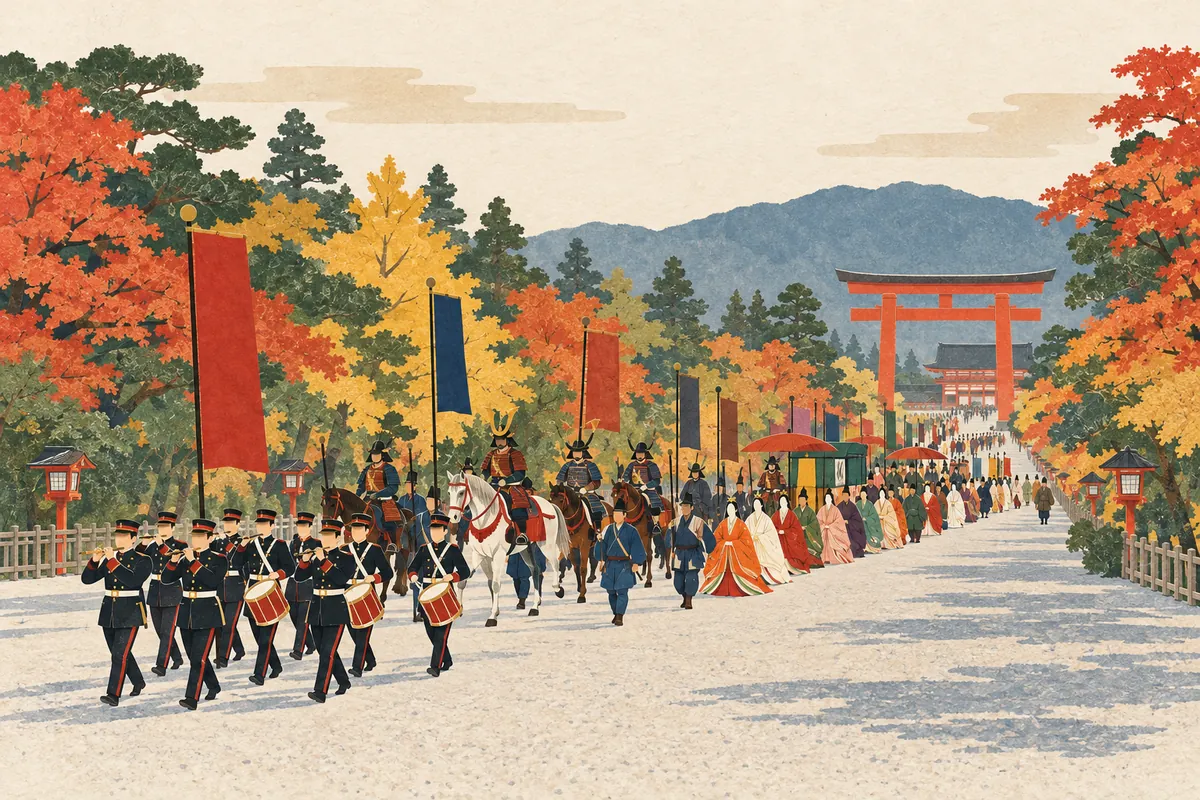
A picture scroll of history walking through autumn Kyoto
Jidai Matsuri is an autumn festival in Kyoto, held every year on October 22.
Jidai Matsuri takes place on October 22, when a procession representing the history of the thousand-year capital parades through the city.
The procession travels from Kyoto Gyoen along Oike-dōri to Heian Shrine.
The Jidai Matsuri procession stretches for about 2 km.
About 2,000 people take part in Jidai Matsuri, forming a procession that represents Kyoto's history.
Why did it begin in 1895?
Jidai Matsuri is the newest of Kyoto's Three Great Festivals. It began in 1895 (Meiji 28) as an event celebrating the founding of Heian Shrine and the 1,100th anniversary of the transfer of the capital to Heian-kyō. That same year, the Fourth National Industrial Exhibition was held in the Okazaki area to revive Kyoto after the capital had effectively moved to Tokyo, and the historical costume procession held on the last day of the anniversary celebration became the origin of Jidai Matsuri.
The festival date, October 22, is the day Heian Shrine regards as Kyoto's birthday. As Heian Shrine's grand festival, it has aimed to be a procession that lets people grasp Kyoto's history and culture at a glance.
Both feature processions in Heian-style costume, but Aoi Matsuri is the annual festival of Shimogamo Shrine and Kamigamo Shrine, said to have originated about 1,500 years ago, while Jidai Matsuri is Heian Shrine's festival, born in the Meiji era. A major difference is that the Jidai Matsuri procession shows not only the Heian period but the attire of each era up to the Meiji Restoration, in order.
October 22: before the procession sets off
The procession leaves the Kyoto Imperial Palace at midday, but the festival begins in the morning. The deities' procession sets out from the main shrine in the morning and heads to a temporary resting place (anzaisho) set up in front of the Kenrei-mon Gate of the Kyoto Imperial Palace. After the Anzaisho-sai rite is held there, the procession sets off for Heian Shrine at noon. At the Anzaisho-sai, the Shinsen Kōsha, a group formed by the Kyoto cuisine association, presents food offerings, and Shirakawa-me (flower sellers from Shirakawa) offer flowers.
In case of rain, the Shinkō-sai and the events that follow are postponed, and whether to hold them is decided early that morning. Watching the whole procession takes about two hours, so paid viewing seats are also available.
Schedule on the day of Jidai Matsuri
| Time | Event |
|---|---|
| 7:00 | Jidai Matsuri (ceremony) |
| 8:00 | Shinkō-sai (ceremony sending out the deities) |
| 9:00 | The deities' procession leaves the main shrine |
| Around 10:00 | Arrives at the temporary resting place in front of Kenrei-mon Gate, Kyoto Imperial Palace |
| 10:30 | Anzaisho-sai (rite at the temporary resting place) |
| 12:00 | The procession sets off for Heian Shrine |
The procession goes back in time
The procession covers eight eras, divided into 20 groups: the Meiji Restoration, Edo, Azuchi-Momoyama, Muromachi, Yoshino, Kamakura, Fujiwara, and Enryaku periods. It moves back through time, led by the Meiji Restoration group, and the last of the historical costume groups is the Kyūsen-gumi archers, said to have guarded the capital when it moved to Heian-kyō. After them come the Shinsen Kōsha group and the front group, followed by the deities' procession centered on two gohōren palanquins carrying the spirits of Emperor Kanmu and Emperor Kōmei.
The procession is run by the Heian Kōsha (11 groups in all), made up of citizens from all over Kyoto City. At first there were 6 groups and about 500 participants; today about 2,000 people take part. The women's groups of the Edo period, the medieval period, and the Heian period are staffed in rotation by local women's associations and the five geisha districts (kagai). Costumes and ritual objects are reproduced based on historical research, and they number about 12,000 items.
Mini quiz for this entry
Check what you've read with 3 multiple-choice questions.
In which season is Jidai Matsuri held on October 22?
When is the Jidai Matsuri procession held?
Where does the Jidai Matsuri procession finish?
Sources and verification
Content checked: October 11, 2026
Updated: October 11, 2026
References are in Japanese.