
Japanese銀閣・慈照寺と東山文化
Ginkaku-ji (Jishō-ji) and Higashiyama Culture
Other spellings and namesJishō-ji (慈照寺) / Higashiyama-dono (東山殿) / Ashikaga Yoshimasa / Ginshadan and Kōgetsudai
In short
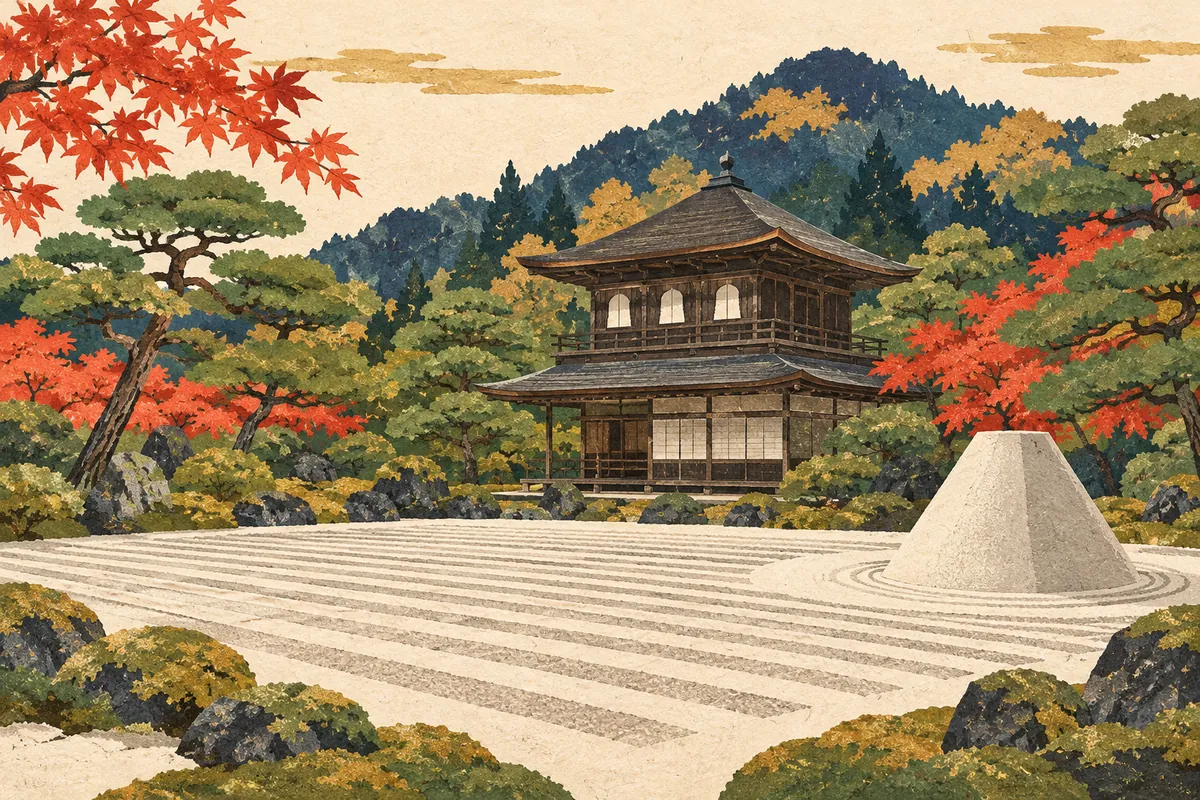
The formal name of Ginkaku-ji (the Silver Pavilion temple) is Jishō-ji. It began when Higashiyama-dono, the mountain villa that Ashikaga Yoshimasa began building in 1482, was converted into a Zen temple after his death. The aesthetic of Higashiyama culture shows in the National Treasures Ginkaku (Kannon-den) and Tōgu-dō, and in a garden with the sand mounds Ginshadan and Kōgetsudai.Key points in 30 seconds
The formal temple name is Jishō-ji; the formal name of the Ginkaku is Kannon-den
Originated as Ashikaga Yoshimasa's Higashiyama-dono; the Ginkaku's framework was raised in 1489
Two buildings are National Treasures: the Ginkaku and the Tōgu-dō
The name Ginkaku (Silver Pavilion) is said to have arisen in the Edo period in contrast to Kinkaku (Golden Pavilion)
From Higashiyama-dono to Jishō-ji
The formal temple name of Ginkaku-ji is Jishō-ji. It was created by converting Ashikaga Yoshimasa's mountain villa into a temple.
Ashikaga Yoshimasa, the eighth shogun of the Muromachi shogunate, built the mountain villa Higashiyama-dono from 1482.
In front of the main hall of Ginkaku-ji are two striking sand mounds, the Ginshadan and the Kōgetsudai.
The upper floor of the Ginkaku is called Chōonkaku, and the lower floor Shinkūden.
The lower floor of the Ginkaku is the Shinkūden, which uses a residential-style design.
A place that symbolizes Higashiyama culture
Ginkaku-ji is a building that represents Higashiyama culture, known for its simple yet deeply tasteful beauty.
Is the Ginkaku silver? Where the name comes from
The formal name of the Ginkaku is Kannon-den. The name Ginkaku-ji is said to have come into use in the Edo period in contrast to Kinkaku-ji. Because its combination of an upper floor in the style of a Zen Buddhist hall and a lower floor in residential style resembles the Kinkaku of Kitayama, it is said to have been called the Ginkaku (Silver Pavilion).
Neither the temple's explanations nor other sources mention silver leaf ever having been applied to the Ginkaku. If you visit imagining "a building gleaming silver," you may be surprised, but the highlight is not its color but the calm appearance of the two-story pavilion and garden as one. A statue of Kannon (Kanzeon Bosatsu) is enshrined on the upper floor, Chōonkaku, and a thousand Jizō statues on the lower floor, Shinkūden.
The Tōgu-dō and Dōjinsai, said to be the prototype of the four-and-a-half-mat room
Two buildings at Jishō-ji are designated National Treasures: the Ginkaku and the Tōgu-dō. The Tōgu-dō is a small hall, three and a half ken (bays) square, that Yoshimasa built in 1486 (Bunmei 18) as his personal Buddhist chapel. Its name is said to come from a Buddhist saying: "People of the east recite the Buddha's name and seek to be born in the west." Its altar room enshrines a statue of Amida Nyorai and a statue of Yoshimasa.
The study inside the Tōgu-dō, the Dōjinsai, is said to be the prototype of the four-and-a-half-mat tearoom. The garden of Higashiyama-dono is regarded as the only surviving remnant of the gardens Yoshimasa built. Why the Ginkaku is described as a building of Higashiyama culture, simple yet deeply tasteful, becomes clear when you see it together with small, quiet spaces like these.
From villa to Zen temple: a timeline of fires and renovations
Yoshimasa built Higashiyama-dono after the Ōnin War had left Kyoto a burned-out wasteland. When Yoshimasa died in 1490, the villa was converted into a Zen temple according to his last wishes, with Musō Kokushi (Musō Soseki) honored as its nominal founder, and it was named Jishō-ji after Yoshimasa's Buddhist name, Jishō-in. In fighting in 1550 (Tenbun 19), almost all the buildings except the Ginkaku and Tōgu-dō burned, and a major renovation was carried out in 1615 (Keichō 20).
The garden is a stroll garden centered on Kinkyōchi Pond and is designated a Special Place of Scenic Beauty and Special Historic Site. The Ginshadan and Kōgetsudai in front of the main hall are said to have been made from the early Edo period, and knowing that they do not date unchanged from Yoshimasa's time changes how you see them. The Ochanoi Garden on the hillside is a dry landscape garden (karesansui) using a stone arrangement excavated in 1931 (Shōwa 6).
The Zazen-seki ("meditation stone"), lying in front of and to the west of Hakkaku-jima island in Kinkyōchi Pond, is said to be associated with Musō Soseki. The interior of the Ginkaku (Kannon-den) is never open to the public, so the basic way to enjoy the temple is to walk around its exterior and garden. The address is 2 Ginkakuji-chō, Sakyō Ward.
Main events in the history of Jishō-ji (Ginkaku-ji)
| Year | Event |
|---|---|
| 1482 (Bunmei 14) | Ashikaga Yoshimasa begins building the mountain villa Higashiyama-dono |
| 1486 (Bunmei 18) | The Tōgu-dō is built as a personal Buddhist chapel |
| 1489 (Chōkyō 3) | The pillars and framework of the Ginkaku (Kannon-den) are raised |
| 1490 | Yoshimasa dies; by his last wishes the villa becomes a Zen temple, Jishō-ji |
| 1550 (Tenbun 19) | Fighting burns the temple buildings except the Ginkaku and Tōgu-dō |
| 1615 (Keichō 20) | A major renovation is carried out |
| Early Edo period | The Ginshadan and Kōgetsudai are said to have been made |
| 1931 (Shōwa 6) | The stone arrangement of the upper garden is excavated |
| 1994 | Inscribed as part of the World Cultural Heritage Site "Historic Monuments of Ancient Kyoto" |
Mini quiz for this entry
Check what you've read with 3 multiple-choice questions.
Which building represents the understated Higashiyama culture of the Muromachi period?
Who created the Higashiyama-dono villa that included Ginkaku?
What is the name of Ginkaku's upper floor?
Sources and verification
Content checked: October 11, 2026
Updated: October 11, 2026
References are in Japanese.