
Japanese椥辻(なぎつじ)
Nagitsuji
Other spellings and namesNagitsuji Station / Nagitsuji Ikejiri-chō / Nagi tree / 椥辻
In short
椥辻 is a place name in Yamashina Ward read Nagitsuji (なぎつじ). The name is said to come from a large nagi tree that once stood here. It is used for a station on the subway Tōzai Line and for 11 town names beginning with 椥辻, and a nagi tree also stands at the Yamashina Government Building, home to the ward office.Key points in 30 seconds
Both the town names and the station name are read Nagitsuji (なぎつじ) (subway Tōzai Line, T05)
Said to come from a large nagi tree that once stood here
There are 11 town names beginning with 椥辻; the Yamashina Ward Office is in Nagitsuji Ikejiri-chō
The nagi at the Yamashina Government Building has been chosen as one of the ward's "trees that are the pride of ward residents"
Nagitsuji Lives On in Town and Station Names
椥辻 is read Nagitsuji (なぎつじ). Yamashina Ward has a row of town names beginning with 椥辻, such as 椥辻池尻町 (Nagitsuji Ikejiri-chō) and 椥辻草海道町 (Nagitsuji Kusakaidō-chō). The Yamashina Ward Office is also located in Nagitsuji Ikejiri-chō, Yamashina Ward.
Nagitsuji Station (T05) on the subway Tōzai Line opened on October 12, 1997 (Heisei 9), and is located in Nagitsuji Kusakaidō-chō, Yamashina Ward. The neighboring stations are Ono (T04) toward Rokujizō and Higashino (T06) toward Uzumasa Tenjingawa, and you can transfer to Keihan buses at the station.
A Place Name Born from a Large Nagi Tree
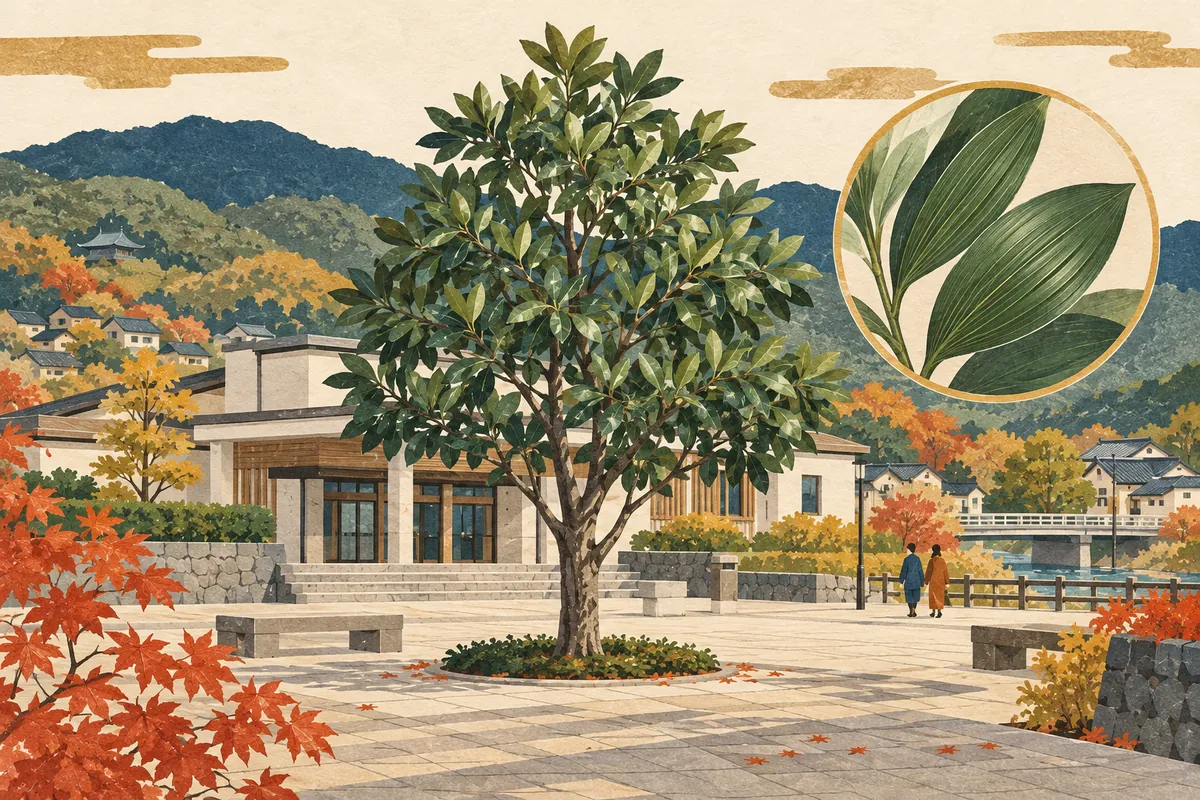
The place name Nagitsuji is said to come from a large nagi tree that once stood here. The nagi standing at the Yamashina Government Building in Nagitsuji Ikejiri-chō (5.3 meters tall, with a trunk circumference of 0.65 meters) has been chosen as one of Yamashina Ward's "trees that are the pride of ward residents."
However, as far as could be confirmed, it is unclear where the great tree behind the name stood or how long it survived. It seems best to think of the nagi at today's government building as a tree chosen to pass on the origin of the place name.
What Kind of Tree Is the Nagi?
The nagi belongs to the Podocarpaceae family; although it is a conifer, it has broad leaves like a broadleaf tree. Its leaves have no midrib, only many fine parallel veins running lengthwise, so it is said that they split easily along their length but cannot be torn crosswise, even when dry.
At Kumano Hayatama Taisha in Wakayama Prefecture, the nagi is regarded as the sacred tree of the Kumano Gongen deity, and people believed that holding up a leaf on their sedge hat or the like would ward off evil and protect them on the journey home. Drawing on the leaf's toughness, there was also reportedly a custom of women placing a leaf behind their mirror so that the bond between a couple would not be broken. The nagi is classified as an evergreen tree.
Eleven Nagitsuji Towns, with School Zones Divided by the Sotokanjō-sen
The list of town names by school attendance zone as of April 2019 (Heisei 31) includes 11 town names in Yamashina Ward beginning with 椥辻. Five of them—Ikejiri-chō, Kusakaidō-chō, Chūzaike-chō, Higashiura-chō, and Higashi-tsubushi—are split by the Sotokanjō-sen (Outer Ring Road): the west side belongs to the attendance zones of Kanshū Elementary and Kanshū Junior High, and the east side to Ōyake Elementary and Ōyake Junior High.
Of the remaining six, only Nagitsuji Higashiyama is in the zone of Ōtsuka Elementary and Otowa Junior High; the others are in the Kanshū Elementary and Kanshū Junior High zones. Even within Nagitsuji, the school a child attends can change depending on the town and which side of the road it is on.
Town names beginning with 椥辻 and their school zones
| Town name | Reading | Elementary school zone | Junior high school zone |
|---|---|---|---|
| 椥辻池尻町 | Nagitsuji Ikejiri-chō | Kanshū (west of the Sotokanjō-sen) / Ōyake (east) | Kanshū / Ōyake |
| 椥辻草海道町 | Nagitsuji Kusakaidō-chō | Kanshū (west of the Sotokanjō-sen) / Ōyake (east) | Kanshū / Ōyake |
| 椥辻中在家町 | Nagitsuji Chūzaike-chō | Kanshū (west of the Sotokanjō-sen) / Ōyake (east) | Kanshū / Ōyake |
| 椥辻西浦町 | Nagitsuji Nishiura-chō | Kanshū | Kanshū |
| 椥辻西潰 | Nagitsuji Nishi-tsubushi | Kanshū | Kanshū |
| 椥辻番所ケ口町 | Nagitsuji Banshōgaguchi-chō | Kanshū | Kanshū |
| 椥辻東浦町 | Nagitsuji Higashiura-chō | Kanshū (west of the Sotokanjō-sen) / Ōyake (east) | Kanshū / Ōyake |
| 椥辻東潰 | Nagitsuji Higashi-tsubushi | Kanshū (west of the Sotokanjō-sen) / Ōyake (east) | Kanshū / Ōyake |
| 椥辻東山 | Nagitsuji Higashiyama | Ōtsuka | Otowa |
| 椥辻平田町 | Nagitsuji Hirata-chō | Kanshū | Kanshū |
| 椥辻封シ川町 | Nagitsuji Fūshikawa-chō | Kanshū | Kanshū |
Watch Out for "Nagizuji" and the Kanji 梛
Some guides give the reading as "Nagizuji" (なぎづじ), but the town names and the subway station are read Nagitsuji (なぎつじ). When looking up an address or station name, it is safest to remember it as Nagitsuji.
Kyoto City also has Motogion Nagi Shrine (in Mibu Nagi-no-miya-chō, Nakagyō Ward), also read nagi, but it uses a different kanji, 梛. The shrine is said to have begun when, during an epidemic, the spirit of Gozu Tennō was welcomed from Hiromine in Harima Province and enshrined, portable shrine and all, in a grove of nagi trees. Because the character differs from the 椥 in the place name 椥辻, be careful not to mix them up when searching or typing.
Walking Tip: From Exit 1 to the Ward Office's Nagi Tree
Around Exit 1 of Nagitsuji Station (west side of the Sotokanjō-sen) are the Yamashina Ward Office, the Higashi Bunka Kaikan (Eastern Culture Hall), the tomb of Sakanoue no Tamuramaro, Iwaya-ji temple, and Ōishi Shrine. Around Exit 2 (east side of the Sotokanjō-sen) are Kyoto Tachibana University and other places.
To get a feel for the origin of the place name, start by seeing the nagi at the Yamashina Government Building near Exit 1. Look at the shape of the leaves and their parallel veins, and you will see the features of a tree long cherished at Kumano.
Mini quiz for this entry
Check what you've read with 2 multiple-choice questions.
How is 椥辻 read—a Yamashina place name that is also a Tōzai Line subway station?
What is said to be the origin of the place name Nagitsuji (椥辻)?
Sources and verification
Content checked: October 11, 2026
Updated: October 11, 2026
References are in Japanese.