
Japanese勧修寺(かんしゅうじ)
Kanshuji / Kajuji
Other spellings and namesKanshūji / Kajūji / Kajuji Temple / Kanshūji-Niōdō-chō / Yamashina Monzeki / 勧修寺
In short
勧修寺 is a name read two ways: the temple in Yamashina Ward is Kajūji, while the surrounding town names, such as Kanshūji-Niōdō-chō, are Kanshūji. Tradition says Emperor Daigo founded the temple in 900 (Shōtai 3) at the wish of his birth mother and named it after the posthumous title of his grandfather, Fujiwara no Takafuji.Key points in 30 seconds
The temple is read Kajūji; the town names are read Kanshūji
Dictionaries also list readings such as Kanjuji and Kajuji
The temple name is said to come from Fujiwara no Takafuji's posthumous title
Yamashina Ward has 29 town names beginning with 勧修寺
The temple is Kajūji; the towns are Kanshūji
The temple's name is read Kajūji (かじゅうじ). The nearby place names are written with the same characters, 勧修寺, but are read Kanshūji (かんしゅうじ).
Just as 勧修寺仁王堂町 in Yamashina Ward is read Kanshūji-Niōdō-chō, every town name beginning with 勧修寺 starts with Kanshūji. It is a classic example of the same kanji being read differently depending on whether it names a temple or an address.
The different readings of 勧修寺
| Use | Reading |
|---|---|
| Temple name (in Kanshūji-Niōdō-chō, Yamashina Ward) | Kajūji (かじゅうじ) |
| Town names in Yamashina Ward (29 towns, including 勧修寺仁王堂町) | Kanshūji-… (かんしゅうじ〜) |
| Headword for the temple in dictionaries | Kajūji / Kanjuji / Kanshūji (かじゅうじ/かんじゅじ/かんしゅうじ) |
| Alternative readings listed in dictionaries | Kajuji, Kanjuji, Kanshūji (かじゅじ、かんじゅじ、かんしゅうじ), etc. |
Even dictionaries disagree on the reading
Comparing dictionaries, the headword reading for the temple varies. The Nihon Daihyakka Zensho encyclopedia and the Digital Daijisen dictionary use Kajūji, the Sekai Daihyakka Jiten encyclopedia uses Kanshūji, and the Daijirin dictionary uses Kanjuji, while the Kokushi Daijiten historical dictionary directs readers from Kajūji to its Kanjuji entry.
Each dictionary also lists other readings, including the form Kajuji. This suggests that the temple's reading was never settled on just one. Rather than thinking that only one of them is correct, it is easier to understand the situation as the temple's Kajūji and the place name's Kanshūji having survived side by side.
The temple is named after Fujiwara no Takafuji's posthumous title
Kajūji is said to have been founded in 900 (Shōtai 3) by Emperor Daigo at the wish of his birth mother, Fujiwara no Inshi, and the temple name was taken from the posthumous title (okurina) of the emperor's grandfather, Fujiwara no Takafuji. It is the head temple of the Yamashina school of Shingon Buddhism, and its mountain name is Kikkōzan.
Kajūji is said to stand on the site of the residence of Miyaji no Iyamasu, the chief district official of Uji District. The Konjaku Monogatari tells how the young Takafuji, caught in a thunderstorm while out falconing, stayed at Iyamasu's residence and was united with his daughter Ressi; their daughter Inshi became a consort of Emperor Uda and gave birth to Emperor Daigo.
After Inshi's death, Takafuji's son Sadakata built temple halls on the site of the Miyaji family residence, and in 905 (Engi 5) it was ranked as a jōgakuji, an officially recognized temple. So the temple's name carries the name of the emperor's maternal grandfather.
Where to see it today: town names, school districts, and a park
Yamashina Ward has 29 town names beginning with 勧修寺, such as Kanshūji-Niōdō-chō, Kanshūji-Kitadainichi-chō, Kanshūji-Higashikurusuno-chō, and Kanshūji-Kanrinji. This shows that a wide area around the temple bears the name Kanshūji.
The name is also used for schools and parks. Most of the Kanshūji towns fall within the Ono Elementary School or Kanshū Elementary School district and the Kanshū Junior High School district. The camphor tree at Kanshū Elementary School, one of the oldest elementary schools in Yamashina Ward, and the row of zelkova trees in Kanshūji Park, the only district park in Yamashina Ward, have both been selected as "Trees of Yamashina Residents' Pride."
For a walk
Kajūji is about a 6-minute walk from Ono Station on the Tōzai subway line (as of 2019). If you look for address signs reading "Kanshūji-… chō" as you walk from the station to the temple, you can feel how far the town names extend.
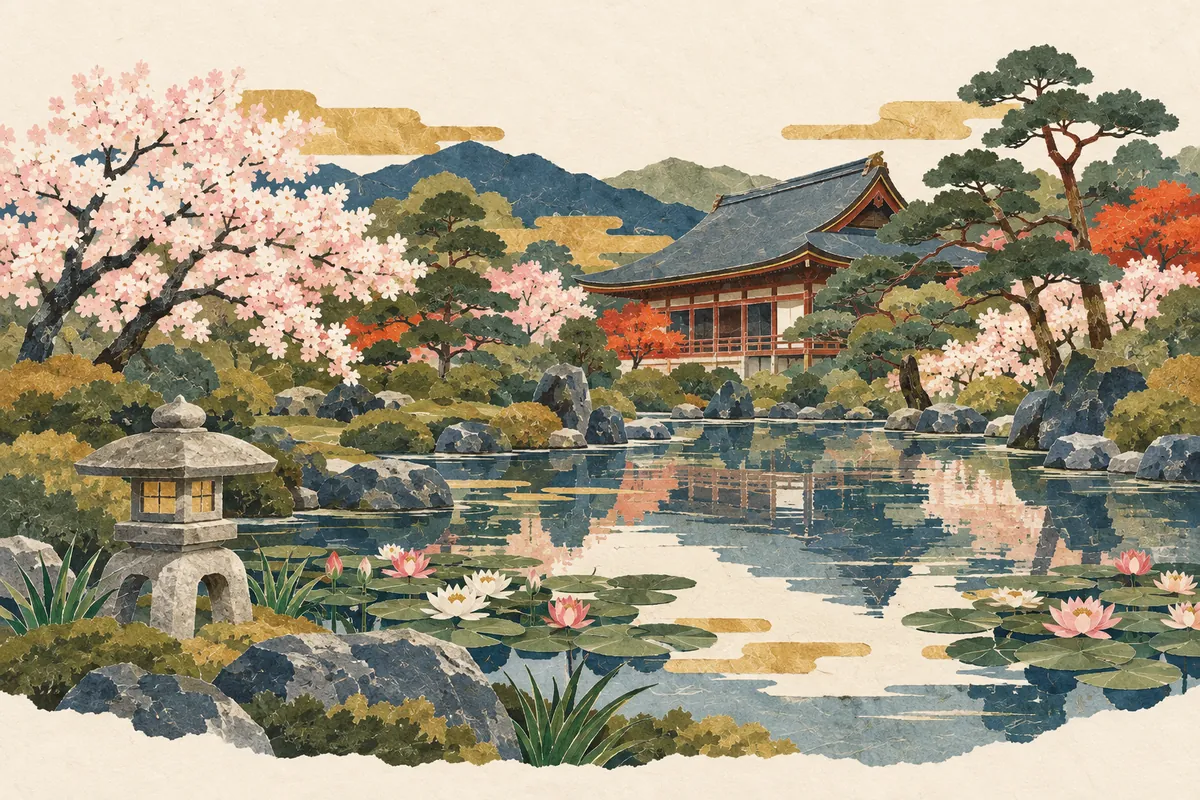
The temple grounds feature a pond-circuit garden centered on Himuro Pond, where water lilies bloom in summer. Tradition says that in the Heian period ice that formed on this pond was presented to the Imperial Palace and used to divine good or bad fortune. It is a beautiful garden with cherry blossoms, as well as lotuses and irises in early summer.
There is also a route that leads west from Zuishin-in to the gate of Kajūji, and nearby historic sites include Miyaji Shrine, which honors the ancestral deity of the Miyaji family, and the tomb of Fujiwara no Inshi. Visiting hours and fees may change, so check the temple's latest information before you go.
Mini quiz for this entry
Check what you've read with 2 multiple-choice questions.
How is the name of the temple 勧修寺 in Yamashina Ward read? (The surrounding town names are read Kanshūji.)
In temple tradition, the name of Kajūji, founded by Emperor Daigo, is said to come from whose posthumous title?
Sources and verification
Content checked: October 11, 2026
Updated: October 11, 2026
References are in Japanese.