
Japanese今熊野(いまぐまの)
Imagumano
Other spellings and namesImakumano / Imagumano school district / Imakumano Shrine / Imakumano Kannon-ji / 今熊野 / 新熊野神社
In short
今熊野 is an area name in Higashiyama Ward, read with a voiced g as Imagumano in town names such as Imagumano-Ikeda-chō. The name of the Imagumano school district is said to come from Imakumano Shrine (新熊野神社), founded in 1160 (Eiryaku 1) by Retired Emperor Go-Shirakawa, who invited the deity of Kumano in Kii Province.Key points in 30 seconds
Town names are read Imagumano; the shrine 新熊野神社 is read Imakumano
Said to be named after Imakumano Shrine, founded by Retired Emperor Go-Shirakawa in 1160
Higashiyama Ward has 18 town names beginning with 今熊野
The site where Kan'ami and Zeami performed sarugaku before Ashikaga Yoshimitsu in 1374
Towns are Imagumano, the shrine is Imakumano
In Higashiyama Ward, all the town names beginning with 今熊野, such as 今熊野池田町 (Imagumano-Ikeda-chō) and 今熊野椥ノ森町 (Imagumano-Naginomori-chō), are read with a voiced g as Imagumano (いまぐまの). The town names include Imagumano-Hiyoshi-chō, Imagumano-Sennyū-chō, and Imagumano-Amidagamine-chō, 18 in all.
The shrine that gave the area its name, on the other hand, is written 新熊野 and read Imakumano (いまくまの), and its full name is Imakumano Jinja. What makes it confusing is that the place name and the shrine name differ both in the first character and in whether the k is voiced.
Comparing the readings of 今熊野 and 新熊野
| Name | Reading |
|---|---|
| 今熊野〇〇町 (town names in Higashiyama Ward, 18 towns) | Imagumano-… (いまぐまの〜) |
| 新熊野神社 (the shrine) | Imakumano Jinja (いまくまのじんじゃ) |
| 今熊野猿楽 (monument in the grounds of Imakumano Shrine) | Imakumano Sarugaku (いまくまのさるがく) |
Kumano brought to the capital by Retired Emperor Go-Shirakawa
The name of the Imagumano school district comes from Imakumano Shrine, which Retired Emperor Go-Shirakawa founded in 1160 (Eiryaku 1) within Hōjū-ji by inviting the deity of Kumano in Kii Province (now Wakayama Prefecture).
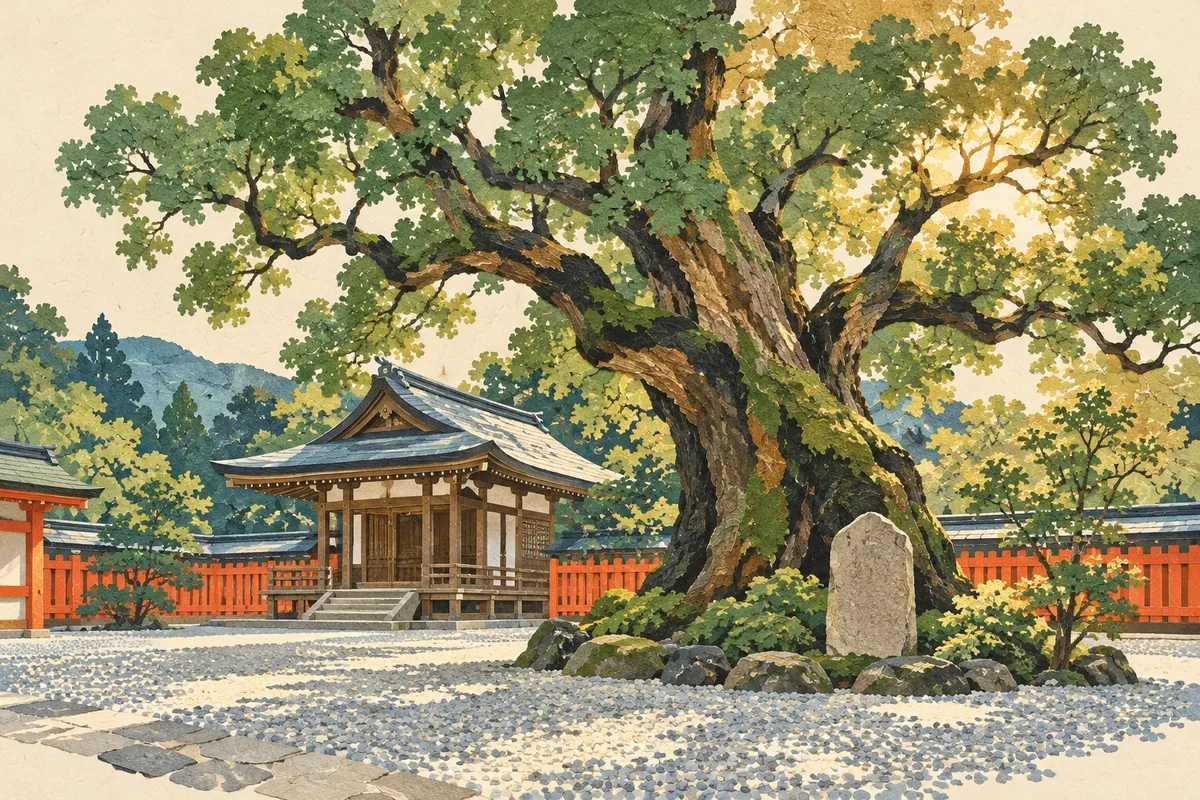
The shrine began when Cloistered Emperor Go-Shirakawa, a deeply devoted believer in the Kumano faith, invited the Kumano Gongen deity of Kii to serve as the guardian of his Hōjūji-dono palace. Tradition says the retired emperor ordered Taira no Kiyomori to bring the deity of Kumano, and it is said that earth and timber were brought from Kumano for the shrine site and the sacred precinct was laid with pale bluish-white pebbles from the beach at Nachi, recreating the holy land of Kumano.
The great camphor tree in the shrine grounds is said to be a sacred tree transplanted from Kumano and planted by Cloistered Emperor Go-Shirakawa himself, and it is a designated natural monument of Kyoto City. The tree is said to be 900 years old.
The shrine where Noh got its start
In 1374 (Ōan 7), Kan'ami and his son Zeami of the Yūzaki troupe from Yamato are said to have performed sarugaku here in front of the shrine before Ashikaga Yoshimitsu, the third shogun of the Muromachi shogunate. The performance became the talk of the capital and led to the backing of the shogun's family and the warrior class. It is also called the starting point of the history of Noh in Japan.
To commemorate this, a monument inscribed "Imakumano Sarugaku" stands in the grounds of Imakumano Shrine, erected in 1980 (Shōwa 55) by the Imakumano Sarugaku Revival Committee. The character 能 (Noh) on the monument was taken from Zeami's own handwritten copy of his treatise Kakyō.
Where to see it today: town names, a school district, and a pottery town
The area around Imagumano-Ikeda-chō is said to have been a pond made at Cloistered Emperor Go-Shirakawa's command, so traces of the era of rule by retired emperors (insei) remain in the town names too. The Imagumano school district itself began in 1931 (Shōwa 6), when Ichihashi Daisan Elementary School (later Imagumano Elementary School) opened because of a growing number of children. Today most of the Imagumano towns fall within the attendance zone of Higashiyama Izumi Elementary and Junior High School, and some within that of Kaisei Elementary and Junior High School.
Through the middle of the district runs the Daigo-michi road (also called Nameishi-goe), which crosses the hills toward Yamashina and Daigo, and the area has long been Kyoto's southeastern gateway. After a climbing kiln was built in 1913 (Taishō 2) in the area known as Jagatani, pottery making spread, and kilns are still scattered around the area, which hosts events such as the Hiyoshi Kilns Festival. From 1926 (Taishō 15) to 1980 (Shōwa 55), Kyoto City University of Arts (and its predecessors) stood around Imagumano-Hiyoshi-chō.
For a walk
Imakumano Shrine is about a 3-minute walk from the Imakumano city bus stop, or about a 15-minute walk from Keihan Shichijō or Tōfukuji Station (as of October 2026). The Imakumano bus stop is also a good starting point for strolls around Higashiyama.
After seeing the great camphor tree and the Imakumano Sarugaku monument at the shrine, look at the address signs nearby and compare the voiced reading of the 今熊野〇〇町 town names with the shrine's name. Hōjū-ji and Rengeō-in (Sanjūsangen-dō) are also nearby, making for a walk through the town of Cloistered Emperor Go-Shirakawa's era.
Mini quiz for this entry
Check what you've read with 2 multiple-choice questions.
The name Imagumano comes from Imakumano Shrine, founded in 1160 by bringing the deity of Kumano in Kii Province. Who founded it?
In Kyoto City's town-name list, how is 今熊野 read in names such as Imagumano-Ikeda-chō in Higashiyama Ward?
Sources and verification
Content checked: October 11, 2026
Updated: October 11, 2026
References are in Japanese.