
Japanese不明門通(あけずどおり)
Akezudōri
Other spellings and namesAkezu-no-mon-dōri / 不明門通り / Akezu-dori
In short
不明門通 (also written 不明門通り) is read Akezudōri. It is sometimes read Akezu-no-mon-dōri, and the name is said to come from the fact that the gate of Inaba Yakushi (Inabadō Byōdō-ji), at the north end of the street, was always kept closed.Key points in 30 seconds
Read Akezudōri (あけずどおり), also Akezu-no-mon-dōri (あけずのもんどおり)
The name is said to come from the always-closed gate of Inaba Yakushi (Byōdō-ji)
A street created in Hideyoshi's urban redevelopment of 1590 (Tenshō 18)
Runs south from the gate of Inabadō to Shiokōji-dōri
不明門 read as "akezu"
不明門通 is a north–south street in Shimogyō Ward, Kyoto City. Following the kanji at face value, you might want to read it "Fumeimon," but it is read Akezudōri, and also Akezu-no-mon-dōri.
If you take 不 as a negative and read 明 as akeru ("to open"), then 不明門 means "a gate that does not open"—an akezu no mon, a never-opened gate. Replacing each kanji with its native Japanese reading shows how the reading and the meaning connect.
The name comes from Inaba Yakushi's closed gate
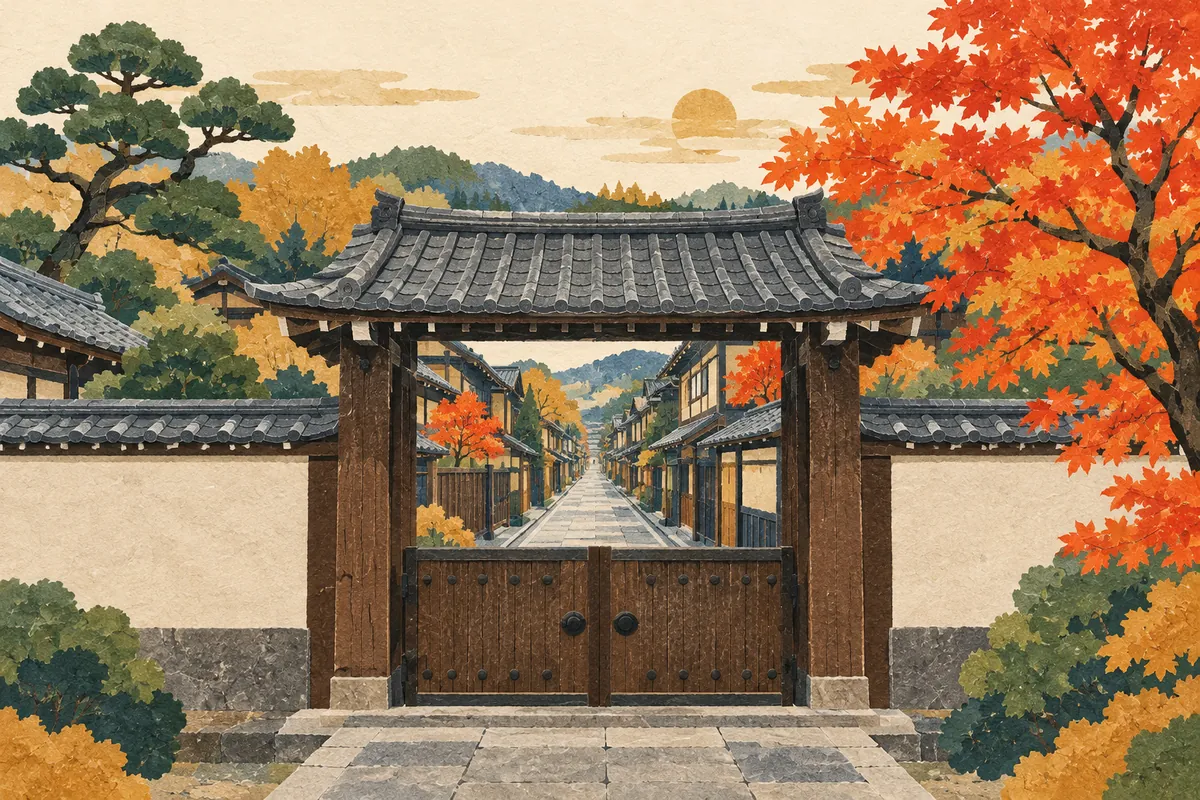
Inaba Yakushi-dō (Byōdō-ji), at the north end of Akezudōri, was a temple hall whose gate was always kept closed, and this is said to be the origin of the street name.
No reliable explanation can be found for why the gate was kept closed. Various stories are sometimes told about the reason, but this dictionary limits its account of the origin to the point that the name "comes from the gate always being closed."
There is more than one reading
Comparing Kyoto encyclopedias, place-name dictionaries, and old topographies shows that the reading differs from source to source. Modern reference works mostly give Akezudōri, while guides to street names and etymological dictionaries of place names also give Akezu-no-mon-dōri.
Readings of 不明門通 by source
| Reading | Sources that give this reading (examples) |
|---|---|
| Akezudōri (あけずどおり) | Kyōto Daijiten, Kyōto no Jiten, Nihon Rekishi Chimei Taikei 27 |
| Akezu-no-mon-dōri (あけずのもんどおり) | Kyōto no Ōji Kōji (Zoku Visual Wide), Shinshū Kyōto Sōsho vol. 3, Kyōto Chimei Gogen Jiten |
| Akazu-no-mon-dōri (あかずのもんどおり) | Kyō Habutae, Miyako Suzume Annaisha |
| Akezu-mon-dōri (あけずもんどおり) | Kyōto Bōmokushi, introductory volume, part 5 |
| Akezumono-dōri (あけづものどおり) | Kyōto Bōmokushi, section on Shimogyō School District No. 12 |
A street born from Hideyoshi's town planning
Akezudōri is a street newly created in the urban redevelopment carried out by Toyotomi Hideyoshi in 1590 (Tenshō 18). That year, Hideyoshi added new north–south roads to the city, creating long, narrow rectangular blocks (tanzaku-gata).
Akezudōri continues south from Kurumayachō-dōri and runs from in front of the gate of Byōdō-ji (Inaba Yakushi-dō) to Shiokōji-dōri. It is also described as the street linking Shiokōji-dōri with the area just north of Matsubara-dōri, and it is said that for a time three different names were in use. Of the road running south from Kurumayachō-dōri in the north, only the section south of Inabadō is called Akezudōri.
Akezudōri in the list of town names
Street names are still used today to describe where a town is. In Shimogyō Ward's list of town names, locations given by street names are added: Kame-chō is 不明門通上珠数屋町下ル (Akezudōri Kami-juzuyamachi sagaru), Butsuguya-chō is 不明門通六条 (Akezudōri Rokujō), and Yoshimizu-chō is 不明門通松原下ル (Akezudōri Matsubara sagaru).
Matsubara sagaru is a distinctively Kyoto way of saying "south along Akezudōri from its intersection with Matsubara-dōri." Shimogyō Ward also has a town called Inabadō-chō (いなばどうちょう), named after the temple that gave the street its name.
To walk it, head south from Inabadō
Inabadō Byōdō-ji, the temple behind the street's name, is known as Inaba Yakushi. According to the temple's founding legend, a statue of Yakushi Nyorai that Tachibana no Yukihira pulled up from the sea in Inaba Province (now eastern Tottori Prefecture) flew to the capital as if following Yukihira after he returned, and he turned his residence into a temple to enshrine it. As a town temple (machidō), it also served as a venue for performing arts, and it appears in many kyōgen plays.
If you walk south from the gate of Inabadō, you are on Akezudōri. Starting from the gate that gave the street its name, you can trace a single route all the way down to Shiokōji-dōri. Standing at the gate, remembering the name akezu and imagining the gate that was said to be kept closed is a way of enjoying this street that only it can offer.
Mini quiz for this entry
Check what you've read with 1 multiple-choice questions.
What is the best-known reading of the Kyoto street name 不明門通?
Sources and verification
Content checked: October 11, 2026
Updated: October 11, 2026
References are in Japanese.