
Baikasai: Kitano Tenmangū's February 25 and Kamishichiken's Nodate Ōchanoyu
Other spellings and namesBaikasai Nodate Ōchanoyu (梅花祭野点大茶湯) / Baika no gokū (梅花御供) / Kōdate (紙立) / Kitano Tenmangū Plum Blossom Festival
Key points
In 2027, Thursday, February 25; it coincides with "Tenjin-san," the fair day on the 25th of every month
The ceremony at the Honden starts at 10:00 (2026). The priests serve with rapeseed blossoms on their headgear
The Nodate Ōchanoyu has been held every year since the 1,050th Daimantōsai in 1952 (Shōwa 27)
2027 (Reiwa 9) is the year of the Han-Mantōsai, held every 25 years
Thursday, February 25, 2027: the anniversary of Michizane's death
Baikasai is a ceremony held every year on February 25 at Kitano Tenmangū (Bakuro-chō, Kamigyō Ward), in memory of the death of Sugawara no Michizane (Kankō) at Dazaifu on the 25th day of the 2nd month of 903 (Engi 3). February 25, 2027 (Reiwa 9) is a Thursday, and notices of the times and fees for the 2027 ceremony and the open-air tea had not yet been issued as of November 2026.
The 25th of every month is Kitano Tenmangū's ennichi (fair day), and on the day of Baikasai, too, Tenjin Market stalls line the whole grounds and draw large crowds.
Kitano Tenmangū has held great festivals called the "Daimantōsai" every 50 years after Michizane's death, and the "Han-Mantōsai" (half Mantōsai) at the 25-year points in between. 2027 is the year in which the Kankō Goshinki 1,125th Han-Mantōsai is held.
A festival of about 900 years, with baika no gokū and kōdate
Baikasai is said to have a history of about 900 years, and on the 25th day of the 2nd month of 1109 (Tennin 2) it was held by order of Emperor Toba.
At the ceremony, special shinsen (food offerings), unlike those of ordinary shrines, are offered. One is "ōban" and "koban," 4 to (about 72 liters) of rice steamed and heaped onto two stands, large and small, called baika no gokū. The other is "kōdate," tubes of paper filled with brown rice and set with sprigs of white and red plum; the number of sprigs is said to relate to the unlucky ages (yakudoshi) of men and women. The brown rice used in the kōdate is given out at the amulet office as "yakuyoke genmai" (brown rice to ward off misfortune).
The rice is prepared by the Shichiho-kai, made up of descendants of the Nishinokyō jinin (shrine servants), who are said to have accompanied Michizane to Dazaifu and, after his death, returned to Kyoto bearing a wooden statue said to have been carved by Michizane himself. On this day the priests serve with rapeseed blossoms (nanohana) on their headgear, said to be because natane (rapeseed) echoes nadameru ("to soothe"). In 2026, too, following the precedent of Empress Teimei's visit, the director of the Imperial Household Agency's Kyoto Office worshipped at the Honden on behalf of the Empress.
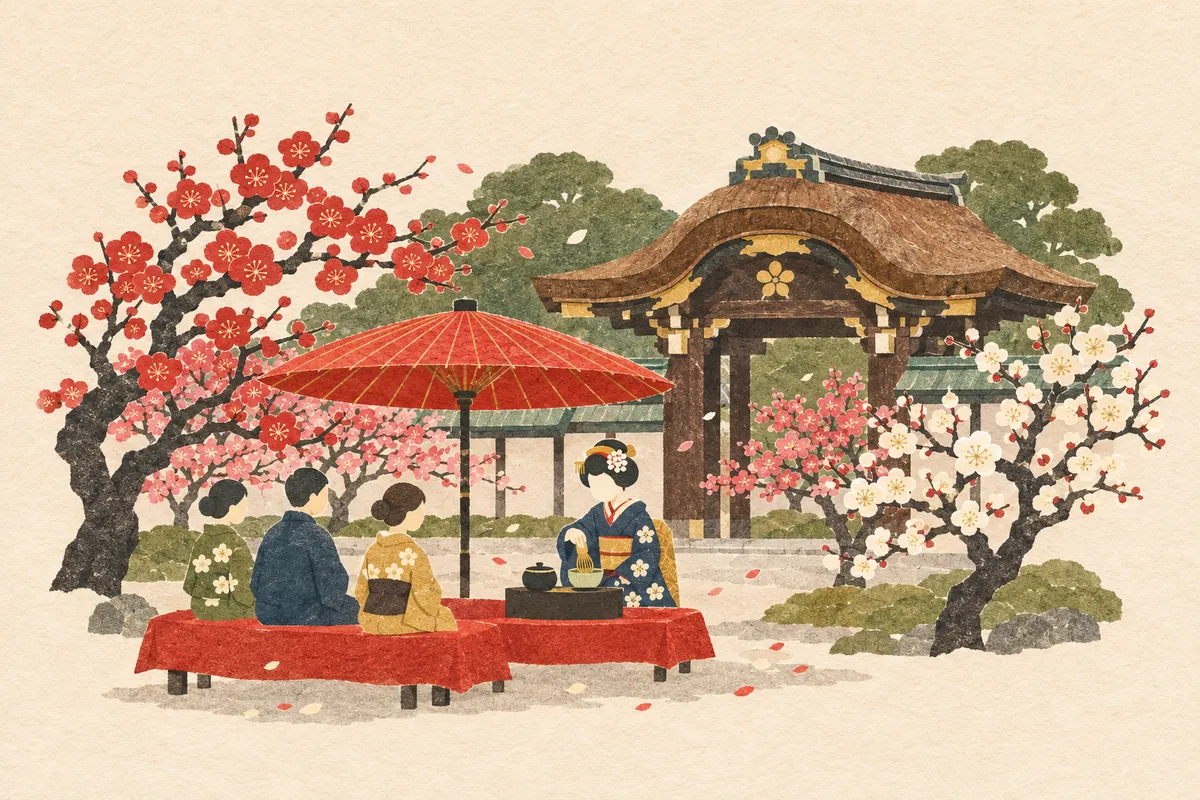
The Nodate Ōchanoyu served by Kamishichiken's geiko and maiko
On the day of Baikasai, the "Baikasai Nodate Ōchanoyu" (梅花祭野点大茶湯) is held in the "Funade no Niwa" garden in front of the Kōbaiden, southwest of the Sankōmon, where the geiko and maiko of Kamishichiken and the ochaya proprietresses together take their places at the tea seats and whisk tea. The event recalls the Kitano Ōchanoyu, the grand tea gathering Toyotomi Hideyoshi held in the shrine grounds in 1587 (Tenshō 15), and it began in 1952 (Shōwa 27), the year of the 1,050th Daimantōsai marking 1,050 years since Michizane's death. On the morning before the ceremony, there is also a kencha (tea offering) rite in which geiko and maiko of Kamishichiken whisk tea in the West Corridor to offer at the Honden and at the auxiliary Toyokuni Shrine (2026).
In the 2025 (Reiwa 7) notice, the open-air tea ran from 10:00 to 15:00 (held rain or shine), with entry reception at the Bundō Kaikan until 14:30, and the offering fee (hatsuho-ryō) was 3,000 yen per person. The tea ticket came with an admission ticket for the Treasure Hall and a voucher for tessen (food offerings taken down from the altar), and was scheduled to be distributed at the Bundō Kaikan from January 25. In rainy 2026, floor seating and chair seating were set up inside tents, and even with the Bundō Kaikan hall used as a waiting room, the line stretched outside the building.
Kamishichiken is a kagai that spreads along the east approach to Kitano Tenmangū, and it is closely tied to the shrine's events; its geiko and maiko also dedicate dances at the Setsubun festival, for example.
The Hana no Niwa plum garden, and what you can see for free
The grounds have about 1,500 plum trees of 50 varieties associated with Michizane, and in the blossom season red and white plums bloom throughout the grounds of about 20,000 tsubo (about 66,000 m²). Early plums start to bloom right after the New Year, and the best viewing is said to be from late February to early March, when early, mid-season, and late bloomers overlap (some accounts extend it to mid-March).
The Hana no Niwa plum garden is usually open for a fee from early February to late March. In 2026 it was open from February 1 to May 24 (with some closed days) as a venue for the event "KYOTO NIPPON FESTIVAL 2026," from 9:00 to 20:30 (last entry 20:00), and admission was 3,000 yen for adults and 1,500 yen for children on the day, or 2,800 yen for adults and 1,400 yen for children in advance. The 2027 period and fees had not been announced as of November 2026.
Worship at the shrine is free, and the gates are open 7:00–17:00. Only the plum garden and the open-air tea seats charge a fee; plums also bloom in the grounds outside the garden, and you can stroll among the Tenjin Market stalls. Eating and drinking are prohibited in the grounds, and visitors are asked not to use tripods for photos inside the plum garden. Wheelchairs can be borrowed at the Bundō Kaikan counter, and there is a ramp at the side gate of the Rōmon.
Getting there
Get off at the "Kitano Tenmangū-mae" city bus stop, right by the shrine (about 35 minutes on route 50 from Kyoto Station, about 10 minutes on route 203 from JR Enmachi Station, or about 15 minutes on routes 51 or 203 from Imadegawa subway station). It is about a 5-minute walk from Kitano-Hakubaichō Station on the Randen (Keifuku Electric Railroad).
Because the 25th of every month is a fair day, the parking lot for worshippers cannot be used. On the day of Baikasai, go by public transportation.
Mini quiz for this entry
At the open-air grand tea gathering held on the day of Kitano Tenmangū's Baikasai, geiko and maiko from which kagai serve tea?
At Kitano Tenmangū's Baikasai, what flowers do the priests wear on their headgear while serving?
In the year of which of Kitano Tenmangū's great festivals did the Baikasai Nodate Ōchanoyu begin?
Sources and verification
Content checked: November 8, 2026
Updated: November 8, 2026
References are in Japanese.