
Hatsuuma: Fushimi Inari Taisha's Hatsuuma Taisai and the Shirushi no Sugi
Other spellings and namesHatsuuma Taisai (初午大祭) / Hatsuuma-mōde (初午詣) / Fuku-mairi (福参り) / Shirushi no sugi (しるしの杉) / Aoyama-kazari (青山飾り)
Key points
In 2027, Hatsuuma falls by the calendar on Monday, February 8. The ceremony usually starts at 8:00; the 2027 notice had not been issued as of November 2026
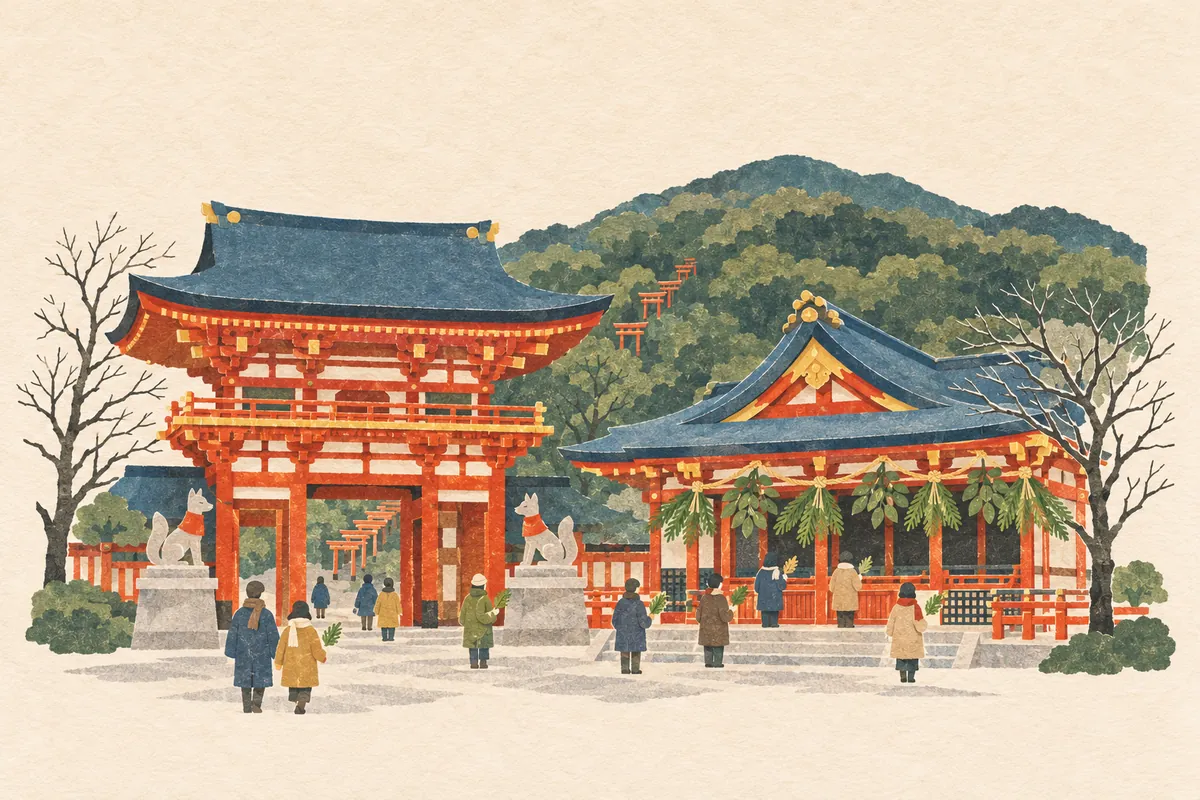
On the Day of the Dragon two days before, "aoyama-kazari" of cedar and shii branches from Mount Inari are hung on the Honden and the auxiliary shrines
The Hatsuuma visit is also called "fuku-mairi" (fuku-mōde), and crowds grow from the Day of the Snake the day before
On the Hatsuuma of the old calendar, the "Otsuka Taisai" is held at the Gozendani Hōhaisho on Mount Inari
Hatsuuma 2027 is Monday, February 8: why the date changes every year
Each day is assigned in turn one of 60 combinations of the ten heavenly stems (jikkan) and the twelve earthly branches (jūnishi), so a Day of the Horse comes around every 12 days. Because Hatsuuma is the first Day of the Horse in February, its date changes from year to year; the Hatsuuma Taisai in 2026 was on Sunday, February 1.
Counting by the calendar, January 1, 2027 (Reiwa 9) is a kanoe-tatsu (庚辰) day, and the first Day of the Horse in February is Monday, February 8, a tsuchinoe-uma (戊午) day. The notice for the 2027 Hatsuuma Taisai had not yet been issued as of November 2026, but in a typical year the ceremony is held from 8:00 on the day of Hatsuuma.
The days around Hatsuuma on the 2027 calendar
| Date | Stem-branch sign of the day | Usual events |
|---|---|---|
| Saturday, February 6 | Hinoe-tatsu (丙辰) | Day of the Dragon. Aoyama-kazari made of cedar and shii branches from Mount Inari are hung on the Honden and the auxiliary shrines |
| Sunday, February 7 | Hinoto-mi (丁巳) | Day of the Snake. From this day the grounds are busy with worshippers |
| Monday, February 8 | Tsuchinoe-uma (戊午) | Hatsuuma. Hatsuuma Taisai from 8:00 |
Hatsuuma in the 2nd month of 711 and "fuku-mairi"
Shrine tradition holds that the Inari deity first settled on Mitsugamine, the three peaks of Mount Inari, on the first Day of the Horse in the 2nd month of 711 (Wadō 4). This "2nd month" is a month of the old calendar. A tradition tells that after years of unseasonable weather and poor harvests of the five grains in many places, the imperial court sent envoys to famous mountains and great rivers to pray; a divine message came, and when the great deity was enshrined on Mount Inari in Yamashiro Province, the five grains ripened well, and the day of that festival was the first Day of the Horse in the 2nd month of 711. However, the surviving fragment of the "Yamashiro no Kuni Fudoki" (Gazetteer of Yamashiro Province), said to be the oldest record of the origins of the Inari shrine, does not yet mention the year 711.
Visiting Mount Inari on the first Day of the Horse in the 2nd month was believed to bring good fortune, and many people are said to have made the pilgrimage on that day every year since the Heian period. That is why the Hatsuuma visit is still called "fuku-mairi" (fuku-mōde, "fortune visit"). Another reason this name took hold is said to be the belief that the Inari deity, settled to the tatsumi (southeast) of the capital, was a god who grants good fortune.
Today's Hatsuuma Taisai is held on the first Day of the Horse in February of the present calendar. Meanwhile, at the Gozendani Hōhaisho (御膳谷奉拝所), behind Mitsugamine to the north on Mount Inari, the "Otsuka Taisai" is held to celebrate the Hatsuuma of the old calendar.
The shirushi no sugi, aoyama-kazari, and hatana with mustard
On the Day of the Dragon, two days before Hatsuuma, it is the custom to make "aoyama-kazari" from cedar and shii (chinquapin) branches from Mount Inari and hang them on the Honden and the auxiliary shrines (sessha and massha) to welcome Hatsuuma.
The "shirushi no sugi" given out on Hatsuuma is a good-luck item that has long been received as a talisman (shirushi) for thriving business and family safety; there is a fee. All the cedars growing on Mount Inari are regarded as sacred trees in which the Inari deity dwells, and in the Heian period it was customary to visit the Inari shrine on the way to or from the Kumano pilgrimage and receive a small sprig of cedar to wear. There is a record of Fujiwara no Tamefusa entering the capital in the 10th month of 1081 (Eihō 1), on his way back from Kumano, with a cedar sprig in his hat, and a scene in the Heiji Monogatari in which, in the 12th month of 1159 (Heiji 1), Taira no Kiyomori's party, hurrying back to the capital while on its way to Kumano, broke off cedar sprigs at the Inari shrine and tucked them into their armor sleeves.
The Shinsen Rokujō contains a poem by Mitsutoshi Ason: "Kisaragi ya / kefu hatsuuma no / shirushi tote / Inari no sugi wa / moto tsu ha mo nashi" ("The second month: today, as tokens of Hatsuuma, the Inari cedars have not a leaf left"). It playfully exaggerates that so many Hatsuuma visitors took sprigs as tokens that the cedars of Mount Inari lost their leaves.
In Kyoto there is a custom of eating hatana (a leafy green) dressed with mustard (karashi-ae) on Hatsuuma. Hatana is used as a pun on the name of Hata no Irogu (秦伊呂具), who founded the shrine, and the dish is also said to relate to the color of a fox's fur.
Visiting on Hatsuuma: free grounds, crowds, and tips for families with children
Fushimi Inari Taisha's grounds have no closing gate, and worship is free on Hatsuuma too. The Hatsuuma visits begin on the Day of the Snake the day before, and through the day itself the shrine overflows with worshippers. It is regarded as one of the largest of Kyoto's early-spring festivals. The amulet office (juyosho) is normally open from 8:00 to 18:00.
In the grounds, eating and drinking outside the designated rest areas (including eating while walking), leaving strollers and the like outside designated places, bringing pets, and stopping on narrow paths to take photos and blocking the way are prohibited.
The Hatsuuma of the 2nd month has also long been a popular day for "oyama-mōde," visiting the sacred sites of Mount Inari. A circuit of the mountain is about 4 km and takes about 2 hours, and wheelchairs can go as far as the Okusha Hōhaisho (there is an elevator).
Getting there
Fushimi Inari Taisha is at 68 Fukakusa Yabunouchi-chō, Fushimi Ward. It is right outside Inari Station on the JR Nara Line (about 5 minutes from Kyoto Station), about a 5-minute walk east from Fushimi-Inari Station on the Keihan Main Line, and about a 7-minute walk east from the "Inari Taisha-mae" stop of City Bus Route Minami 5.
The roads around the shrine's parking lot are very congested even on ordinary days, so visitors are asked to use public transportation. Parking for purposes other than worship is not allowed.
Mini quiz for this entry
Which dish is customarily eaten in Kyoto on Hatsuuma and is said to play on the name of Hata no Irogu (秦伊呂具), founder of Fushimi Inari Taisha?
Sources and verification
Content checked: November 8, 2026
Updated: November 8, 2026
References are in Japanese.