
Senbon Torii: How Many Torii Fushimi Inari Taisha Has, and How They Are Donated
Other spellings and namesFushimi Inari Senbon Torii / Torii hōnō (鳥居奉納, torii donation) / Inari-nuri (稲荷塗) / Oyama-meguri (お山めぐり) / Thousand Torii Gates
Key points
Runs from east of the Honden to the Okusha Hōhaisho; where it comes out is known as "Myōbudani"
About 10,000 torii are said to stand along all the paths of Mount Inari (as of November 2026)
Donation fees range from 300,000 yen for size 5 to from 1,890,000 yen for size 10 (varies by location; as of November 2026)
The Oyama-meguri circuit is about 4 km and takes about 2 hours; wheelchairs can go as far as the Okusha
Where is Senbon Torii? From east of the Honden to the Okusha Hōhaisho
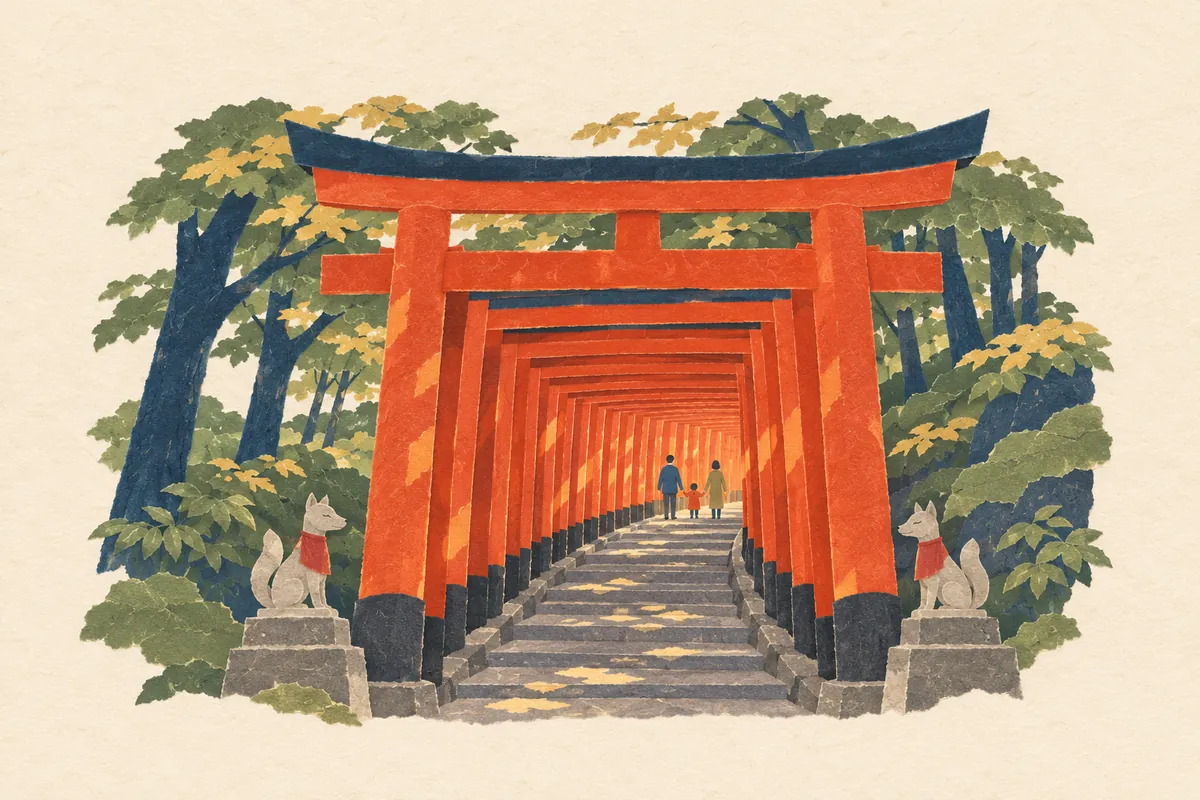
The grounds of Fushimi Inari Taisha face west, and you proceed east through the Rōmon, the Geihaiden, and the Honden. Senbon Torii is on the path that climbs from east of the Honden up to the Okusha Hōhaisho.
The custom of expressing prayers and gratitude by donating a torii began in the Edo period, and the donated torii, lined up one after another, became today's famous sight, Senbon Torii. A torii is offered so that a wish will "go through" (tōru), or in thanks for a wish that "went through."
Beyond the rows of torii is the Okusha Hōhaisho, in a valley known as Myōbudani and generally known as the "Oku-no-in." It is a place to worship Mount Inari from afar, and Mitsugamine, the three peaks of Mount Inari, lie right behind its building. The present building was built after damage in 1794 (Kansei 6); in 1975 (Shōwa 50) it was moved back to its present position, and a worship space was set up in front.
How many torii? About 10,000
The torii do not end with the Senbon Torii stretch; they continue along all the paths of Mount Inari. Their number is said to be about 10,000 (some accounts say several thousand).
Besides torii, many "otsuka" have also been dedicated on Mount Inari. Otsuka are stones carved with the names that worshippers give the Inari deity in their own devotion, or with the name of the "so-and-so Inari Ōkami" they enshrine at home, and placed on the mountain; they increased after the Seven Sacred Sites (shichi shinsekichi) were fixed in the Meiji era and parent mounds (oyazuka) were built. Their number is said to be ten thousand, or even tens of thousands.
Donating a torii: a guide to offering fees
Torii donations are still accepted: you can inquire at the shrine office (Management Section) or apply at the teahouses at the sacred sites on Mount Inari. The offering fee (hatsuho-ryō) is set by the size number of the torii, and the larger the number, the higher the fee. Inquiries go to the shrine office (phone 075-641-7331, 9:00–16:00).
Torii sizes and a guide to offering fees
| Size | Offering fee |
|---|---|
| Size 5 | 300,000 yen |
| Size 6 | From 567,000 yen |
| Size 7 | From 702,000 yen |
| Size 8 | From 1,000,000 yen |
| Size 9 | From 1,175,000 yen |
| Size 10 | From 1,890,000 yen |
The vermilion color and "Inari-nuri"
Inari torii, like the shrine buildings, are customarily painted vermilion, and this style of painting is called "Inari-nuri." Ake, the word for vermilion, has a bright ring that echoes aka (red), akarui (bright), and akane (madder red), and the vermilion color is said to carry a faith that sees life, the earth, and the power to bring things forth as workings of the spirit (mitama) of the Inari deity.
Vermilion is also considered a color that counters evil powers, and it has long been used widely for ancient palaces, temples, and shrines. The vermilion of Inari is said to express the abundance of the Inari deity's power. Ni (mercury), the raw material of vermilion, has also long been used as a preservative for wood. Vermilion-painted shrines are not limited to Inari shrines, however.
Where can you see it now? The Oyama-meguri, and tips for families with children
Senbon Torii is within the shrine grounds, which have no closing gate, so you can pass through free of charge at any hour of the day or night. A visit to the Honden, Senbon Torii, and the Oyama-meguri takes about 120 minutes as a rough guide.
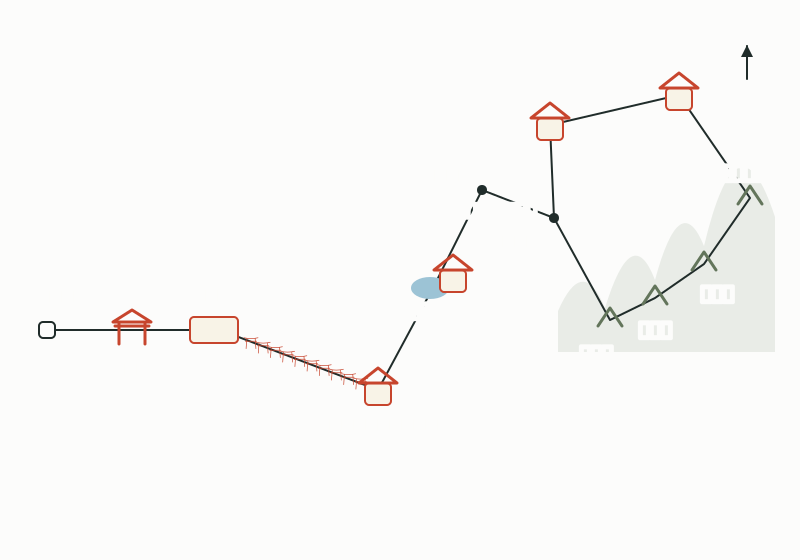
The "Oyama-meguri" beyond the Okusha Hōhaisho is a circuit of about 4 km taking about 2 hours: it passes Shin-ike pond (Kodama-ga-ike), where the Kumataka-sha stands, Mitsutsuji, and Yotsutsuji, makes a round of the sacred sites of San-no-mine, Ai-no-mine, Ni-no-mine, and Ichi-no-mine, and returns from the Gozendani Hōhaisho to Yotsutsuji. The highest peak, Ichi-no-mine, is 233 m above sea level. If you go around behind Kōjin-mine (the Tanaka-sha sacred site) near Yotsutsuji, you can look out over the area from central Kyoto northward.
Wheelchairs can go as far as the Okusha Hōhaisho, and there is an elevator (check its operating hours). In the grounds, leaving strollers and the like outside designated places, eating and drinking outside the designated rest areas (including eating while walking), stopping on narrow paths to take photos and blocking the way, and damaging the torii are prohibited.
From Senbon Torii to the Oyama-meguri Route
Getting there
Fushimi Inari Taisha is at 68 Fukakusa Yabunouchi-chō, Fushimi Ward. It is right outside Inari Station on the JR Nara Line (about 5 minutes from Kyoto Station), about a 5-minute walk east from Fushimi-Inari Station on the Keihan Main Line, and about a 7-minute walk east from the "Inari Taisha-mae" stop of City Bus Route Minami 5. To reach Senbon Torii, go through the Rōmon and continue east past the Honden.
The roads around the shrine's parking lot are very congested, so visitors are asked to use public transportation. The parking lot in the grounds is closed from December 30 to January 6.
Mini quiz for this entry
Besides the shrine office, where can you apply to donate a torii at Fushimi Inari Taisha?
Sources and verification
Content checked: November 8, 2026
Updated: November 8, 2026
References are in Japanese.