
The Honden and Senbon Torii of Fushimi Inari Taisha
Other spellings and namesOinari-san
Key points
The Honden was rebuilt after the Ōnin War burned it, and enshrines five deities in one building
Of the 9 Important Cultural Property buildings, 7 were designated in 2014; the Honden and the Ochaya were designated earlier
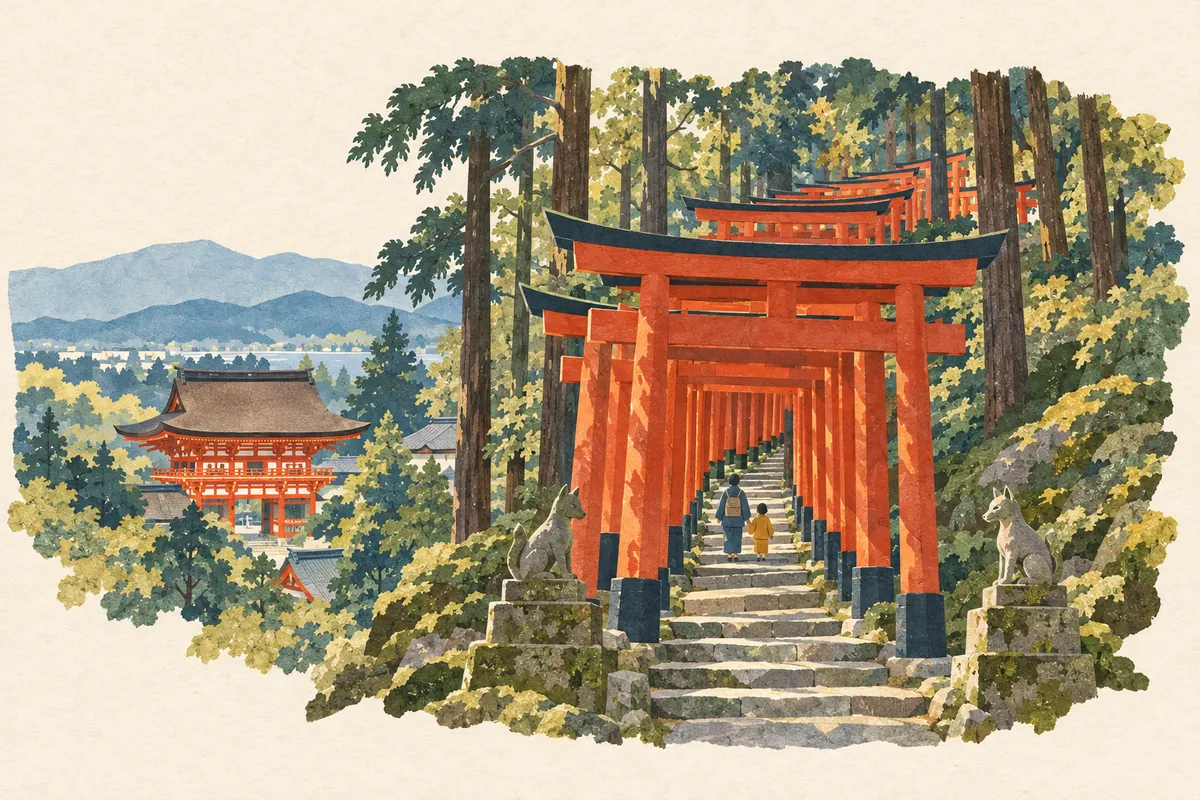
"Senbon Torii" names one stretch of path toward the Okusha Hōhaisho; the torii continue along all the mountain paths
Foxes are the invisible white-fox messengers of the Inari deity, not the deity itself
Head shrine of the Inari shrines
Fushimi Inari Taisha stands at the western foot of Mount Inari, the southernmost of the Thirty-Six Peaks of Higashiyama, and its grounds, which include Mount Inari, cover about 260,000 tsubo (about 870,000 m²). It is the head shrine of the roughly 30,000 Inari shrines across Japan, and is also called "Oinari-san."
According to the shrine's tradition, it began on the first Day of the Horse (hatsuuma) in the 2nd month of Wadō 4 (711), in the reign of Empress Genmei, when a wealthy man of Fukakusa, by imperial order, enshrined the deities on the three peaks of Mount Inari; the shrine marked the 1,300th anniversary of its founding in 2011 (Heisei 23). The shrine itself, however, places the origins of the faith even earlier.
As for the shrine's name, a surviving fragment of the "Yamashiro no Kuni Fudoki" (Gazetteer of Yamashiro Province) tells how a rice cake that an ancestor of the Hata clan used as an archery target turned into a white bird and flew away, and rice (ine) grew on the mountain peak where it landed, which gave rise to the name Inari. There are also various other theories.
The Ōnin War and the rebuilding of the Honden
In 1468 (Ōnin 2), in the midst of the Ōnin War, Mount Inari became a battlefield, and the shrine buildings and temple halls on and below the mountain burned. In time a temporary sanctuary was built, and after kanjin (fund-raising) in provinces across the country, the Honden was rebuilt. The present Honden dates from its rebuilding in 1494 (Meiō 3). The Hongansho, set up to raise funds for the restoration, continued as a temple called Aizen-ji from the Genroku era to the end of the Edo period.
The Honden is a large sanctuary in the five-bay nagare-zukuri style with cypress-bark roofing (hiwadabuki), also called "Inari-zukuri." It enshrines Ukanomitama no Ōkami at the center, Satahiko no Ōkami to the north, and Ōmiyanome no Ōkami to the south, and, adding Tanaka no Ōkami and Shi no Ōkami further out to the north and south, five deities in all in a single building. The gegyo (gable pendants) are edged in gilt metal, and kaerumata (frog-leg struts) are set in the front worship area.
The Honden was designated a National Treasure under the old system on April 5, 1909 (Meiji 42), and is now an Important Cultural Property.
The Rōmon, Geihaiden, and Gonden
The grounds face west, and from the approach you proceed east through the Rōmon (tower gate), the Geihaiden (outer worship hall), the Naihaiden (inner worship hall), and the Honden in that order. The Gonden stands north of the Honden, and the Okumiya and the Byakko-sha are at the top of the stone steps behind the Honden.
The Rōmon was built in 1589 (Tenshō 17). A written prayer by Toyotomi Hideyoshi survives, praying for the recovery of his mother, Ōmandokoro, from illness and promising to donate 10,000 koku if his wish was granted; during the dismantling and repair of 1973 (Shōwa 48), an ink inscription with the same date, "Tenshō 17," was found, confirming the tradition that Hideyoshi built it. It is one of the largest tower gates of any shrine. In 1694 (Genroku 7), the Rōmon was moved west by hikiya (moving a building intact) to make room for a worship hall, and the North and South Corridors were connected to it.
The Geihaiden is a building of 1840 (Tenpō 11). Because the five mikoshi (portable shrines) were lined up in it during the Inari Festival, it was built strongly, with the ōbiki floor beams beneath it set closely at intervals of about 50 cm. The Gonden, built in 1635 (Kan'ei 12), is a temporary sanctuary that is a slightly smaller version of the Honden.
Important Cultural Property buildings of Fushimi Inari Taisha
| Building | Date | Style | Designation |
|---|---|---|---|
| Honden | 1494 (Meiō 3) | Five-bay nagare-zukuri, cypress-bark roofing | April 5, 1909 (National Treasure under the old system). Now an Important Cultural Property |
| Rōmon | 1589 (Tenshō 17) | Three-bay tower gate with one entrance, irimoya roof, cypress-bark roofing | Important Cultural Property (January 27, 2014) |
| Okumiya | Momoyama period | Three-bay nagare-zukuri, cypress-bark roofing | Important Cultural Property (January 27, 2014) |
| Gonden | 1635 (Kan'ei 12) | Five-bay nagare-zukuri, cypress-bark roofing | Important Cultural Property (January 27, 2014) |
| Byakko-sha | Early Edo period | One-bay kasuga-zukuri, cypress-bark roofing | Important Cultural Property (January 27, 2014) |
| Ochaya | Early Edo period | Irimoya roof, pantile roofing (sangawarabuki) with cypress-bark roofing on the lower eaves | Important Cultural Property (April 25, 1927) |
| South Corridor | 1694 (Genroku 7) | Gabled (kirizuma) roof, cypress-bark roofing | Important Cultural Property (January 27, 2014) |
| North Corridor | 1694 (Genroku 7) | Gabled (kirizuma) roof, cypress-bark roofing | Important Cultural Property (January 17, 2014) |
| Geihaiden | 1840 (Tenpō 11) | Irimoya roof, cypress-bark roofing | Important Cultural Property (January 27, 2014) |
The Senbon Torii and the Okusha Hōhaisho
The "Senbon Torii" (Thousand Torii) is the stretch of the path from east of the Honden toward the Okusha Hōhaisho where vermilion torii stand with no gaps between them. The custom of donating a torii so that a wish will "go through" (tōru), or in thanks for a wish that "went through," arose and spread in the Edo period and created today's famous sight. Today about 10,000 torii stand along all the paths of the mountain.
The vermilion of the torii and shrine buildings is called "Inari-nuri" and is said to express the abundant power of the Inari deity. The raw material of the vermilion, ni (mercury), has long been used as a preservative for wood.
The Okusha Hōhaisho beyond the Senbon Torii is also called the "Oku-no-in" and is a place to worship Mount Inari from afar. Behind it to the right are the "Omokaru Ishi" stones: you lift the head of a stone lantern, and if it is lighter than you expected, your wish is said to come true.
The messengers (kenzoku) of the Inari deity are foxes, but not the foxes of the fields and mountains: they are invisible white foxes (byakko-san), and the Inari deity itself is not a fox. The Byakko-sha behind the Honden has a small opening in its side that is thought to be a passage for the foxes.
Layout of the Grounds of Fushimi Inari Taisha (Schematic Diagram)
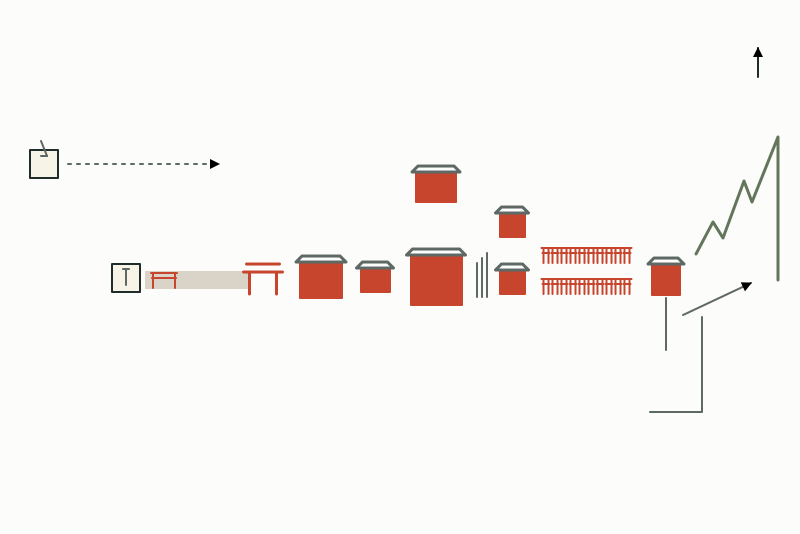
The grounds by Inari Station and the oyama-meguri
Fushimi Inari Taisha is at 68 Fukakusa Yabunouchi-chō, Fushimi Ward. It is right outside Inari Station on the JR Nara Line (about 5 minutes from Kyoto Station), about a 5-minute walk east from Fushimi-Inari Station on the Keihan Main Line, and about a 7-minute walk east from the "Inari Taisha-mae" stop of City Bus Route Minami 5. The parking lot in the grounds is closed from December 30 to January 6.
The grounds have no closing gate and are open for worship day and night, free of charge (as of October 2026). The "Oyama-meguri," a circuit of the sacred sites and otsuka (stone mounds) of Mount Inari, is about 4 km around and takes about 2 hours; the highest peak, Ichi-no-mine, is 233 m above sea level. Wheelchair users can go as far as the Okusha, and there is an elevator. You cannot enter the Honden or other buildings or go inside the fences, and eating and drinking outside the designated rest areas (including eating while walking) and bringing pets are prohibited.
Mini quiz for this entry
At the "Senbon Torii" (Thousand Torii) of Fushimi Inari Taisha, with what meaning did the many torii come to be donated?
During the dismantling and repair of Fushimi Inari Taisha's Rōmon gate in 1973 (Shōwa 48), an ink inscription reading "Tenshō 17" was found, which confirmed the tradition that a certain person built the gate. Who was it?
Fushimi Inari Taisha's Geihaiden (outer worship hall, Important Cultural Property) was built strongly, with the ōbiki floor beams beneath it set closely at intervals of about 50 cm. What is the reason?
Sources and verification
Content checked: October 22, 2026
Updated: October 22, 2026
References are in Japanese.
- 文化庁「国指定文化財等データベース 伏見稲荷大社 本殿」
- 文化庁「国指定文化財等データベース 伏見稲荷大社 権殿」
- 文化庁「国指定文化財等データベース 伏見稲荷大社 外拝殿」
- 文化庁「国指定文化財等データベース 伏見稲荷大社 楼門」
- 文化庁「国指定文化財等データベース 伏見稲荷大社 南北廻廊(南廻廊)」
- 文化庁「国指定文化財等データベース 伏見稲荷大社 南北廻廊(北廻廊)」
- 文化庁「国指定文化財等データベース 伏見稲荷大社 奥宮」
- 文化庁「国指定文化財等データベース 伏見稲荷大社 白狐社」
- 文化庁「国指定文化財等データベース 伏見稲荷大社御茶屋」
- 伏見稲荷大社「伏見稲荷大社とは」
- 伏見稲荷大社「よくあるご質問」
- 伏見稲荷大社「沿革」
- 伏見稲荷大社「御祭神」
- 伏見稲荷大社「大社マップ」
- 伏見稲荷大社「交通アクセス」
- 伏見稲荷大社「伏見稲荷大社からのお願い」
- 京都市観光協会「京都観光Navi 伏見稲荷大社」
- 京都府観光連盟「京都府観光ガイド 伏見稲荷大社」