
The Honden of Yasaka Shrine and Gion-zukuri
Key points
The previous Honden burned in 1646, just after shogunate repairs, and Ietsuna rebuilt it eight years later
The people who carry on the Gion Matsuri have kept the Honden up, raising the funds for its three Edo-period repairs
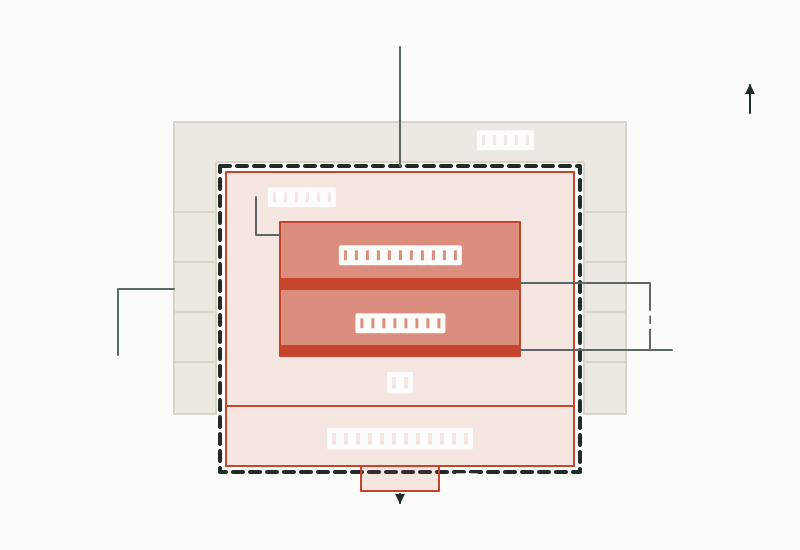
In Gion-zukuri, one great roof covers the nainaijin, naijin, and gejin (inner and outer sanctums) together with the raidō, and aisles are attached to both sides and the back
The main gate is the South Rōmon, directly in front of the Honden. The West Rōmon, which most worshippers pass through, is the oldest building in the grounds
The Honden, a National Treasure since 2020
Yasaka Shrine, which stands at the eastern end of Shijō-dōri, is the head shrine of the Gion faith, in which people pray to drive away epidemics. The present Honden was rebuilt in 1654 (Jōō 3) by the fourth shogun, Tokugawa Ietsuna. The previous Honden burned on the 18th day of the 11th month of Shōhō 3 (1646, lunar calendar), just after repairs carried out as a project under the direct control of the Edo shogunate had been completed.
The Honden became a Specially Protected Building (a "National Treasure" under the old system) on April 17, 1911 (Meiji 44), and was designated a National Treasure on December 23, 2020 (Reiwa 2). It conveys the spatial composition of Heian-period architecture, shows clearly the relationship between medieval religious rites and the building, and has been maintained to this day by the people who carry on the Gion Matsuri. The repairs of the Edo period, in the Jōkyō, Meiwa, and Bunsei eras, were also funded by money raised by the people of the yamahoko float neighborhoods and of the nagae-chō, the neighborhoods that carry the mikoshi (portable shrines).
At the same time as the National Treasure designation, 26 buildings, including the main sanctuaries of auxiliary shrines in the grounds, the Buden (dance pavilion), the South Rōmon, and the shrine buildings of the otabisho outside the grounds, were added as Important Cultural Properties. Together with the 3 buildings already designated, the Honden of Ebisu-sha, the West Rōmon, and the stone torii, this made 29.
"Gion-zukuri": Honden and Raidō under one roof
The moya (core building) at the center of the Honden is divided into the nainaijin (innermost sanctum) at the back and the naijin (inner sanctum) in front, each with a shelf for offerings along its front. This shelf arrangement has no known parallel elsewhere. The gejin (outer sanctum) surrounds the moya on all four sides, the raidō is attached to the front (south), and a single great irimoya roof with cypress-bark roofing (hiwadabuki) covers all of this. Aisles (hisashi) are further added on both sides and at the back to widen it, and the side aisles are divided into small rooms. This form of the Honden is also commonly called "Gion-zukuri."
The Honden and the raidō were originally separate buildings. A record of 935 (Jōhei 5) lists the sanctuary and the raidō separately. Enlarging a building by adding aisles was a Heian-period method of construction, and it is clear that this form had been established by the Kamakura period. An illustrated map of the grounds drawn in 1331 (Gentoku 3), the Important Cultural Property "Gion-sha Ezu" (Illustrated Map of Gion Shrine), also shows the same great roof as today.
It is considered the largest in scale of any shrine main sanctuary, with a building area of 662.38 m² and a height of 15.53 m. Even among National Treasure main sanctuaries the construction differs: Kamigamo and Shimogamo Shrines are nagare-zukuri, in which the front of the roof flows long, and Kitano Tenmangū is Gongen-zukuri, in which the main sanctuary and worship hall are joined by an Ishi-no-ma.
The Honden of Yasaka Shrine (Gion-zukuri) Seen from Directly Above (Schematic Diagram)
The legend of the dragon's hole
The Honden stands over a pond, and legend has it that the pond is a ryūketsu (dragon's hole) where the Blue Dragon (Seiryū) lives. The Zoku Kojidan, a collection of tales from the Kamakura period, tells how, at the time of a fire in 1070 (Enkyū 2), someone tried to measure its depth and found no bottom even at fifty jō (about 151.5 m). The pond is now sealed with plaster mounded up in a kamebara ("turtle belly") shape and cannot be seen. The sacred water in the grounds is drawn up from water that wells up beneath the Honden.
The West Rōmon, South Rōmon, and Buden
The West Rōmon (tower gate), standing where Shijō-dōri dead-ends in the east, was rebuilt in 1497 (Meiō 6) after burning in the Ōnin War and is the oldest building in the grounds. When Shijō-dōri was widened in 1913 (Taishō 2), the gate was moved 6 m east and 3 m north so that it would appear in the center of the street, and with the wing corridors added on its left and right in 1925 (Taishō 14) it took on its present appearance.
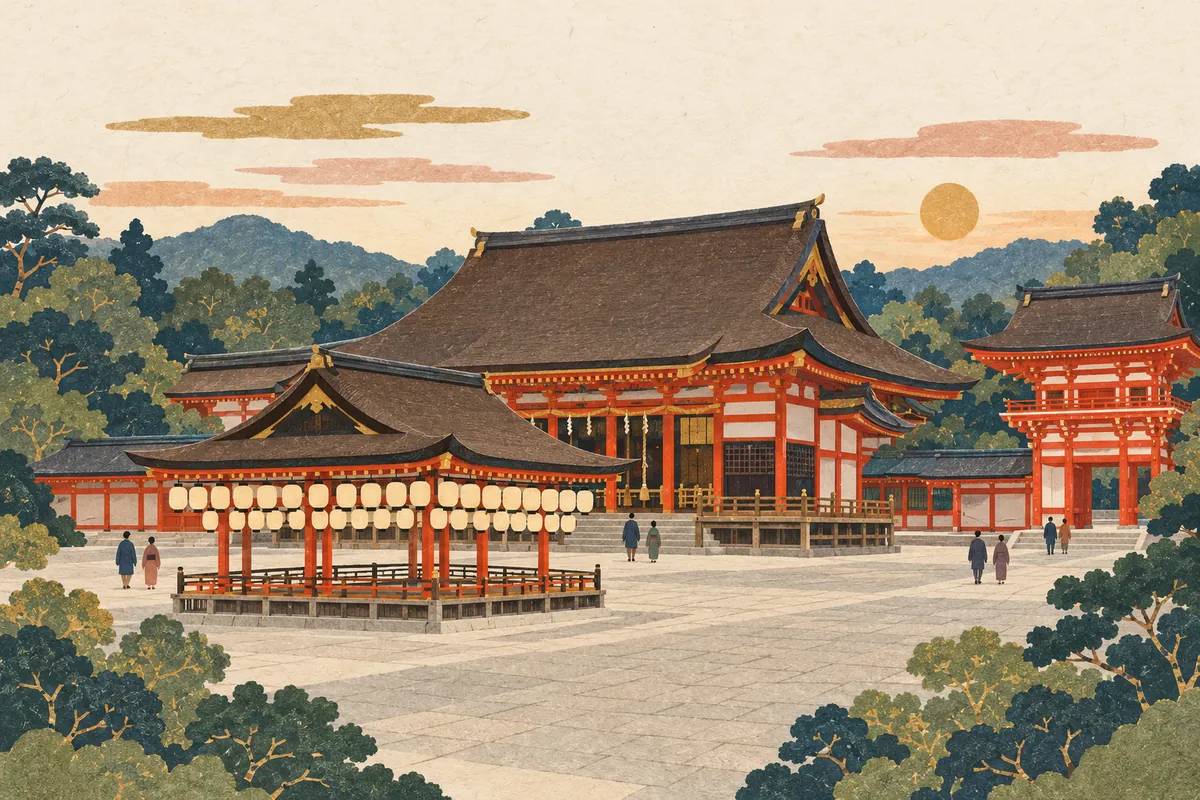
The West Rōmon is the gate most worshippers pass through, but the main gate is the South Rōmon, directly in front (south) of the Honden. The South Rōmon stands beyond the stone torii on the main approach, and the Honden, Buden, and South Rōmon are lined up in a straight row. The Buden is the building where the three mikoshi are placed during the Gion Matsuri, and it is hung with lanterns donated by okiya (houses of geiko and maiko) in the hanamachi (geisha districts) and by nearby restaurants. The mikoshi are kept in the mikoshi storehouse in the grounds.
Shrine buildings outside the grounds stand at the Shijō Otabisho (Teramachi-dōri Shijō sagaru, Shimogyō Ward), where the mikoshi stay during the Gion Matsuri, and at the Matatabi-sha (Sanjō-dōri Inokuma nishi-iru, Nakagyō Ward) and the Ōmandokoro-sha (Karasuma-dōri Bukkōji sagaru, Shimogyō Ward).
Main Important Cultural Property buildings of Yasaka Shrine
| Building (designation name) | Year built | Type and date of designation | Notes |
|---|---|---|---|
| West Rōmon | 1497 (Meiō 6) | Important Cultural Property (April 17, 1911) | Where Shijō-dōri dead-ends. A tower gate with a gabled (kirizuma) roof |
| Stone torii | 1646 (Shōhō 3) | Important Cultural Property (April 17, 1911) | A myōjin-style torii on the main approach in front of the South Rōmon |
| Honden of Ebisu-sha | 1646 (Shōhō 3) | Important Cultural Property (April 17, 1911) | An auxiliary shrine with aisles on both sides and the back |
| Honden of Utsukushigozen-sha | 1591 (Tenshō 19) | Important Cultural Property (December 23, 2020) | An auxiliary shrine with aisles on both sides and the back |
| Honden of Ōtoshi-sha | c. 1654 (c. Jōō 3) | Important Cultural Property (December 23, 2020) | Auxiliary shrine |
| Ema-dō (votive tablet hall) | 1744 (Enkyō 1) | Important Cultural Property (December 23, 2020) | Moved from the west side of the Honden in 1926 (Taishō 15) |
| Honden of Matatabi-sha | 1789 (Kansei 1) | Important Cultural Property (December 23, 2020) | Outside the grounds |
| Honden of Ekijinja | c. 1823 (c. Bunsei 6) | Important Cultural Property (December 23, 2020) | An auxiliary shrine with aisles on both sides and the back |
| Honden of the Shijō Tabisho (East Hall) | 1837 (Tenpō 8) | Important Cultural Property (December 23, 2020) | Outside the grounds |
| South Rōmon | 1879 (Meiji 12) | Important Cultural Property (December 23, 2020) | The main gate, directly in front of the Honden. Irimoya roof |
| Buden (dance pavilion) | 1903 (Meiji 36) | Important Cultural Property (December 23, 2020) | Holds the three mikoshi during the Gion Matsuri |
| Wing corridors of the West Rōmon (2 buildings, north and south) | 1925 (Taishō 14) | Important Cultural Property (December 23, 2020) | To the left and right of the West Rōmon |
| Mikoshi storehouse | 1928 (Shōwa 3) | Important Cultural Property (December 23, 2020) | Reinforced concrete |
Worship at any hour and entering the Honden for prayers or Ryūketsu mairi
Yasaka Shrine is at 625 Gion-machi Kitagawa, Higashiyama Ward: about a 5-minute walk from Keihan Gion-Shijō Station, about an 8-minute walk from Hankyū Kyoto-Kawaramachi Station, and from JR Kyoto Station right by the "Gion" stop on City Bus Routes 100 and 206. The grounds are open for worship 24 hours a day, and worship is free. The shrine office is open 9:00–17:00 (as of October 2026). There is no parking in the grounds. Wheelchair users can enter the grounds from the parking lot of the Tokiwa Shinden, passing through the shrine office.
The inside of the Honden is normally closed to the public. People receiving a prayer ritual (with an offering, hatsuhoryō, from 8,000 yen) enter through the entrance on the west side of the Honden and apply at the reception inside the Honden. "Ryūketsu Mairi," a visit to worship inside the Honden, is also held from time to time.
Mini quiz for this entry
Yasaka Shrine's West Tower Gate (Nishi-rōmon) stands at the eastern end of which street?
The Honden of Yasaka Shrine stands over a pond. Which of the Four Gods is said to live in it?
Sources and verification
Content checked: October 19, 2026
Updated: October 19, 2026
References are in Japanese.
- 文化庁「国指定文化財等データベース 八坂神社本殿」
- 文化庁「文化遺産オンライン 八坂神社本殿」
- 文化庁「国宝・重要文化財(建造物)の指定について」(令和2年10月16日 報道発表)
- 文化庁「国宝・重要文化財(建造物)の指定について」概要(令和2年10月答申)
- 文化庁「国指定文化財等データベース」(国宝・重要文化財〈建造物〉、八坂神社で検索)
- 文化庁「国指定文化財等データベース 八坂神社 西楼門」
- 文化庁「国指定文化財等データベース 八坂神社 南楼門」
- 文化庁「国指定文化財等データベース 八坂神社 舞殿」
- 文化庁「国指定文化財等データベース 八坂神社 石鳥居」
- 文化庁「国指定文化財等データベース 八坂神社 蛭子社本殿」
- 文化庁「国指定文化財等データベース 八坂神社 美御前社本殿」
- 文化庁「国指定文化財等データベース 八坂神社 大年社本殿」
- 文化庁「国指定文化財等データベース 八坂神社 絵馬堂」
- 文化庁「国指定文化財等データベース 八坂神社 又旅社本殿」
- 文化庁「国指定文化財等データベース 八坂神社 疫神社本殿」
- 文化庁「国指定文化財等データベース 八坂神社 四条旅所本殿(東殿)」
- 文化庁「国指定文化財等データベース 八坂神社 大政所社本殿」
- 文化庁「国指定文化財等データベース 八坂神社 西楼門翼廊(北翼廊)」
- 文化庁「国指定文化財等データベース 八坂神社 神輿庫」
- 八坂神社「八坂神社について」
- 八坂神社「八坂神社の歴史」
- 八坂神社「八坂神社の建造物」
- 八坂神社「境内見どころ」
- 八坂神社「お社・ご祭神」
- 八坂神社「令和の祇園感神院復元事業」
- 八坂神社「ご参拝・ご祈祷」
- 八坂神社「境内マップ・アクセス」
- 京都市観光協会「京都観光Navi 八坂神社」