
The Main Sanctuaries of Kamigamo and Shimogamo Shrines
Key points
The National Treasures are 4 buildings: Kamigamo's Honden and Gonden and Shimogamo's East and West Honden
Designated National Treasures on March 31, 1953 (Shōwa 28)
The latest shikinen sengū was in 2015 (Heisei 27): the 42nd at Kamigamo and the 34th at Shimogamo
Shimogamo's two deities are the mother (Tamayori-hime-no-mikoto) and maternal grandfather (Kamo-taketsunumi-no-mikoto) of Kamigamo's deity, Kamo-wakeikazuchi-no-Ōkami
The four National Treasures
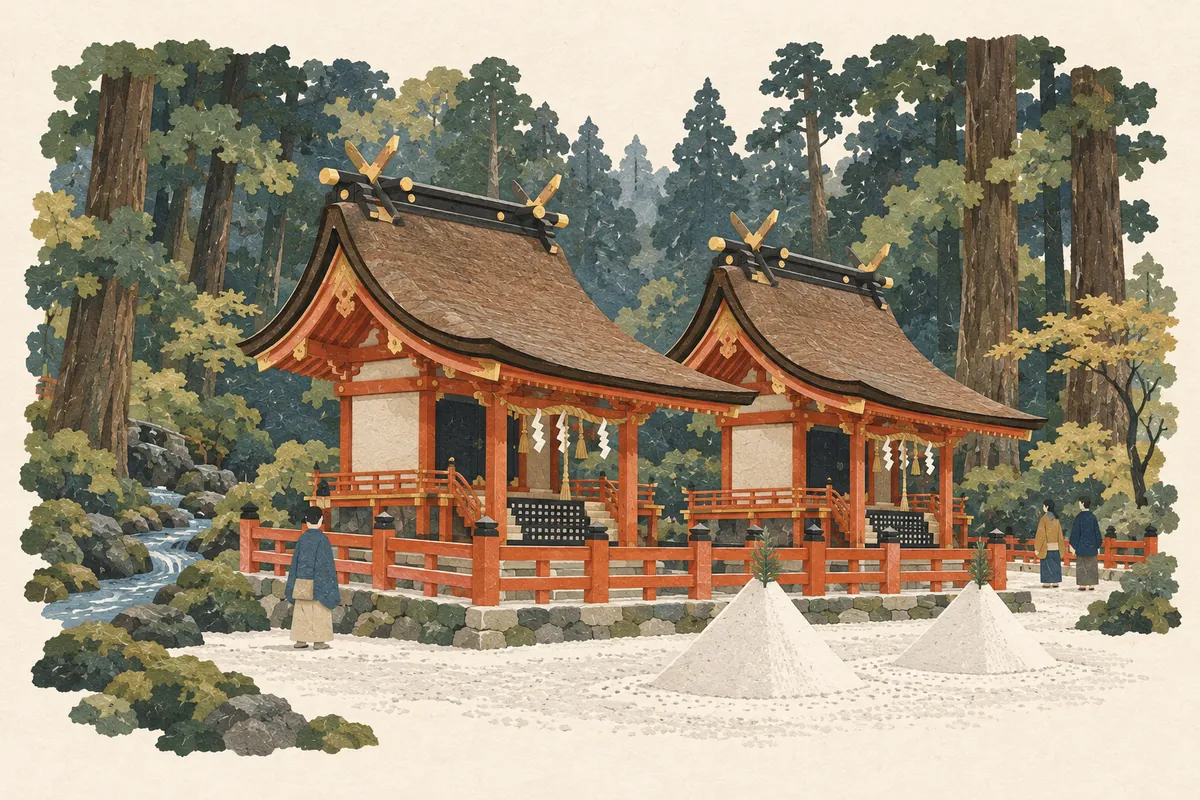
The formal name of Kamigamo Shrine is 賀茂別雷神社 (Kamo-wakeikazuchi Jinja), and that of Shimogamo Shrine is 賀茂御祖神社 (Kamo-mioya Jinja). Each shrine's National Treasure is one item made up of two buildings; all four were rebuilt in 1863 (Bunkyū 3), in the sangensha nagare-zukuri form (nagare-zukuri three bays wide), with cypress-bark (hiwadabuki) roofs.
At Kamigamo Shrine, halls of the same shape and size stand side by side, east and west: the east one is the Honden (main sanctuary) and the west one the Gonden. The Gonden is a permanent temporary hall that serves as a temporary main sanctuary during the shikinen sengū. Shimogamo Shrine enshrines Tamayori-hime-no-mikoto (玉依媛命) in its East Honden and Kamo-taketsunumi-no-mikoto (賀茂建角身命) in its West Honden.
In the year of the rebuilding, Emperor Kōmei made an imperial visit to the Kamo shrines to pray for the expulsion of foreigners (jōi). The main sanctuaries of both shrines became Specially Protected Buildings in 1901 (Meiji 34) and National Treasures in 1953. Among Kyoto City's National Treasure buildings, they are the most recent in date of all the shrine and temple buildings. In all, Kamigamo Shrine has 2 National Treasure and 41 Important Cultural Property buildings, and Shimogamo Shrine 2 National Treasure and 53 Important Cultural Property buildings.
The form of nagare-zukuri
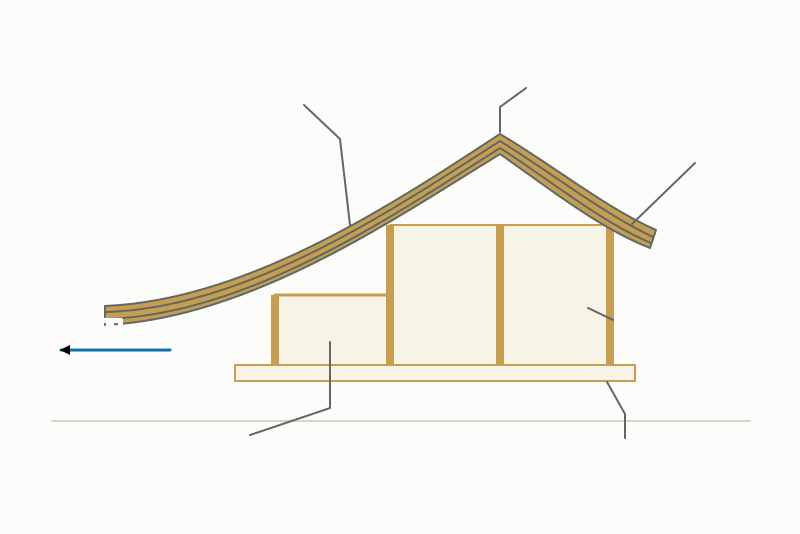
Nagare-zukuri is a form in which the front slope of a gabled (kirizuma) roof, with the entrance on the eave side (hirairi), is lengthened. The main sanctuaries of the two Kamo shrines have a three-bay aisle (hisashi) attached to the front of a core building (moya) three bays wide (keta-yuki) and two bays deep (harima), and the front of the roof slopes gently down over the aisle. Verandas run around all four sides, and a kōhai (porch roof) is attached at the front.
Nagare-zukuri is the most widespread form of shrine main sanctuary in Japan. The Honden of Kamigamo Shrine is known to look little different from when it was rebuilt around 1303 (Kagen 1), and together with the East and West Honden of Shimogamo Shrine, which are of exactly the same form, it is a classic example of nagare-zukuri.
Even among National Treasure main sanctuaries the construction differs: Kitano Tenmangū is Gongen-zukuri, with a stone-floored room joining the main sanctuary and worship hall, and at Yasaka Shrine a single great roof covers both the main sanctuary and the worship hall.
Side View of a Nagare-zukuri Main Sanctuary (Schematic Diagram)
The shikinen sengū every 21 years
A shikinen sengū is a ceremony in which the shrine buildings are rebuilt at fixed intervals and the deity is moved into them. In 1036 (Chōgen 9), a shikinen sengū every 21 years was established for the Kamo shrines. After interruptions caused by war and other troubles, it was revived in 1628 (Kan'ei 5) at Kamigamo and in 1629 (Kan'ei 6) at Shimogamo, recreating the Heian-period appearance.
The last rebuilding of the main sanctuaries of Shimogamo Shrine was in 1863, and today's shikinen sengū consists of temporarily moving the deities every 21 years so that damaged parts can be repaired. At Kamigamo Shrine's 42nd sengū, the cypress-bark roofs of the halls were replaced: the deity was moved to the Gonden in the rite of moving to the temporary hall, and returned to the Honden in 2015 (Heisei 27) in the rite of moving back to the main sanctuary (the Shōsengū). Shimogamo Shrine held its 34th shikinen sengū in 2015 as well, and its next sengū will be in 2036 (Reiwa 18), marking 1,000 years since the first in 1036.
How Kamigamo and Shimogamo are related
The deity of Kamigamo Shrine is Kamo-wakeikazuchi-no-Ōkami. Legend has it that while Tamayori-hime-no-mikoto was purifying herself in a river, a red-lacquered arrow (ninuri no ya) came floating down; she took it home and placed it by her bed, became pregnant, and gave birth to Kamo-wakeikazuchi-no-Ōkami. Tamayori-hime's father, Kamo-taketsunumi-no-mikoto, is the deity's maternal grandfather.
One theory holds that Shimogamo Shrine separated from Kamigamo Shrine in the mid-8th century, and according to shrine tradition its sacred fence (mizugaki) was repaired in the 7th year of Emperor Sujin's reign (90 BCE). Both shrines were revered by the imperial court as guardians of Heian-kyō, and the Aoi Matsuri (Kamo Festival) is the annual festival of both. The purification rite of the Saiō-dai, one of its preliminary ceremonies, is hosted by the two shrines in alternate years.
The tatesuna and Tadasu no Mori
The Honden of Kamigamo Shrine is built to face Kōyama (神山), a 301.5 m mountain about 2 km to the north-northwest. The pair of conical sand mounds called tatesuna (立砂) directly ahead as you pass through the second torii represent Kōyama, and the pine needles in groups of three and two stuck in their tops represent a pair of yang and yin. After leaving the grounds, the "Nara no Ogawa" stream changes its name to the Myōjin River, and the shake-machi, the district of shrine priests' residences, runs along it.
Tadasu no Mori (糺の森) at Shimogamo Shrine is a forest of about 124,000 m² spreading over the delta where the Kamo and Takano Rivers meet, and it preserves the same vegetation as the primeval forest of the Yamashiro plain around the 3rd century BCE. The grounds were designated the national Historic Site "Precincts of Kamo-mioya Shrine" in 1983 (Shōwa 58), and both shrines were inscribed in 1994 (Heisei 6) as part of the World Heritage property "Historic Monuments of Ancient Kyoto."
The Hakuba Sōran Shinji and Kemari Hajime
On January 7, Kamigamo Shrine holds the Hakuba Sōran Shinji (白馬奏覧神事), a ritual adapted from the court's Hakuba no Sechie banquet, which follows the old belief that seeing a white horse (also called aouma, "blue horse") drives away evil for the year. Seven-herb rice porridge (nanakusa-gayu) is offered before the deity, and the sacred horse "Kōyama-gō" is presented for the deity's viewing; anyone may watch. The horse is also led every hour from noon to 15:00.
At Shimogamo Shrine, Kemari Hajime, the first kemari of the year, is held on January 4, when players of the Kyoto Kemari Preservation Society in eboshi caps kick a deerskin ball high into the air.
Special worship at Kamigamo Shrine and the Ōidono at Shimogamo Shrine
Kamigamo Shrine is at 339 Kamigamo Motoyama, Kita Ward, right by the "Kamigamo Jinja-mae" stop of City Bus Routes 4 and 46. The area inside the second torii is open 5:30–17:00 (as of October 2026). You can worship at the Honden and Gonden through special worship, in which a priest guides you inside the middle gate (chūmon) to stand in front of the Gonden (reception 10:00–16:00; adults 500 yen, junior high school students and younger free when accompanied by family). Fees change during special opening periods, when children are charged too, and special worship is suspended around the Aoi Matsuri and the New Year holidays.
Shimogamo Shrine is at 59 Shimogamo Izumigawa-chō, Sakyō Ward, a 12-minute walk from Keihan Demachiyanagi Station. Passing through Tadasu no Mori brings you to the Rōmon tower gate, and the area inside the Rōmon is open 6:30–17:00. The area inside the mikaki fence, where the East and West Honden stand, is a place no one may enter. Special viewing of the Ōidono (Important Cultural Property) and other buildings is 10:00–16:00, adults 1,000 yen, junior high school students and younger free.
Mini quiz for this entry
What do the tatesuna (立砂), the pair of conical sand mounds directly ahead as you pass through the second torii of Kamigamo Shrine, represent?
Tamayori-hime-no-mikoto, enshrined in the East Honden of Shimogamo Shrine, is what relation to Kamo-wakeikazuchi-no-Ōkami, the deity of Kamigamo Shrine?
Which is a correct description of nagare-zukuri, the style of the National Treasure main sanctuaries of Kamigamo Shrine and Shimogamo Shrine?
Sources and verification
Content checked: October 18, 2026
Updated: October 18, 2026
References are in Japanese.
- 文化庁「国指定文化財等データベース 賀茂別雷神社 本殿」
- 文化庁「国指定文化財等データベース 賀茂別雷神社 権殿」
- 文化庁「国指定文化財等データベース 賀茂御祖神社 東本殿」
- 文化庁「国指定文化財等データベース 賀茂御祖神社 西本殿」
- 文化庁「国指定文化財等データベース」(国宝・重要文化財〈建造物〉、京都府、国宝で検索)
- 文化庁「国指定文化財等データベース 史跡 賀茂御祖神社境内」
- 文化庁「国指定文化財等データベース 世界遺産 古都京都の文化財」
- 文化庁「世界遺産 古都京都の文化財 推薦書 内容説明 A 賀茂別雷神社(上賀茂神社)」
- 文化庁「世界遺産 古都京都の文化財 推薦書 内容説明 B 賀茂御祖神社(下鴨神社)」
- 賀茂別雷神社(上賀茂神社)「上賀茂神社について」
- 賀茂別雷神社(上賀茂神社)「国宝 本殿・権殿」
- 賀茂別雷神社(上賀茂神社)「御神話」
- 賀茂別雷神社(上賀茂神社)「境内案内」
- 賀茂別雷神社(上賀茂神社)「国宝本殿 特別参拝」
- 賀茂別雷神社(上賀茂神社)「参拝・御祈祷のご案内」
- 賀茂別雷神社(上賀茂神社)「上賀茂神社のひととせ」
- 賀茂別雷神社(上賀茂神社)「第42回式年遷宮」
- 賀茂別雷神社(上賀茂神社)「アクセス」
- 賀茂御祖神社(下鴨神社)「御祭神・歴史・神話」
- 賀茂御祖神社(下鴨神社)「境内マップ」
- 賀茂御祖神社(下鴨神社)「特別拝観について」
- 賀茂御祖神社(下鴨神社)「アクセス」
- 賀茂御祖神社(下鴨神社)「祭典行事」
- 賀茂御祖神社(下鴨神社)「蹴鞠はじめ」
- 賀茂御祖神社(下鴨神社)「年末年始のご案内」
- 賀茂御祖神社(下鴨神社)「下鴨神社の四季」
- 賀茂御祖神社(下鴨神社)社務所「『糺の森』第3期整備計画について」(京都市審議会資料)
- 京都市観光協会「京都観光Navi 賀茂別雷神社(上賀茂神社)」
- 京都市観光協会「京都観光Navi 賀茂御祖神社(下鴨神社)」
- 下鴨神社糺能保存会「第十一回 糺勧進能」(京都観光Navi掲載チラシ)
- 北野天満宮「北野天満宮について」
- 八坂神社「八坂神社の建造物」
- 京都市「上賀茂伝統的建造物群保存地区保存計画」